As temperatures finally start to reach double figures and we get a glimpse of sunny days ahead, our focus starts to turn towards the garden.
You can’t fail to be inspired by the bursts of colourful crocuses on the Stray and it won’t be long before we see Harrogate’s famous pink cherry blossoms appearing too.
This is usually the time of year I tentatively step out of the back door, have a look at the dire state of the barren landscape before me and then retreat back to the house. ‘I’ll tackle it later’, I tell myself as I metaphorically bury my head in the kids’ waterlogged sandpit.
Therapeutic
I actually really enjoy gardening once I get into the swing of things. I find it really therapeutic. But I usually have no idea where to start and can sometimes it can feel a bit overwhelming.
So I turned to the experts from two horticultural charities to get their tips on how to tackle the garden now spring has finally sprung.
Horticap
Phil Airey, manager of Harrogate gardening charity Horticap, on Otley Road, said:
“It’s March and the garden is coming alive. The bulbs are ready to shine, with snowdrops, daffodils, crocuses and tulips to follow.
“Perennials are just starting to grow, so this is your time to cut away all the old growth from winter. Before you do, just check for wildlife. They might have been using the old foliage as cover, so just check before you remove it.”

Phil said it was now time to cut down any dogwood, also known as Cornus, which are deciduous trees and shrubs.
Vibrant stems
He said:
“Cut it down to one or two buds from the ground so you will leave it stumpy. This will help it grow vigorous shoots, leaving you with the vibrant coloured stems for next winter.”
After being battered by three storms, Phil said it was worth making sure any ripped branches in damaged trees had “clean cuts”.
He said:
“Just use any saw to make a clean cut and this will help protect the tree from infections. This is for small trees, as larger ones must be carried out by a trained tree surgeon.”
I was surprised at Phil’s next tip, as I would usually wait a bit longer to start tackling the grass, but if it helps get rid of messy old leaves, I’m all for it.
He said:
“Have you had your mower serviced? Because you can start cutting your grass. Cut it at your highest setting, don’t cut it too low just yet.
“Doing this will act like a vacuum, sucking up old leaves and twigs. Leaving the lawn looking tidy and free of debris.”
Phil said it was now “all go” at Horticap, which provides training in horticulture and rural skills to adults with learning and other disabilities.
Read more:
- TV architect George Clarke will bring buildings to life at Harrogate’s Royal Hall
- Stray Gardener: March is the perfect time to start planting seedlings
No better sight
He said:
“The summer bedding is here and there is no better sight than a tiny geranium (pelargonium) starting to grow.

“The students are busy getting labels ready and clearing the beds. We are also sowing the veg in the greenhouse, but you can start sowing peas and broad beans directly into prepared beds and pots.

“It’s also time to start “chitting” your seed potatoes. It is a simple process of forcing seed potatoes into growth before they are planted out. You can place them on a window sill or glasshouse.

“It’s getting very busy at Horticap, and that means only one thing. People want to be out in the gardens so this weekend is a great time to start. Spring has definitely sprung.”

RHS Harlow Carr
Over the road at RHS Harlow Carr, which is run by the UK’s leading gardening charity, horticulturists Malcom Dewar and Philip Keesing said it was time to “sit back and enjoy the display of all the spring-flowering bulbs as they start to pop”.

RHS Garden Harlow Carr.
This is something I think most of us are particularly looking forward to after what feels like an eternal winter.
Top tips
They offered the following top tips:
- Finish cutting back grasses and perennials if you haven’t already done so, to make way for this year’s growth.
- Trim winter-flowering heathers as they finish flowering, to prevent them from becoming leggy.
- Deadhead winter pansies and violas to encourage them to keep on blooming into the spring.
- Deadhead daffodils as they finish flowering and let the foliage die back naturally.
- Sow some seeds.
- Trim up overgrown hedges and ivies before the bird nesting season.
- Carry on cutting back herbaceous perennials, weeding and tidying flower beds as you go.
- Repair any paving or hard surfaces in the garden that may have been damaged from snow and ice.
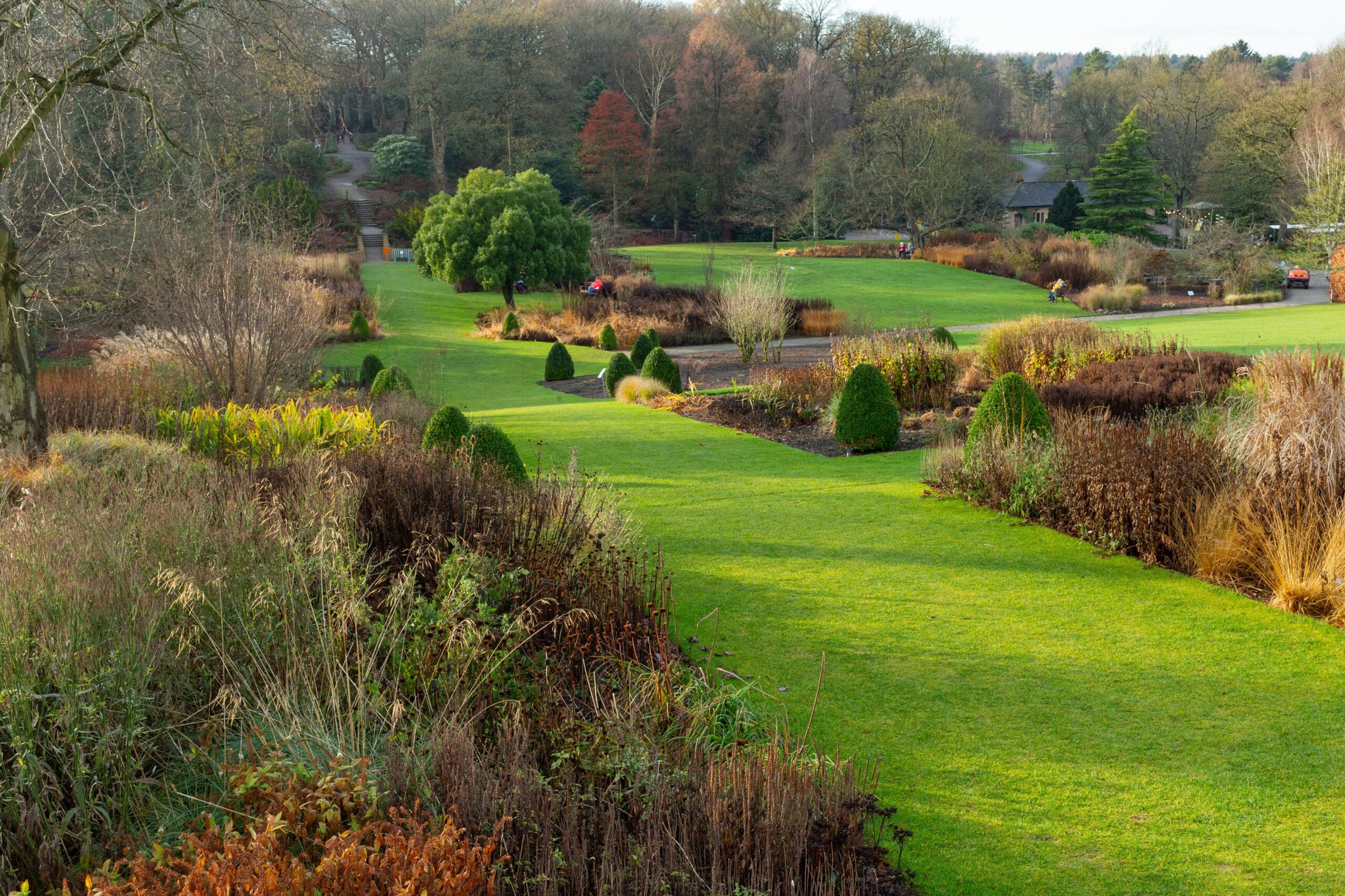
The main borders at RHS garden Harlow Carr.

The Stray Gardener is written by Rudding Park’s Kitchen Gardener, Fiona Slight. Fiona has worked in horticulture for more than 30 years in the UK and abroad, and specialises in growing fruit and vegetables for fine dining. This month, Fiona explains the different ways to sow seed.
March is the time of year when a lot of different types of seed can be sown successfully. There is nothing so rewarding as being able to grow a plant from seed and either enjoy its beautiful blooms throughout the summer or reap the rewards of tasty vegetables home grown by yourself. If you follow a few easy steps and quite often just follow the instructions on the packet, you can have success!
So where do you start? It makes sense to choose seed that you really want to grow. Read the packet instructions closely to ensure you can provide the right conditions that germinating seed will need. Most seed will need good light conditions, the correct temperature (usually given on the seed packet) and moisture. It is more than possible to grow and raise seeds on a windowsill. I do it myself every year.

Sweet pea seedlings planted in cardboard tubes.
Seed can be sown in a variety of different containers, for example, sweet pea seeds are best grown in cardboard tubes or root trainers which are tall thin containers to allow the plants a good root run and also minimal root disturbance when planted. Calendula (Pot Marigold) on the other hand, is best grown in a small seed tray or pot to allow them to grow to a size large enough to handle to be pricked out into larger pots. Whichever one you use, ensure it is clean and dry to avoid passing on any pests and diseases to your seedlings.
The next thing to think about is what material you grow your seeds in, the compost you choose is important, depending on the size and type of seed. Generally, shop bought seed compost works very well and is ready sterilised. It is important to ensure the compost is reasonably fine and well-drained. This is especially important for small seed to ensure good contact with the soil for germination.

Firmed down compost
For sowing smaller seed, fill your container with compost, and tap down to remove excess air holes. Smooth the compost off to get a level, flat surface, and then firm down either with another pot or tray with a flat bottom or a specially made wooden tamper. You now have a good surface to scatter your seed onto. Be careful not to sow too thickly as this can cause problems later on. Firm down the seeds to get good contact with the compost, and then, if the seeds requires it, cover with a thin layer of vermiculite, perlite or compost (generally until you can’t see the seed anymore). After that, I prefer to soak the seed from underneath in a tray of water as there is less chance of displacing the seeds and it ensures the compost is fully moist.
For larger seed, such as peas or beans, you can sow them individually or in pairs. Lay the seed on top of each cardboard tube or section of the root trainer and once all the seeds are placed, you can then push them down into the compost, usually a finger nail deep but it does depend on the size of seed. Then cover over the hole with more compost and water in thoroughly.

A variety of seedlings
Keeping the seed packets for future reference is very useful and helps with going on to the next stage of growing. Don’t forget to label your seeds, and if you have too many, share them with your friends.
Happy sowing!
Fiona’s Five Top Tips for March
- Now is the time to cut back any Cornus or Willow grown for their colourful stems
- March is a great time to divide congested clumps of grasses
- Plant onion and shallot sets
- Divide and re-plant bulbs in the green such as snow drops and winter aconites
- Pot on Dahlia tubers and place in the greenhouse to start to grow before planting out in May
Harrogate charity and garden centre Horticap welcomed gardening celebrity Alan Titchmarsh today to officially open its cafe area and to tour the new nature trail.
Horticap is based on Otley Road, across from RHS Harlow Carr, and provides training in horticulture and rural skills to adults with learning and other disabilities.
The TV presenter and patron of the charity was invited when the cafe and nature trail first opened last summer but was unable to attend due to covid restrictions so he performed the official opening today.
Mr Titchmarsh also spoke to students and staff about new projects underway at the centre.
Phil Airey, operations manager at Horticap, said:
“We don’t really make it public when he is coming because the place gets too busy, but he came down to speak to students and see the new cafe and shop.
“It was great, he really spent time with the students and spoke to them about the projects they’re working on.
“He said he had a lovely time and even visited Bettys to take some Fat Rascals home!”

Cutting the ribbon at Horticap today. Photograph: Horticap
Read more:
- Top Gear stars in Harrogate this afternoon
- Harrogate district community groups encouraged to apply for £2,500 grants
Stray Gardener: Create a legacy and plant a tree
The Stray Gardener is written by Rudding Park’s Kitchen Gardener, Fiona Slight. Fiona has worked in horticulture for more than 30 years in the UK and abroad, and specialises in growing fruit and vegetables for fine dining. This month, Fiona explains how and why you should plant a tree.
One of the most satisfying things to do in life is to plant a tree, not only is it contributing to helping the environment by providing habitats for wildlife, reducing carbon dioxide in the environment and enhancing your local area. They are great for your mental health, spending time with trees is a very relaxing and mindful thing to do and you are creating a legacy for generations of people for years to come.
But how do you get started? First of all, it is important you research your trees well and choose one that is suitable for your site. My heart always sinks when I see a tree such as the majestic monkey puzzle in a very small front garden, knowing it will never achieve its full life span of a 1000 years as it will have to be taken down long before that to avoid damage to the building it is next to.
Trees are best planted from October to April in the cooler dormant period of the year. This also means you can buy a bare root tree which is cheaper and are only available at this time. You can plant container grown trees too with the advantage that these can be planted pretty much all year round, but it does mean a lot more watering to get them established.

Once you are ready to plant, you need to dig a hole at least three times as wide as the pot or root spread and the same depth. Container grown plants benefit from having the roots gently loosened to help them to get established more quickly. It is a good idea to thoroughly soak the roots in a bucket of water before planting, some people also add a special powder with a fungus called mycorrhizae which can help the roots to establish quicker.
The tree can then be placed in the hole making sure that the point where the roots meet the trunk is level with the surface of the soil. You can use your spade placed horizontally across the hole to check if you are not sure the level is right.

Fastening a tree tie to the stake for stability
Then, it is just a case of refilling the hole, firming well and making sure there are no air pockets around the roots that could cause the root to dry out before establishing. Make sure the stem stays upright as you do this.
You may need to add a tree guard or spiral if you think there is a chance that the stems could get nibbled. Very small trees shouldn’t need staking and will grow better without one. Larger trees that may be top heavy will probably need to be staked to support them until they get established, usually this takes around 2 years. The stake is best put in at a 45% angle and the tree tied with a rubber or jute tie which can be screwed or nailed to the stake to keep it in place. Don’t forget to check the stakes and ties regularly and loosen as the tree grows.

A staked Davidia involucrata tree
After that, water well if conditions are dry and then add a layer of mulch around the base of the tree, making sure not to mulch right up to the stem as they can get smothered.
If you know somewhere you could put a tree, why not have a go this weekend and start creating a legacy.
Happy planting!
Fiona’s 5 Top Tips for February
- This is the perfect time to start dividing and re-planting snowdrops and winter aconites once they have finished flowering.
- Trim back Ivy, Virginia creeper and other climbers that are starting to get too big before birds start nesting.
- If possible, Protect early flowering fruit trees such as Apricots from frost with fleece.
- Citrus trees can be top dressed with compost or re-potted if required.
- Start chitting seed potatoes
The Stray Gardener is written by Rudding Park’s Kitchen Gardener, Fiona Slight. Fiona has worked in horticulture for more than 30 years in the UK and abroad, and specialises in growing fruit and vegetables for fine dining. This month, Fiona explains how we can help wildlife in our gardens by building bug hotels.
In recent years, the plight of insects in the natural world has come to the fore, and it has been recognised some horticultural techniques we have adopted over the years have a detrimental effect on them, such as pesticides that kill bees and other beneficial insects. Our obsession with having very neat and tidy garden means there are less hiding places for small creatures or our gardens are surrounded by impregnable fences or walls making it hard for animals like hedgehogs to move around. This doesn’t need to continue as we can all do small things to help wildlife return, while still enjoying our lovely gardens.
If you have fruit trees or vegetables it is very beneficial to have as many insects as possible in your garden. This helps with pollination to provide you with a bountiful crop to harvest, so it makes sense to help provide them with extra space to call home. Not only that, you can encourage lots of predatory insects and invertebrates such as lady birds, lacewings, frogs and toads into your garden to help control those pesky pests such as slugs, snails, aphids and caterpillars.
Bug hotels are a fantastic way to give all sorts of insects, invertebrates and small animals a home all year round, and for others a dry, safe and warm place to hibernate in winter.
The best bug hotels have lots of small spaces of different sizes and made from different types of materials. My favourite materials to use include: old bricks with holes in, bamboo canes that have been hollowed out, piles of leaves and pine cones, bits of bark, broken bits of terracotta pots or old terracotta pipes, rolled up pieces of cardboard, in fact anything natural or biodegradable that can provide places to hide will do.

The simplest type of bug hotel can be a pile of logs or sticks in the corner of your garden. If you want to try something a bit more decorative, they can be made from stacked up pallets, brick and stone, which then can have each layer and section filled with different types of material. You could even provide room for a hedgehog, toad or frog to hibernate in the bottom of it by raising the lower level up on bricks to make a nice dark, leafy hole for them.

Many insects prefer shady, dry and cool spots – although some insects, such as bees, prefer the sun. If possible, place your bug hotel so that it has a mix of both sunny and shady areas. This provides both dry and damp areas for the different types of creatures you want to encourage. If possible, place it in a quieter area of the garden to avoid too much disturbance as the bugs start to populate their new residence.
You can of course, buy some lovely ready-made bug hotels. But why not have a go at collecting up some of the materials during January when there is less to do in the garden. Most of them can be found around the garden already to make your own amazing hotel, for a lovely home ready for some very interesting and useful insects, animals and invertebrates to move into.
Happy building!
Fiona’s 5 Top Tips for January
- Plan your vegetable crop successions for the coming season to get the most out of your growing area.
- Check overwintering tubers such as dahlias, begonias and cannas for signs of rot and remove any if infected.
- Ventilate your green house on mild sunny days to help avoid fungal infections.
- Now’s the time to go and look at winter flowering shrubs and take note of any that you would like to add to your garden.
- Ornamental grasses can now be cut back, but can be left until later in February to provide cover for wildlife if they are still looking good.
The Stray Gardener is written by Rudding Park’s Kitchen Gardener, Fiona Slight. Fiona has worked in horticulture for more than 30 years in the UK and abroad, and specialises in growing fruit and vegetables for fine dining. This month, Fiona explains her methods for taking and propagating root cuttings.
I love propagating plants and over the years I have tried lots of different techniques. One that I have found simple and useful to do is root cuttings. You can do them at a quieter time of year (November to March) when plants are dormant. It allows you to propagate up larger amounts of plants with limited tools and equipment, you don’t need expensive heated propagators or rooting hormone powder. They are a little slower to root, but you tend to get a much stronger and healthier plant in the long run. As the root cuttings grow, they are less likely to be affected by foliar pests and diseases in the initial stages of growth, allowing them to grow to a good size to be able to fight them off later.

Root cuttings are particularly successful with mint plants.
Root cuttings don’t work with all plants. The greatest success comes from using thick fleshy roots and even more success comes from roots that have a tendency to sucker, such as mint. Other herbaceous plants to use include: anemone, papaver, echinops, acanthus, primula denticulata and phlox. Some woody plants are also successful from root cuttings, including aralia, catalpa (Indian bean tree), chaenomeles, robinia and syringa.
The process of taking root cuttings is very simple. Select a nice strong healthy plant with a good-sized clump. Dig this up, or if it is very large, try to dig and expose the roots to select the thickest ones. Try not to use more than a third of the root system, and once the roots are selected, make sure you replant very quickly to avoid the plant drying out. I tend to grow mint in containers to avoid it growing everywhere, it is then very easy to take the plant out of the pot and select the roots you want to use.

Fiona plants her root cuttings in trays and pots
Choose young, roughly pencil thick roots (although this does depend on the plant and some, like mint, can still root from thinner roots). Cut them off close to the crown using a sharp knife or secateurs. I then start cutting from the top of the root (the bit closest to the crown). Cut lengths of up to 8cm. To make sure you plant the roots the correct way up, if you cut the top straight across and then make a slanted cut at the bottom of the cutting you know the slanted bit needs to go into the compost first.
Use a well-drained gritty propagation compost and fill pots or trays with it. Make sure the pots you use are deep enough for your cuttings. Then insert the cuttings into the compost so the top is just below the surface (remembering to put the slanty end in first!). Top dress with grit to help keep excess moisture away from the top of the cutting, to avoid it rotting off before it roots. Place the tray or pots in a cold frame or other sheltered place and you should have some plants ready to pot on by the spring. Don’t forget to check them and water if they get dry!

Fiona suggests using a gritty propagation compost
Another technique you can use with thinner roots, is to lay roughly 10cm lengths of the roots horizontally on top of the gritty compost in a seed tray and then cover with grit again. You will get small plants growing along the length of the root, which can be detached in sections and potted up in the spring.
This really is an easy, cost effective and fun way to increase numbers of your favourite plants. So, if you have a spare couple of hours, just give it a go!
Fiona’s five top tips for December:
- Regularly check protective covers for tender plants to make sure they are still intact and in place.
- Start ordering seed catalogues to get ahead of the game and get your seeds ordered early before they are out of stock.
- Reduce watering on houseplants to ensure they don’t rot off over the winter.
- Tie wall shrubs and climbers securely to ensure they don’t get damaged by windy weather.
- Clean the glass and tidy in the greenhouse ready for next season.
Read More:
Stray Gardener: To dig or not to dig?
The Stray Gardener is written by Rudding Park’s Kitchen Gardener, Fiona Slight. Fiona has worked in horticulture for more than 30 years in the UK and abroad, and specialises in growing fruit and vegetables for fine dining. This month, Fiona explains her easier alternative to digging – and how it can help the planet too.
November is usually the time of year when you start thinking about tidying up your vegetable garden, start digging over the beds and adding manure or other humus rich material. But do you really want the hassle of all that hard work, and is it really necessary? I don’t think so and here’s why…
I am essentially quite a lazy person and if there is an easier way to do something I’ll have a go! I have found there is an alternative to digging that is becoming increasingly popular, especially by people who want to grow along organic lines and be more environmentally friendly.

‘No-dig’ as it is called, is a process where organic matter such as garden compost, well-rotted manure or spent mushroom compost is applied to the soil surface copying the natural process of decomposition when plants die back and leaves fall. Doing this avoids breaking up the fragile ecosystems that have developed in the soil and allows fungi and soil organisms to break down and incorporate the organic matter into the soil naturally. We have adopted this technique on all the raised beds in the Kitchen Garden at Rudding Park, and are now reaping the rewards.
No-dig is especially beneficial for vegetable growing, by making either raised beds (useful if you have very wet, clay soils) or beds that have narrow paths round them for easy access, but to avoid having to tread on them too often. That being said, once a no-dig bed has established, it is possible to stand on it and not do too much damage as the soil organisms produce a strong structure to withstand some light foot fall.

Once the no-dig beds are in place and they are established, you will find you need less time weeding. Digging over soil is a sure-fire way to expose seeds which will then germinate and can cause problems if not dealt with quickly; by not digging the soil over you can avoid this happening. By applying manure or compost to the top layer of your bed, you are effectively mulching, which can stop the first flush of annual weeds growing through in the spring, buying you more time for other jobs.
The downside is, it doesn’t get rid of all perennial weeds, so careful preparation beforehand will pay dividends. Removing any obvious perennial weeds before you start or by laying cardboard or other thick layers such as carpet that can be removed after a period of time should help to get rid of them. Any that pop up after that can be dealt with individually and will eventually decline in time.

No-dig is also a great way to help the environment. By continuously mulching your beds, it helps improve their ability to hold on to moisture, meaning you do not need to water as much in dry periods. Also, digging the soil can cause stored carbon to oxidise and be released as carbon dioxide, so by avoiding digging the carbon stays in the soil, helping to limit climate change.
If you have been put off growing fruit and vegetables in the past because of the hard work digging, consider giving no-dig a try. Once you have the structure in place, not only does it make life easier, you are also doing your bit for the environment.
Read More:
Fiona’s Five Top Tips for November:
- Prune your fruit bushes – blackcurrants, redcurrants, whitecurrants and gooseberries can all be pruned from November to March. Prune out any dead, dying or diseased stems, aiming for a goblet shape.
- Clear out fallen leaves from ponds to ensure the water stays healthy for fish and other wildlife.
- Prune roses down to prevent wind rock over the winter.
- Pot up amaryllis bulbs and water regularly for a good display at Christmas.
- Try root cuttings on plants such as papaver, anemone and verbascum.
Happy gardening!
Stray Gardener: Cool CucurbitsThe Stray Gardener is written by Rudding Park’s Kitchen Gardener, Fiona Slight.
Fiona has worked in horticulture for more than 30 years in the UK and abroad, and specialises in growing fruit and vegetables for fine dining.
If you have the room, courgettes, pumpkins and squashes are well worth growing, producing tasty fruit with a variety of uses in the kitchen. May is the perfect time to get these plants growing.
Why not grow pumpkins for lanterns at Halloween? Any pumpkin variety will do, with ‘Jack O’ Lantern’ being a good option if you want the authentic orange skin. Squashes are a much better option for cooking as they have a very sweet, full flavour. ‘Crown Prince’, ‘Honey Boat’ and ‘Harrier’ are all varieties that I have tried with great success, even if I do say so myself!

Squash plants can be grown up frames
Pumpkins and squash do need a bit of room to grow, but are fantastic for covering areas of soil to keep down weeds, so if you have an area of ground you struggle to keep under control, this may be the option. However, for smaller areas they are great for growing up trellis or supports, especially a variety called ‘Uchiki Kuri’, a very decorative squash that also tastes fantastic.
Courgettes don’t tend to trail, so can be a good option for a smaller garden or for a container on the patio, producing large amounts of fruit from one plant. Cultivars such as ‘Midnight’, ‘Defender’ and the yellow ‘Gold Rush’ are a good option for containers and the open ground.

Cold frames are useful to harden off plants ready for planting out
Seeds are best sown inside in early May on their sides and singly in pots or large module trays, and planted out in late May/early June. Any earlier and they could be damaged by late frosts and bad weather. It’s advisable to harden them off gradually before planting out. A cold frame or other container that can be covered over at night will do. As long as they are all planted in good, moisture retentive compost or well-rotted manure, and are kept well-watered and fed, you can’t go too far wrong.
It’s a good idea to protect with cloches when first planted to guard against frost and cool weather. They also need to be protected against slugs when first planted.

Recycled factory lampshade used as a cloche for protecting the planted squash
Five more tips and tricks for your garden in May:
- Keep up with weeds. Try to get them before they flower and seed to help break the cycle. Consider where to remove weeds from: are there areas you could leave to encourage wildlife?
- Plant out dahlias later in the month, either in large pots or the ground. Keep some horticultural fleece handy to cover them with if a late frost is forecast.
- Keep sowing salad leaves successionally to ensure you have a good supply of leaves all summer long.
- Plant out bedding plants no earlier than the third to last week in May. It may even be beneficial to wait until the beginning of June if you know you are in a particular area for frost.
- Ensure peas and beans are properly supported when you plant them. We use twiggy branches from trees and shrubs for a decorative and practical look.
Read More:
The Stray Gardener: Spring Stirrings
The Stray Gardener is written by Rudding Park’s Kitchen Gardener, Fiona Slight.
Fiona has worked in horticulture for over 30 years in the UK and abroad, and specialises in growing fruit and vegetables for fine dining.
We’ve made it! March is when things really start to spring in to action in the garden. The bleak winter is over and with lighter days plants start to come to life.
Spring flowering plants are especially important as a little more warmth in the air means honey bees, bumble bees and other pollinating insects start to get going and they need the early flowers to start their amazing lifecycles. Not only that, they lift our spirits and send a message letting us know that good weather is on the way and things can only get better. I have included a few of the plants that really lift my spirits and make me feel good as I work in the garden at this time.

A magnolia bud
Flowering shrub wise, my absolute favourite are Magnolias. They start tempting you with the wonderful show that is going to come at the end of March and in to April with their beautiful velvety furry buds that gradually get larger and swell before the white, pink, cream or purple petals finally burst forth. My favourites are good, old fashioned M. stellata and M. loebneri ‘Leonard Messel’ which are perfect for a small garden, and M. soulangeana ‘Black Tulip’ which has wonderfully dark purple flowers and could still be grown in a smaller sized garden, eventually growing to around eight metres in time.
Looking closer to the ground, you can’t avoid the wonderful creamy/white flowers of the Primrose (Primula vulgaris), my favourite flower of all time and a real magnet for pollinating insects. You need to get down on your knees and up close with this beauty as it has the most beautiful scent and should not be missed when in full flower. Plus, even better, the flowers are edible and can be used for decoration on cakes and even as a botanical in gin. What’s not to love about that!

Cyclamen hederifolium
However, even before the Primulas gets going, Winter Aconites (Eranthis hyemallis) hold up their wonderful yellow heads, and not long after come the Cyclamen with their fantastic white, pink or purple flowers, followed by the many wonderful different types and colours of Helleborus. H. argutifolius is a particularly hardy and lovely choice with pale green/cream flowers, with the many different types of orientalis also making an impact when not much else is around.

Helleborus orientalis
It doesn’t always have to be flowers that lift our spirits. In the vegetable garden, garlic plants are starting to produce the first of their leaves in preparation for their tasty cloves to develop later in the year. Purple sprouting broccoli start to produce the first of their wonderfully tender and sweet florets, and they don’t just produce one crop, oh no – they are cut and come again and will produce many florets over a few weeks in the spring.
March is a perfect time to get planting, so what’s stopping you? It’s a great way to see the flowers, ensuring you know you have chosen the colour and the type of plant you will really appreciate and love for years to come. I know I do!
Happy planting!
Read More:
The Stray Gardener: On your marks, get set, grow!
The Stray Gardener is written by Rudding Park’s Kitchen Gardener, Fiona Slight.
Fiona has worked in horticulture for over 30 years in the UK and abroad, and specialises in growing fruit and vegetables for fine dining.
January weather getting you down? Here are five things I do to take my mind off those dull dark days, and to ensure things are raring to go when the weather improves and we have more motivation to get outside.
1. Grow what you like
At home, I only grow what I know we want to eat. Choose your favourite fruit and vegetables and if you think any of them will be difficult to grow, have a go anyway! Research well before starting, as this gives you a far better chance of success. If you have room, soft fruit is always an easy and very productive choice. Soft fruit can be very expensive even in season, so if you can grow your own, not only have you reduced food miles, you’ve saved money too. Most soft fruit freezes or preserves really well and has a multitude of uses at any time of year.
2. Get organised
Decide when and where things are going to grow, think about successions and using your space to grow the maximum number of vegetables – especially important in a small space. Don’t just think about summer, try to plan ahead for winter crops that will be ready to harvest in early spring the next year.

Make a plan for your 2021 planting
3. Be floral – Remember to add some flowers too. Not only are they pretty, they entice pollinating insects and many types of predators that will help to protect your precious crop. Flowers such as Violas, Nasturtiums, Sweet Alysum and Sweet Rocket are also edible and help to finish off a plate of food beautifully. Sweet peas (not edible) and Dahlias fit in a Kitchen Garden really well, and also provide beautiful blooms for cutting.
4. Clean – Tidy out your shed, wash pots, clean labels to re-use, clean tools. If everything is clean and ready to go, it saves time later in the year when you are most likely too busy to do it. Clean your green house if you have one, it makes a big difference in winter and early spring to have clean glass to let in optimum light levels. Use garlic candles, which are a more environmentally friendly way to kill off any overwintering pests, such as aphids and red spider mite that may be lurking in there.

Apple blossom will soon be in bloom again
5. Reflect – Take stock of your garden, slowly wander round looking at what you have, are you still using the fruit you put in? Does anything need lifting and dividing in Spring, such as Rhubarb. Do you have any room for a fruit tree? If so, order a bare root tree, they are much cheaper, and you get a lot more choice than you do with container grown trees. Lastly, how can you entice more wildlife in to your garden, this is not only more beneficial to the environment, but can help with controlling unwanted pests in your garden.
Remember, better weather and longer daylight hours are just around the corner!