Ripon campaigners prepare for post D-Day battle with the bulldozers
Planning update
Last week, the government agencies Homes England and the Defence Infrastructure Organisation provided an update on the Clotherholme proposals in a planning report published on North Yorkshire Council’s website.
The report pledged to “work with the Ripon Military Heritage Trust on a heritage strategy which will balance the urgent need for new homes for local people with a strategy for preserving and recording the unique history and heritage of the barracks”.
The trust’s continuing concerns
But the trust, which has launched a website as part of a campaign to preserve key aspects of the site, believes the agencies have shown little desire to co-operate since Harrogate Borough Council granted planning permission in February last year and their pledges remain vague and opaque.
Trust chairman Guy Wilson said:
“We are hugely disappointed that after 15 months of engagement with Homes England, the current outline planning application lacks any provision for the preservation of even a single example of the rare and unique huts at Deverell Barracks.
“Neither has any land been allocated to allow for the relocation and re-use of these heritage assets. Both were specific requests that the Harrogate Borough Council planning committee called for in February 2023.
“It has sadly become apparent that none of the parties to this development has any real interest in preserving the heritage of the site and none has made any attempt to work constructively with us. All they are interested in is appearing to do enough to get their present plans passed without alteration, in which case the result will be that significant heritage assets will be lost and this we very much regret.”
The planning update said the housing scheme will preserve the main military roads and names as well as provide information signs
Trustee Michael Furse told the Stray Ferret:
“The city has a rich and deep military history and has enjoyed a long and close relationship with the Royal Engineers.
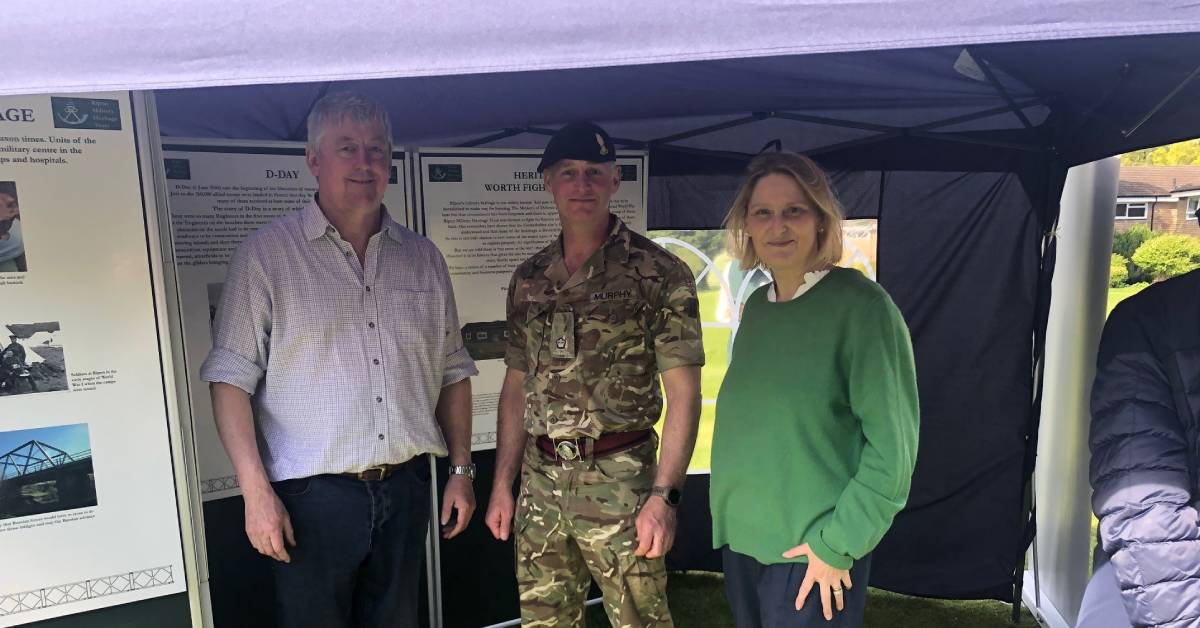
“We and many Ripon residents strongly believe that the important heritage assets at the barracks site are worth fighting for.”
Main image: Field-Marshal Montgomery recognised the important role that Ripon’s Royal Engineers played in the installation of Bailey Bridges, such as this one in Italy. Picture Wikipedia
Read more:
Harrogate war veteran, 99, to recall Nazi concentration camp liberationA Harrogate World War II veteran believed to be among the first servicewomen to enter a Nazi concentration camp is to give a talk about her experiences next week.
Sheila Pantin, who will be 100 next month, will give the talk as part of the Harrogate war memorial centenary commemorations.
The event, which is sold out, will take place at the town’s West Park United Reformed Church.
Sheila joined the army aged 17 and trained as an ambulance and staff car driver with the Auxiliary Territorial Service, the women’s branch of the British Army, rising to the rank of sergeant.
She became one of the first British servicewomen to enter Belsen concentration camp in April 1945 after its liberation.
Reflecting on the time, Sheila said:
“I thought they meant ‘barracks’ but it turned out they didn’t mean that at all. There was the camp with this huge entrance and an awful lot of huts surrounded by barbed wire fencing.
“We were entering Belsen. I could see our boys digging out mass graves to give the bodies proper burials.
“The only people left alive were in rags and were in a terrible state. They didn’t even know how to eat.”
Read more:
It was Sheila’s job to look after the survivors in the camp, to clean them, dress them, show them how to use a knife and fork, to try to restore a little humanity after the horrors of the Nazi Holocaust.
Sheila’s talk will take place on Wednesday, September 27, and forms part of a wider selection of events taking place as part of the commemoration.
More details of the centenary commemorations are available here.
Ripon military heritage trail plans backed by city councilRipon councillors have given their unanimous backing to proposals for a heritage trail focused on the city’s unique military history.
At Monday’s full council meeting, Guy Wilson and Jane Furse of Ripon Military Heritage Trust, provided an update on work that the charity is doing in a bid to save buildings and bridges at the the Ripon barracks site, where Homes England has planning consent to build the 1,300 homes development known as Clotherholme.
The trust wants to ensure that heritage structures that tell the story of the crucial role that Ripon played in World War II and the Cold War are not destroyed.
These include a number of rare huts on the Deverell Barracks section of the site that date back to 1939 and are among only a handful still in existence.
The trust wants to preserve seven of the huts for future relocation to a site next to the Laver Banks training area.
But to do this, they need approval for the buildings to to be dismantled and kept in the storage depot at Deverell Barracks.
The trust’s plan also involves the phased development of a military heritage centre alongside countryside trails which will interpret the city’s unique military heritage, while providing a gateway to the Clotherholme scheme.
Trust chair Mr Wilson said:
“We have presented our ideas to Homes England and are now seeking the support of the city council.”
Councillor Stuart Flatley said:
“These plans are mind blowing for Ripon. Military history is massive and this has to be good for the whole community.”
Councillor Pauline McHardy added:
“This is a wonderful idea. Many people who live in Ripon used to serve at that site and have a lasting connection to it.”
The proposals were welcomed by city council leader Andrew Williams, who said:
“We share the aspirations of Ripon Military Heritage Trust and will continue to offer it our full support.”
It was agreed that North Yorkshire Council planners will be called upon by the city council to ensure that heritage infrastructure on site is protected and preserved.
Council orders deep clean for Ripon War MemorialNorth Yorkshire Council is arranging for Ripon’s War Memorial to have a deep clean to rid it of dirt and algae.
Since it was unveiled in October 1921, the memorial in Spa Gardens has been the focal point of the city’s Services of Remembrance, commemorating those who served and died for their country in the conflicts of 1914-1918 and 1939-1945.
Each year hundreds of people, ranging from scouts and guides to former servicemen and women and civic dignitaries, gather in the gardens to pay respect to the fallen.
In recent years, some of the 339 names of Ripon men who died in the two world wars have become obscured by green algae.
This led Ripon City Council to call on the former Harrogate Borough Council to carry out a thorough clean.
City council leader Andrew Williams told the Stray Ferret:
“We raised the issue of the condition of the memorial on at least two separate occasions with officers at Harrogate council and were told 18 months ago that the memorial was on annual spring cleaning programme, but nothing happened.
“I’m pleased to say that we have had an immediate and positive response from the North Yorkshire parks and environmental services team.
“We have been advised that they have inspected the memorial and have instructed a specialist contractor to undertake cleaning in the coming weeks to bring it back up to the standard required.”
Read more:
Priceless military heritage to be protected at Ripon development siteFears that priceless elements of Ripon’s rich military heritage could be flattened to make way for the 1,300-home Clotherholme scheme have been allayed.
Jane Furse, a trustee of the Ripon Military Heritage Trust, which has plans to create heritage trails on the development site, told the Stray Ferret:
“We were concerned that some extremely rare huts on the Deverell Barracks part of the site, and other historically important structures, would be demolished, but I’m relieved to say that this will not be the case.
“These huts are among the few surviving of their kind in the UK and help to tell the story of the vital national and international role that Ripon’s Royal Engineers played in just about every aspect of World War II and subsequent conflicts.
“This included training British and allied troops in the erection and use of Bailey Bridges in theatres of war such as Sicily and France and bomb disposal, that saved the lives of civilians and military personnel around the world.”
Minutes of Harrogate Borough Council’s February 23 planning meeting at which Homes England was seeking outline approval to progress development of the huge Clotherholme scheme, confirm that the huts and other structures will have protection.
Under the provisions of a Section 106 agreement the developer is required to put in place a strategy to ‘secure military heritage within the site.’

Jane Furse of Ripon Military Heritage Trust pictured at the barracks site
The planning meeting minutes also say:
“Prior to the commencement of works to each phase of development, a record (including photographs, drawings and summary of historic analysis) shall be made of a representative selection of buildings with military heritage on site and shall be submitted to and approved in writing by the local planning authority. Copies of this record shall be placed on the North Yorkshire Historic Environment Record.”
Ms Furse, an architectural historian and former inspector of historic buildings with English Heritage (now Historic England) pointed out:
“Inclusion within the S 106 agreement means that the significance of military heritage assets at the site has been formally recognised and that is very welcome news.
“It means that we can go forward, in liaison with Homes England and other parties, to progress plans for military heritage trails at Clotherholme that alongside other heritage attractions, will add to the city’s development as a tourist destination.”
Bomb disposal and the American connection
The wooden huts at Deverell Barracks are of heritage importance, because they are identical to ones that were located at the nearby Harper Barracks which became the home of the Royal Engineers’ School of Bomb Disposal in 1941.
Setting up of the national school in Ripon, soon saw Royal Engineers based in the city providing vital training and passing on know-how to the Americans, in the wake of Japan’s attack on Pearl Harbour, the USA naval base.
Ms Furse said:
“The Royal Engineers sought out examples of every known enemy bomb and developed countermeasures to defuse them. The School developed a rigorous training programme in bomb identification and disposal methodology.
“The Americans, although aware of the threat of unexploded bombs, had no proper procedures for safe disposal and the aftermath of the bombing of Pearl Harbour on December 7 1941, meant that for the first time, they were faced with unexploded bombs scattered throughout their bases and the harbour.
“On December 9, the British Military Attache’s office in Washington received a request for a joint personnel exchange – an early example of the ‘special relationship’ between ourselves and the USA.
“A group of eight hand-picked American soldiers headed by Major Thomas J Kane, travelled to Ripon to train with the Engineers, arriving on February 1 1942.
“After six weeks of attending lectures and demonstrations, all of the U.S. Army ordnancemen passed the course and were made honorary Royal Engineers – they were even given official RE patches and allowed to wear them on the sleeves of their American uniforms.”
The expertise gained from the Royal Engineers in Ripon subsequently saw Major Kane set up the USA’s first Bomb Disposal School in Maryland.
Read more:
Ripon’s rich military history threatened by 1,300-home barracks schemeKey parts of Ripon’s military past could be demolished to make way for the proposed 1,300-home development at the city’s barracks.
Homes England is seeking outline planning permission for the Clotherholme housing scheme, which would be the biggest single residential development in Ripon’s history.
Ripon Civic Society has now highlighted the potential loss of rare items that are part of Ripon and the UK’s military heritage.
The vital role Ripon’s military establishment played in both world wars and the Cold War has been highlighted in new research by the society.
Christopher Hughes, its chairman of the society, said:
“The site at Laver Banks is important in the history of Ripon’s past and in the defence of Britain in World War II and since.
“We have done detailed work on the Homes England proposals for the whole of the army camp site. We encourage them, and Harrogate Borough Council, to take a revised look at proposals for demolition of some of the structures our research has identified, and to protect them for the future.”
The society has been closely engaged in the planning process and has been keen to stress the importance of the last remaining remnants of the city’s vast World War I camp, in which the poet Wilfred Owen was stationed.

The heavy girder bridge, which crosses the River Laver on the Barracks site, was the next generation of the bridge designed by Sir Donald Bailey.
Setting up Ripon Military Heritage Trust to aid further research, it has now discovered that from the start of World War II the remaining site was the test-bed for developing and trialling demountable bridges, including the world-famous Bailey bridge.
The School of Military Engineering was evacuated from Chatham in Kent to Ripon at the start of the war.
Military heritage structures
Ripon architectural historian, lecturer and writer, David Winpenny, who is a vice-president of the society, said:
“As well as providing training for engineers on the Bailey bridge, the school also developed the massive Bailey Suspension Bridge, capable of spanning up to 400 feet.
“It was tested in Ripon at the Laver Banks site of Ripon Camp by British, Canadian and American troops before being deployed in Burma and other theatres of war.
“From 1946 a new heavy girder bridge was developed; by 1955 60 had been ordered. The first to be put in place was over the River Ure in Ripon. It was mainly used in West Germany as well as in Malaya.
“Development continued in the following decades. The only surviving heavy girder bridge was installed in Ripon as late as 1992.
“Ripon also has the larger of only two surviving k‘demolition’ training bridges, designed with cavities in which explosives could be packed to eliminate the bridges before an enemy assault.
Read more:
Mr Winpenny added:
“As well as these rare survivals, and the still-extant infrastructure of the testing site, the Ripon Camp also has the last four Twynam Huts remaining; these were the successors to the Nissan Huts and were developed in 1959 for use as accommodations for personnel, offices and stores.
“They were deployed worldwide, including in Cyprus, Aden and Libya, as well as on Ascension Island during the Falklands War and at Long Kesh Camp in Northern Ireland.”
‘Amazing how significant Ripon was’
The society has shared its findings with Homes England, which is responsible for the transition of the site from army camp to housing and employment site, and with Harrogate Borough Council, which will determine the planning application.
It has said that these significant but vulnerable remnants of Ripon’s military past require special protection as part of the planning process. The society wants to work closely with all parties to establish a community legacy for Ripon and the wider area by promoting and interpreting the site.
Guy Wilson, creator of the Royal Armouries museum in Leeds, and one of the Ripon Military Heritage Trust trustees, said:
“It is amazing how significant this quiet part of North Yorkshire was in the Second World War. What was happening in Ripon helped us to win the war and our research has discovered how important Ripon was in the development and perfection of the Bailey bridge and its successors.
“It is a story hitherto unknown but one very worth telling and remembering.”
Historic images projected onto Ripon Workhouse Museum at nightPictures of local people from the past are lighting up the front of Ripon’s Workhouse Museum with a new after-dark display.
People of Ripon’s Past, features historic photographs from the Ripon Re-Viewed collection including, among others, North Eastern Railway staff, workers from Ostcliffe’s Tannery, land girls and a refugee family.
Running until March 21, the daily display can be seen between 6pm and midnight.
The Images are projected onto the museum with a design created by locally-based audio-visual and lighting specialists Fusion LX
Helen Thornton, director of Ripon Museum Trust said:
“We had some fantastic feedback from the community on our previous lighting displays and we wanted to continue into 2022.
“After talking with Ripon Re-Viewed, we came up with the idea to display some brilliant historic photos of Ripon in days gone by, as a way to bring the community together through our shared past.
“Hopefully, the display will intrigue and inspire anyone passing by the museum on Allhallowgate.”
Read more:
Mandy Whitehead, project lead at Ripon Civic Society said:
“A big thank you to the Workhouse Museum for the opportunity to share some of the fabulous images from Ripon’s past. We hope it will give the local community an insight into life in Ripon.”
Ceremony marks start of remembrance events in RiponRipon’s week of events to remember the dead of two world wars and other conflicts began at the weekend.
The Dean of Ripon, The Very Revd. John Dobson, led prayers as he blessed the Royal British Legion Garden of Remembrance next to the cathedral.
Saturday’s ceremony was attended by serving officers and standard bearers representing all of the armed forces, along with civic dignitaries, including Stuart Martin, the chair of North Yorkshire County Council and a Ripon councillor, and city council leader Andrew Williams.

Attendees were invited to place small wooden crosses bearing a poppy, in front of the plinth at the garden
A two-minute silence was observed before small crosses with poppies on them were put in place by a number of attendees in front of the garden plinth.
Jeet Bahadur Sahi, who served in the Gurkhas for 22 years and is chair of the Royal British Legion Ripon branch, told the Stray Ferret:
“This is a special year for the legion and the branch as we celebrate our 100th anniversary.
“The remembrance garden, which opened in 2018, was created by the Ripon branch with support from the public, businesses and authorities.
“In addition to the war memorial in Spa Gardens, it provides a permanent and prominent place where the fallen can be remembered.”

Photograph: Tyler Parker Photography
Spa Gardens will be the focus next weekend when Ripon’s civic Remembrance Sunday service is held at the city’s war memorial, followed by a service at the cathedral.
The event, which starts at 11am, will honour the service and sacrifice of the armed forces, British Commonwealth veterans, allies and civilians involved in the world wars and other conflicts.
Those wishing to attend are asked to assemble at Spa Gardens from 10.30. Following the service, there will be a march past and salute in front of Ripon Town Hall, with the procession leading to the cathedral, where a further service will be held.
Read more:
Ripon remembers the fallen on VJ DayThree months and one week after the socially-distanced celebrations took place for the 75th anniversary of VE Day, Ripon marked VJ Day in more modest fashion.
Victory over Japan, which followed the dropping of atom bombs on Hiroshima and Nagasaki on 6 and 9 August 1945, brought an abrupt and brutal end to World War II and meant that British and Commonwealth troops, who fought in the Far East, could return home.
But tens of thousands of the 1.3 million men and women who made up the South East Area Command and what subsequently became known as the ‘Forgotten Army’ did not return to loved ones and their names can be found on War Memorials in the UK and around the world.

The War Memorial at Spa Gardens, Ripon
Today the ‘Forgotten Army’ will be remembered, across the UK, with a two minute silence; the sounding of church bells, a fly past of World War II aircraft and a national service of remembrance attended by Prince Charles and the Duchess of Cornwall, broadcast live by the BBC.
Read more:
The National Memorial Arboretum in Staffordshire, provides the setting for the BBC’s coverage, while an hour earlier, in the similarly sylvan surroundings of Spa Gardens, Ripon, the city’s Mayor Councillor Eamon Parkin, laid a wreath at the war memorial.
He told the Stray Ferret:
“Our city, which is home to the Royal Engineers, has a proud military history stretching back to 1915 and on landmark days like these, we take a few minutes to remember what the men and women of the armed forces have done for us in every theatre of war and continue to do for us in keeping the peace.”
Cllr Parkin, added:
“Sadly, the necessary coronavirus restrictions prevented us from staging the large-scale events that we had planned to celebrate the 75th anniversary of VE Day and also affect today’s commemoration, but that does not stop us from remembering those who fought and fell in the Far East and indeed, all our war dead.”