
This story is sponsored by Newcastle Building Society.
In many towns and cities just like Knaresborough, the growth of online shopping and the popularity of out-of-town retail outlets has changed the face of our high streets over recent years. And it’s hard to ignore the fact that the rise of digital banking is having an impact on the number of bank branches and the availability of financial services in our communities.
With more than 5,000 bank branches across the UK closing since 2015, people who don’t have access to digital banking, or those who prefer to manage their money in person might well worry about the future of the once-familiar bank branch.
However, one building society is gaining attention in the region by bucking the national trend of branch closures and for coming up with new ways to restore access to financial services in its communities.
Newcastle Building Society has 31 branches across the North East, North Yorkshire and Cumbria – a number which has actually grown over recent years with the recent addition of the Knaresborough branch – and despite the number of branch closures by others around the UK, says its commitment to face-to-face financial services is only getting stronger.
Michael Conville, chief customer officer at Newcastle Building Society said:
“Customers tell us again and again that they’re worried about the future of branches. As an organisation owned by our members we’re constantly thinking about how to better serve our communities and we’re absolutely committed to investing in our branches and growing access to local financial services.
“Branches are expensive to run, but instead of admitting defeat and pulling down the shutters, we’re taking a fresh approach, working with local people and finding new ways to make branches work for our communities. That includes rethinking what the branch might look like and showing what can be achieved when you’ve got customers’ best interests at heart.”
How has Newcastle Building Society bucked the trend?
One of the ways Newcastle Building Society has been able to open more branches when others around them close is through its innovative community partnership branch. Since 2016 the Society has opened in four new locations – Yarm, Hawes, Wooler, and Knaresborough, each time working with local partners to open a new branch in a space shared with other local services.
In Knaresborough, the Society’s branch sits inside the local library, taking up a fraction of the space of a traditional branch but offering all the same services and making it easy for people checking out the latest books to check out the latest savings interest rates.
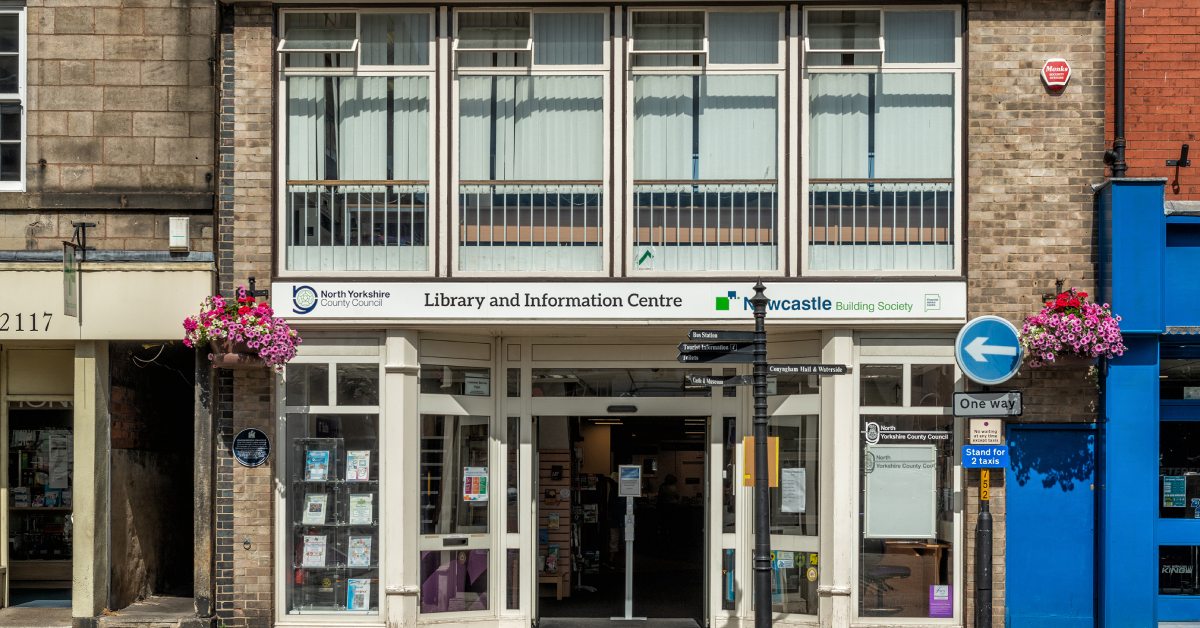
The Newcastle Building Society branch is a part of the library and information centre.
The Society is also investing in its presence in Newcastle city centre, with plans to open a brand new flagship community branch at Monument in summer 2024.
Michael added:
“There’s a real risk of financial exclusion in places where banks have left town. Often that impacts the most vulnerable and makes people more reliant on others to help manage their money. The community partnership branch works when there is a real need for financial services and a clear desire from local people and leaders to work together to bring those essential services back to the high street. It’s been a success for us in four places already and we’re working on more community branches all the time.”
Banking for everyone
As well as its commitment to branches, Newcastle Building Society is sticking with some of the more traditional ways of keeping up to date with your savings, such as the savings passbook, which many banks and building societies are phasing out.
But the Society is also investing in the latest technology to hand the power of choice to its customers and help restore access to cash and basic banking services in places where the banks have left. In its Knaresborough and Gosforth branches, a UK-first pilot of a multi-bank kiosk allows customers of any bank to withdraw and deposit cash from their current account – whoever they bank with – under the Society’s roof, free of charge without the need to be a customer of the society. For small businesses in particular, it means less time spent travelling to their nearest bank and more time running their business.
Michael concluded:
“Technology is probably the biggest driver of change in financial services and by working with OneBanx and their multi-bank kiosk, we’re helping to restore basic banking services which are especially important for small businesses and the wider health of the high street economy. We’re also investing in our digital offering, including our online savings portal and app, because we believe customers deserve the best of both worlds – the convenience of online services and the reassurance and comfort that only comes from a friendly conversation on your local high street.”
To find out more about what we can do for you, pop into your local branch at 40 Market Place or visit the branch page by clicking or tapping here.
North Yorks Council warns action to plug £25m black hole is essentialThe politician charged with ensuring a range of key services are maintained for North Yorkshire’s 618,000 residents has warned unless the authority strips back £25m of annual costs its ability to fulfil a range of economic goals will be significantly curtailed.
North Yorkshire Council‘s executive member for finance, Councillor Gareth Dadd, issued the alert as the authority’s executive met to consider pushing forward the recently launched unitary council’s first economic strategy.
The meeting heard the five-year plan was set to be launched next year and aim to support business growth, key sector development, generating inward investment and prioritising regeneration while improving infrastructure and connectivity.
Executive members were told the vision is to be “an innovative, carbon negative economy driven by our productive and entrepreneurial business base and the places and communities that make North Yorkshire distinctive”.
Cllr Dadd, who is also the authority’s deputy leader, said as moves to consider next year’s budget were getting underway, even with grant funding for some of the economic development opportunities the council was pursuing it would still need to financially support the schemes.
Referring to the strategy, he said:
“It is a salutary reminder of the importance of us getting our revenue budget in ship-shape order for us to make choices over some of the priorities that this document will produce.”
After the meeting, Cllr Dadd said the council was set to make “substantial in-roads” into the £25m black hole in the coming months, with authority prioritising making operational efficiencies, while not ruling out cuts to services.
He emphasised while creating the unitary authority had presented savings opportunities, many councils across the country were facing “immense financial challenges”.
He said:
“If we don’t sort the revenue budget out and continue taking from reserves then our ability to fulfil the economic development plan will be rapidly diminished because we will not have the reserves to support it.
“The first station of this train journey has to be to have a sustainable revenue budget which will then lead to council tax cuts or investment in services.
“Clearly that puts us in a great position to make those choices and if we do decide to invest then we need to prioritise that as well. There is no running away from it – everything is underpinned by the revenue budget.”
The authority’s recurring annual deficit is forecast to have fallen by about £5m since the start of the financial year, partly as a result of having increased buying power following the merger of eight councils.
Cllr Dadd added:
“Our priority will always be efficiencies in operations rather than service cuts. We are looking at back office first and the premium from unitary is there to be taken. It won’t all come at once.
“I can’t guarantee there won’t be service changes, but as long as I have a breath in my body and in the position I am, the influence I have got will be used to protect services for vulnerable people.”
Read more:
- Ripon Cathedral wants new refectory to ‘prevent visitors using cafés in the city’, says campaigner
- County-wide zone has damaged taxi businesses, says Ripon councillor
Government grants needed to help finances, says county council leader
More measures are needed to help North Yorkshire County Council’s finances despite support from government on council tax, says the leader of the authority.
Cllr Carl Les said the council needed grants from central government in order to help balance its books.
His comments come as Chancellor Jeremy Hunt is expected to announce an increase in the threshold in which authorities can increase council tax by without a local referendum.
Currently, the threshold is 2.99% – but Mr Hunt is expected to hike this to 5% in today’s autumn statement.
Cllr Les told a meeting of the county council yesterday that while the measure would be welcomed, more support would be needed.
He said:
“It will give us flexibility, but I don’t think that it’s the only leaver that we need to pull.
“Government grants has got to be part of that answer as well.”
The move comes as county council leaders warned in June that the upcoming North Yorkshire Council could face a blackhole of £50 million in its finances.
Read more:
- North Yorkshire Council faces £50m black hole, says finance boss
- North Yorkshire to tackle housing crisis with second homes charge
Cllr Gareth Dadd, executive member for finance at the county council, said the situation was largely due to deficits it will inherit from district councils and high inflation.
The new unitary authority will replace Harrogate Borough Council, the county council and the remaining six districts.
Although he did not estimate the total structural deficits that the seven second tier authorities, including Harrogate Borough Council, would have accumulated by the time the new council is launched in April, he said it was believed it would be “substantial”.
It has been estimated the combined ongoing deficits of the district and borough councils could be in the region of £10 million.
In addition, ahead of the recent increasing inflation rate the county authority had been prepared to cover a deficit of up to £20 million.
With inflationary pressures, which include the council’s gas and electricity bill rising by some £3m, it is believed the total deficit could nearly reach £50 million.
Cllr Dadd said at the time:
Fire, bankruptcy and coronavirus: Harrogate Cricket Club adapts to survive“That is a frightening figure, but nonetheless, I think we are right to raise that at this stage.”
143 years, not out. Harrogate Cricket Club lost its clubhouse to fire just over a decade ago and came close to bankruptcy in The Great Depression but coronavirus could have been the end of the club.
Harrogate Cricket Club played its first match at its ground at St George’s Road on July 7, 1877 but could have played its last in 2020 without major financial support.
Local sports often rely on the income generated by renting out clubhouses for events. When The Balcony at Harrogate Cricket Club closed its doors the management did not know when or if it could reopen.

Chairman Steve Clarke with The Balcony manager Andy Hawkswell.
Steve Clarke, the chairman of Harrogate Cricket Club, estimates that The Balcony’s closure over so many months left a black hole in its finances to the tune of £40,000.
Read more:
- How Harrogate Rugby Club is getting back to business
- When this Harrogate school is holding a ‘Question of Sport’
It could have been devastating to the club, which has needed to pay out for the maintenance of the grounds and facilities without any income. But grants from Harrogate Borough Council and the ECB have covered those huge costs.
A spectator boost for the club followed that financial boost last weekend, with around 100 people turning up to watch the games and a few members visiting The Balcony for drinks.

The Balcony is open for business.
Chairman Steve Clarke told The Stray Ferret that they cannot generate income without playing cricket:
“It has been really difficult. It is really interesting for the senior teams. We have to make sure everyone is socially distanced, that the toilets are cleaned regularly and that there are hand sanitiser stations around the club. The league has slimmed down the fixtures and ruled out promotion or relegation so everyone can get out and play.”
The Balcony will be key to the club’s future. Andy Hawkswell has just taken over as the new tenant and plans to give it a refreshed ‘sports bar’ feel. He said:
“There have been a lot of people waiting for us to open. It is good to see. We are making some big changes on the pitch and off it. We are going to be broadening the horizons of what we offer in terms of our food and drink and also by renting out the space we have here for schools and community groups.”