Thank you for your interest in this story
To continue reading this article, subscribe to the Stray Ferret for as little as £1 a week
Already a subscriber? Log in here.
26
Feb
Community gathers to plan creation of new Crimple Common and Greenway
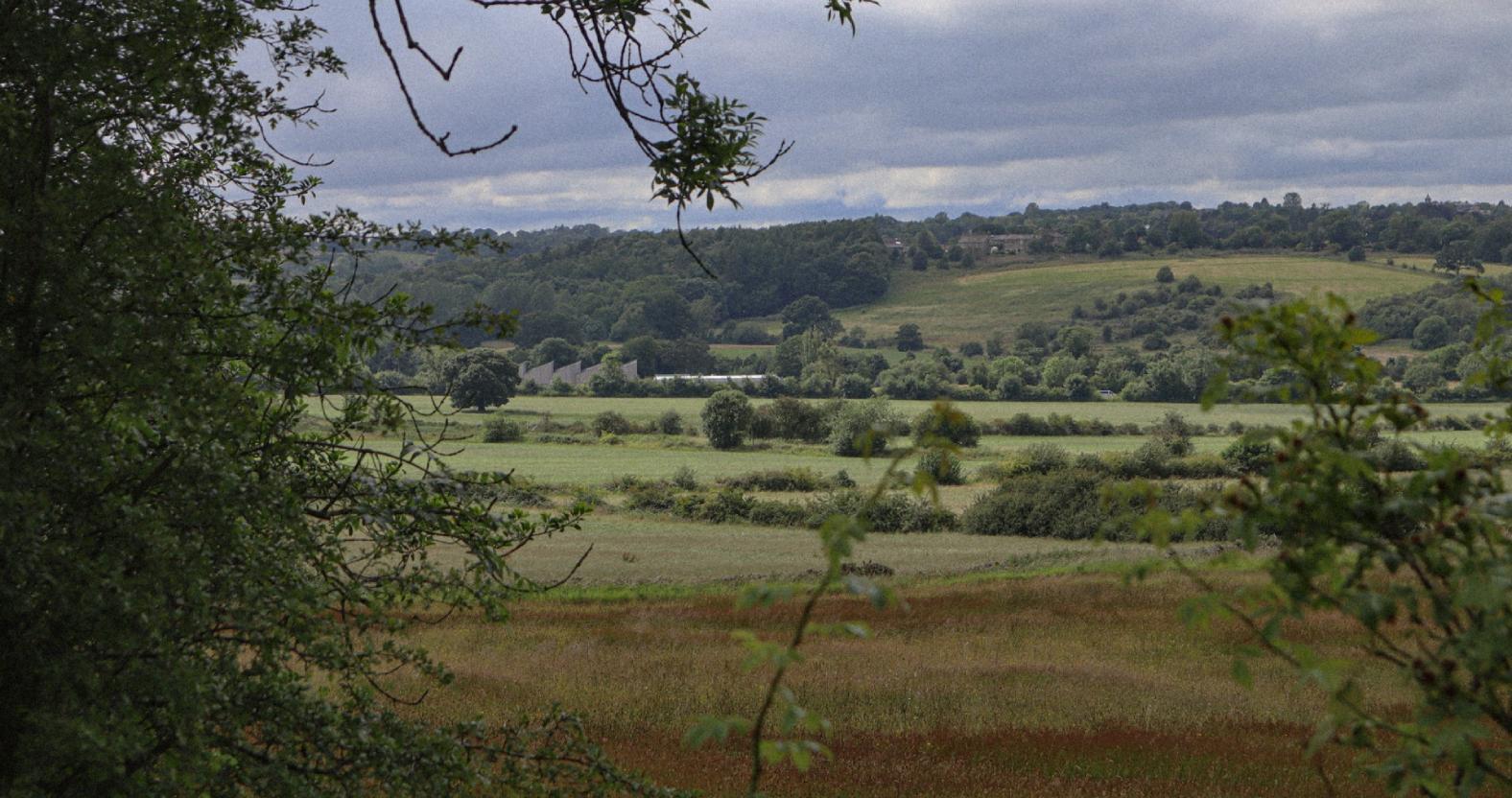
Residents from across the south of Harrogate met this week to discuss how best to protect Crimple Valley from development.
The meeting was convened by the architects of the Crimple Commons initiative, which envisages Crimple Valley as a shared asset for nature and community.
The project has begun as a loose coalition of interested parties, and takes inspiration from the success of Long Lands Common between Harrogate and Knaresborough, where more than 100 acres of land have been brought into community ownership.
Various parts of Crimple Valley have come under threat of development over the years, and each time the plans were defeated in large part due to coordinated action by residents. The intiative is intended as a proactive attempt to pre-empt any future proposed development schemes.
Ambitions
Crimple Commons is a programme of linked initiatives across the valley, and initial discussions have identified certain key ambitions. One of these is the creation of Crimple Common itself on land owned by North Yorkshire Council to the west of the A61 Leeds Road.
It would be bounded roughly by Crimple Beck, Stone Rings Wood and Sandy Bank Wood.
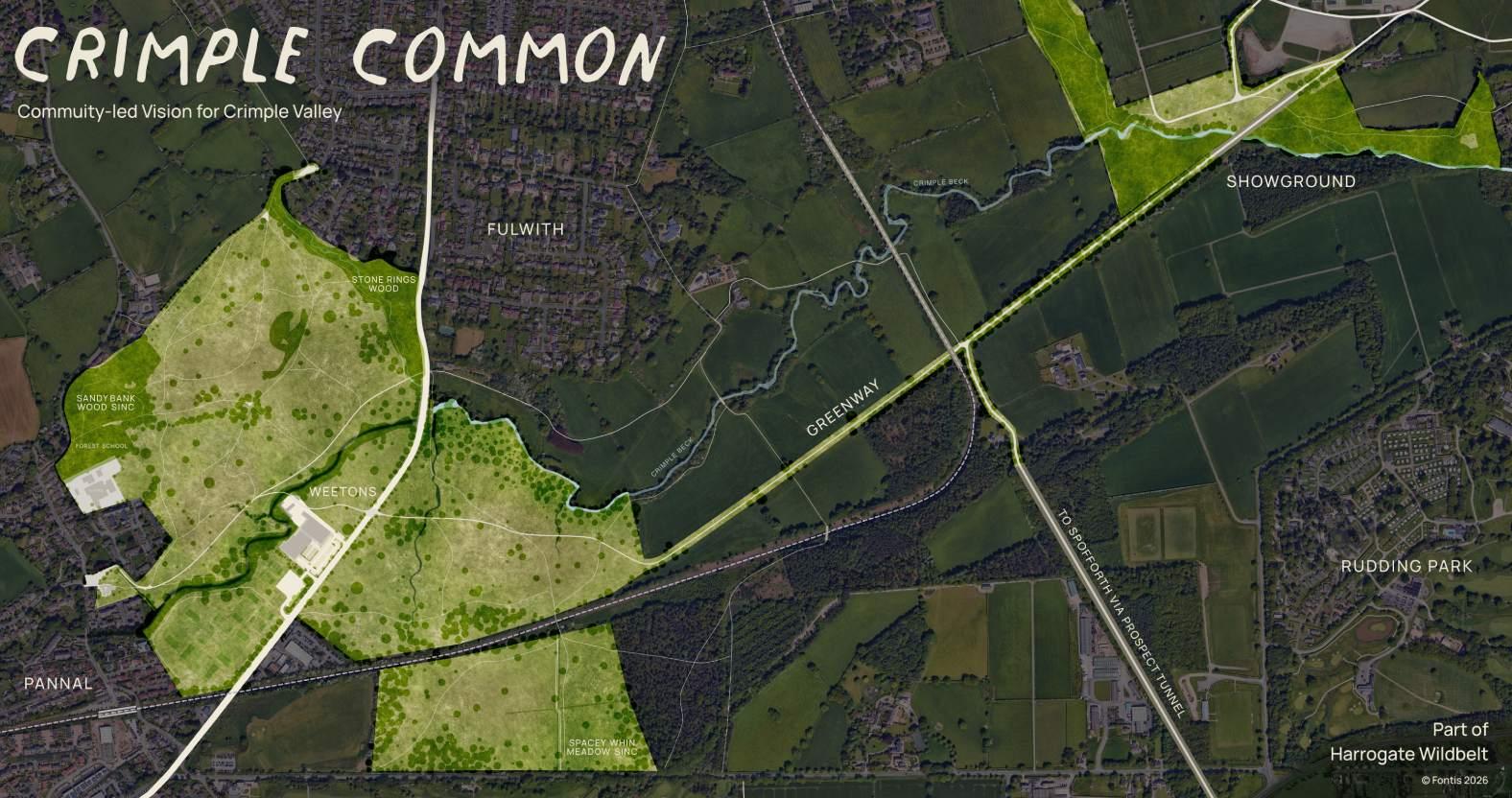
The proposed Crimple Common and Crimple Greenway.
Another ambition is the creation of a Crimple Greenway between Pannal and Harrogate. It would follow the old railway line through the valley, using the currently neglected Low Crimple Viaduct and pass beneath the final arches of the main viaduct, before curving through the proposed common.
Presenting the proposals, George Eglese, who also sits on the Long Lands Common board, said:
We want to think now about how we take this further. We want to co-create and collaborate with the community and get people involved.
We want to explore what people’s ambitions are. How do they feel about something like this? And is there anyone else who should be involved?
Those questions were answered – at least in part – by the turnout for Tuesday evening's meeting. About 50 people packed into Pannal Village Hall for the event, including residents, councillors, and subject specialists such as Malcolm and Gia Margolis, who were instrumental in the creation of Nidderdale Greenway.
Following Mr Eglese’s presentation, attendees split into four groups to discuss ideas and come up with further suggestions.
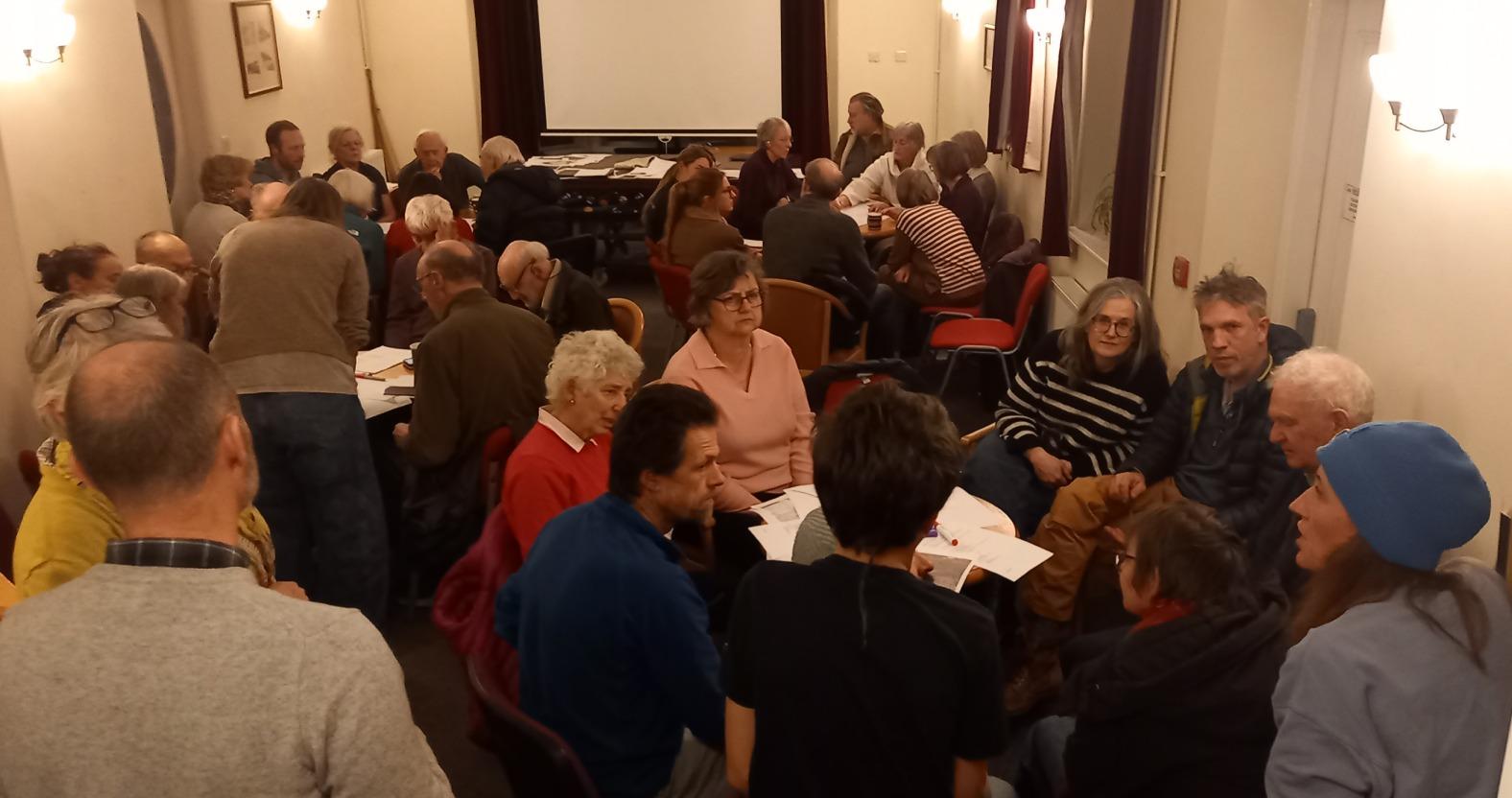
Attendees were split into groups to discuss ideas.
All seemed enthusiastic about the common and greenway ideas, and some added their own thoughts about the possibility of community allotments and orchards, wetlands and forest schools.
Seasonal wetlands
Speaking of the creation of Crimple Common, Mr Eglese pointed out that old maps label much of the low ground in the valley as Crimple Carr – ‘carr’ is wet woodland or boggy ground – showing that the valley once functioned as a natural floodplain.
With this in mind, he suggested reintroducing seasonal wetlands, flood meadows and reedbeds, which would “offer a powerful nature-based flood mitigation strategy”, slowing down waterflow into Crimple Beck – which the Environment Agency currently rates as having 'poor' ecological status – and improving water quality and biodiversity downstream.
Species-rich
Other areas of what would become Crimple Common are already ecologically valuable – both Sandy Bank Wood and Spacey Whin Meadow are sites of importance for nature conservation (SINC).
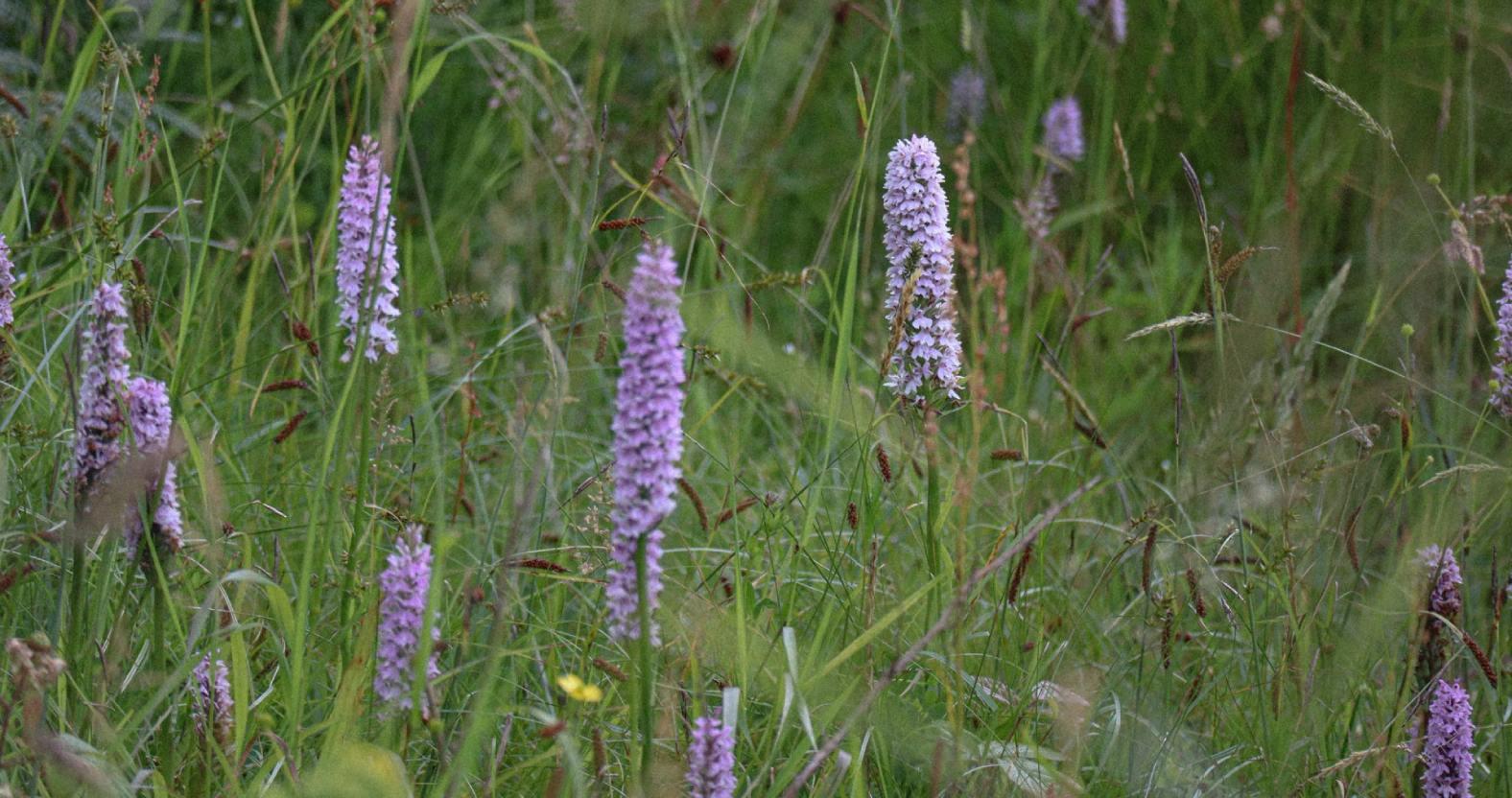
Southern marsh orchids growing in the Crimple Valley.
Otters and roe deer are frequent visitors, and barn owls, dippers, kingfishers and grey wagtails all nest near the beck. There is also a significant number of rare and unusual species of plants, such as southern marsh orchids, and fungi, such as striate earthstars.
Yet some species are under threat. Harrogate resident Kevin Walker, who is head of science at the Botanical Society of Britain and Ireland, has been tracking numbers of several birds in the valley for 30 years. His records show that curlew, which were once common there, have not been seen for more than a decade.
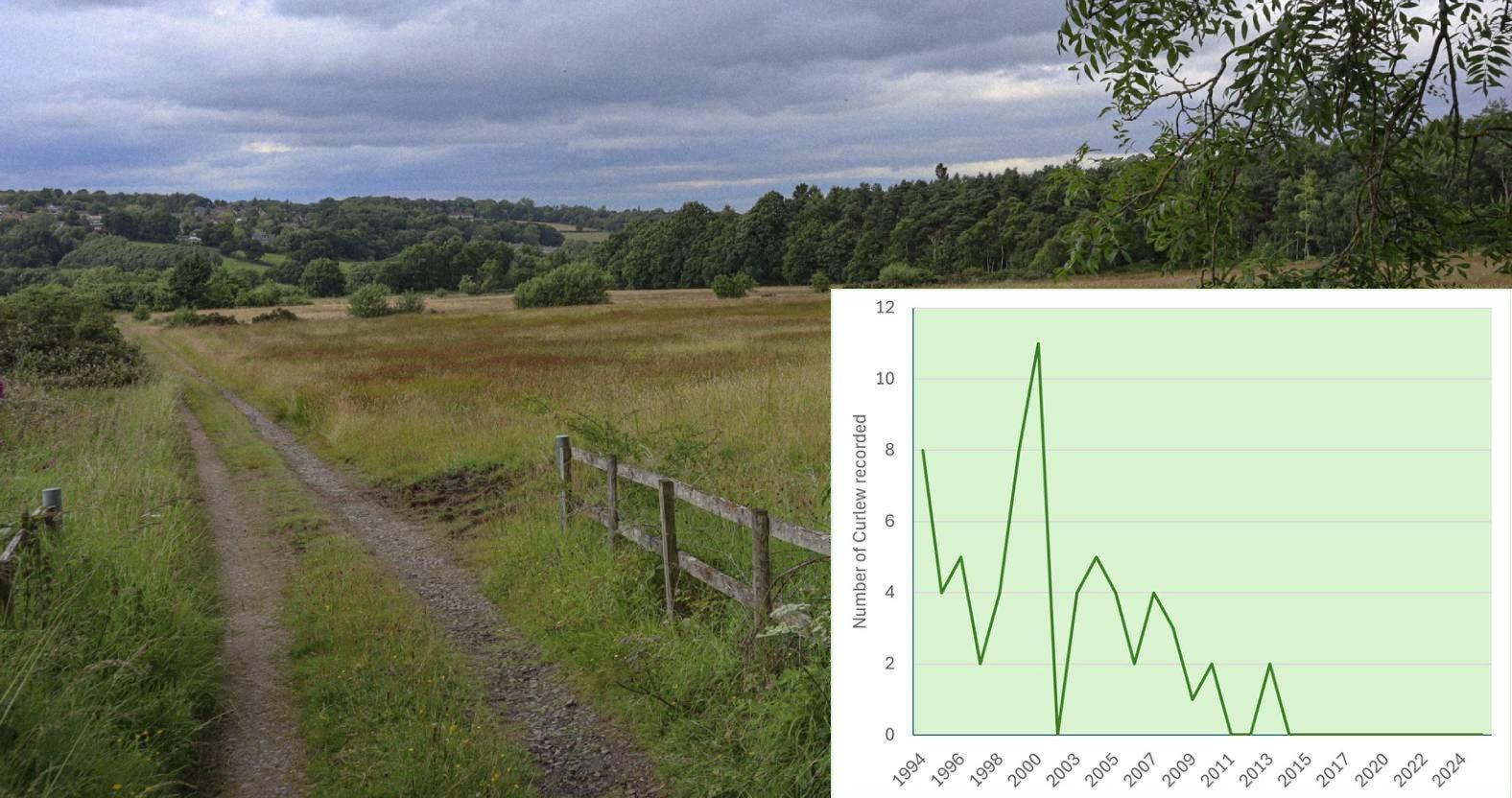
Spacey Whin Meadow in the Crimple Valley used to be a breeding site for curlew, but as the graph shows, they are no longer seen there.
Harrogate Wildbelt
Mr Eglese envisages Crimple Common as the southern arc of what he calls the Harrogate Wildbelt, a continuous wild ‘belt’ around Harrogate, consisting of the Nidd Gorge to the North East and Oakdale to the North West, with support from the likes of the Pinewoods Conservation Group, Long Lands Community and Bilton Conservation Group.
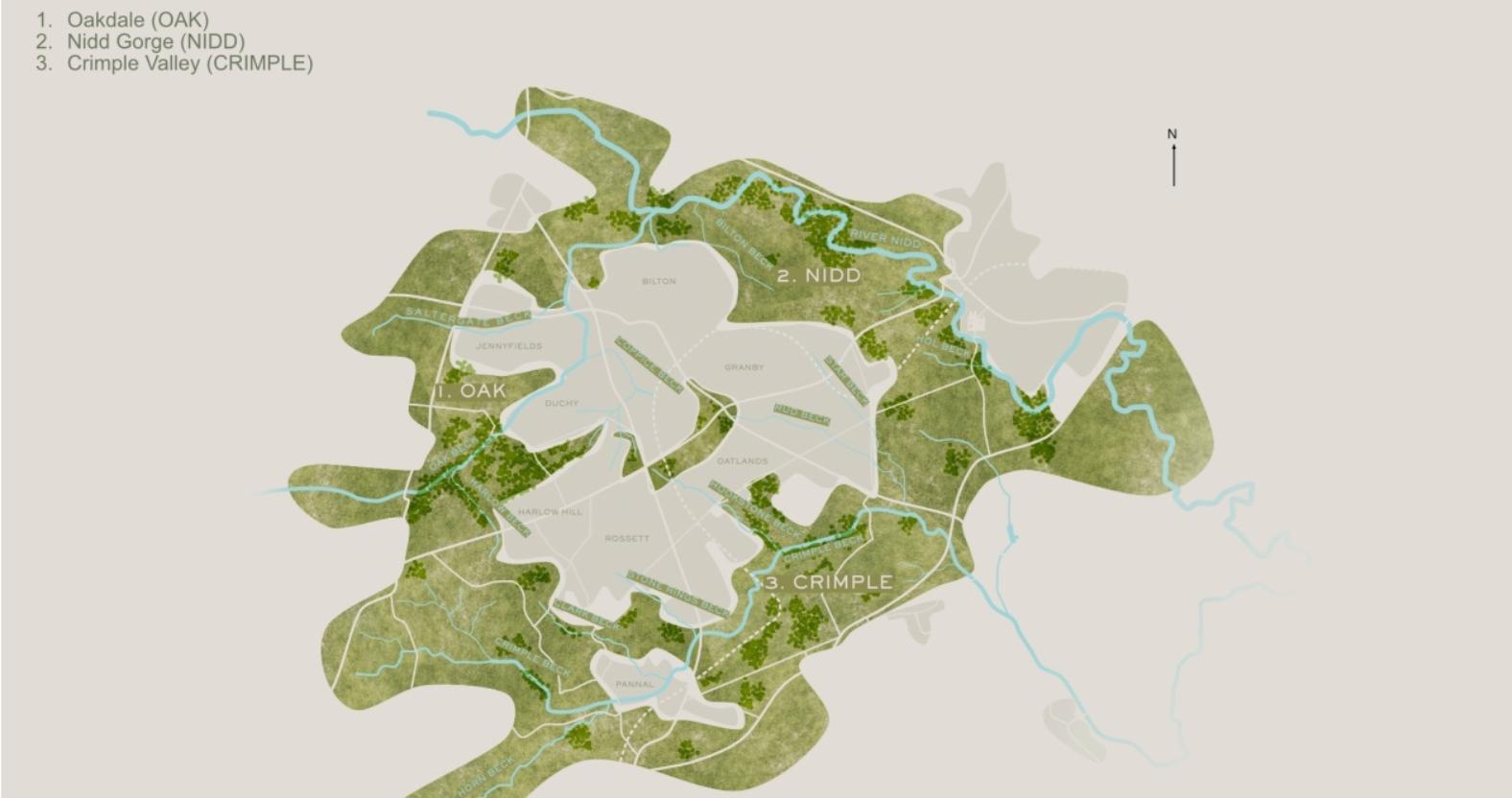
Map of the Harrogate Wildbelt, as proposed by George Eglese.
The idea forms part of a project called the Harrogate Cure, an initiative he has developed to restore Harrogate’s connection to the natural environment and its "spa essence".
Green Party councillor Sian Oakes – who is also on the Long Lands Common board, introduced and wrapped the event. She finished by saying:
All these ideas can come together to create a wonderful vision. It’s not easy, but it’s got to be done.
Everybody can help in their own way, because everyone’s unique – we need lots of people with lots of viewpoints and ideas.
Don’t ever think ‘What can I do?’. However you join in, your contribution is unique, and special, and needed.
Tuesday evening's meeting was the first of several events to develop the Crimple Commons initiative. Open drop-in sessions for anyone interested will be held at Pannal Scout Hut from 10am to 4pm today (Thursday, February 26), and on Wednesday, March 4 and Monday, March 16.

0