04
Jul
Is a degree worth it? I report for the Stray Ferret on the difficult decision facing my generation
Over the past years, there's been a lot of debate about whether going to university is worth it. Graduates face a huge amount of debt and now AI threatens many student jobs in the wider world.
I'm 17, studying A levels in year 12, at King James's School (KJS) in Knaresborough.
Myself and others in my year have got some big decisions to make. I wanted to ask them and local employers the big question: ‘is university worth it or not?’
Before the 1998 Teaching and Higher Education Act, university was the natural next step for students as higher education was free. Getting into debt was less of a problem.
But now, the financial burden is massive: in 2012 tuition fees froze at £9,250 and with recent inflation the average student debt is more than £50,000.
What do the students think?
Evelyn Skinner, a year 12 student at KJS in Knaresborough, told me that the portrayal of university and its value in the news put her "in a bit of a turmoil". She said:
I’m going to use the gap year to figure things out. I want to have the social experience […] but you might just not find a job after that and that’s a waste of all that money and you’re in debt.
However, money does not off put everyone entirely, instead it emboldens them to find a solution to it.
Another KJS student, Hana Standen is considering studying a fashion course. She says that university is a positive investment and she is prepared to risk the cost:
I will be getting a job so I can pay for things without falling into debt. My parents went to uni and they always told me how good it was and that inspired me to want to give it a go.
I think the media has definitely has played a part in me wanting to go to uni. In many TV shows there are positive, romanticised versions of uni.
Not only is the preparation for debt considered, but another factor to contemplate is whether a degree course is as worthwhile as it used to be due to the uncertainty after graduation.
Year 12 St Aidan’s student, Bea Garret, who’s hoping to study Law at university, explained that a high-skilled job looked daunting:
I have considered doing a gap year. I have been interested in going abroad and volunteering... I am just not sure.
I am very aware of the debt, and it is hard for me to cope with. I will not get much support. I work at a pub at Mother Shipton's and cleaning... and in the holidays I am working 15 days in a range of various jobs.
I definitely think law has been romanticised by Legally Blonde, Suits and The Rookie. But I know that is not the reality. It is long hours on the hamster wheel, and I have no clue if I would actually just end up hating my life. I think I do not yet realise how hard it will be.
I am terrified to make the wrong decision as even a degree does not guarantee a job after graduation.
Others have a more upbeat view. One person who has already made her choice is former St Aidans pupil Daisy Cartwright, who is studying Chemistry at Newcastle University. She talks about it in an entirely positive light, making it seem worthwhile:
Because I wanted to continue learning while I was still in the mindset for studying. I knew about the cost, workload, and that a degree doesn’t guarantee a job. Even so, I felt the long-term benefits and career opportunities in chemistry made it worthwhile.

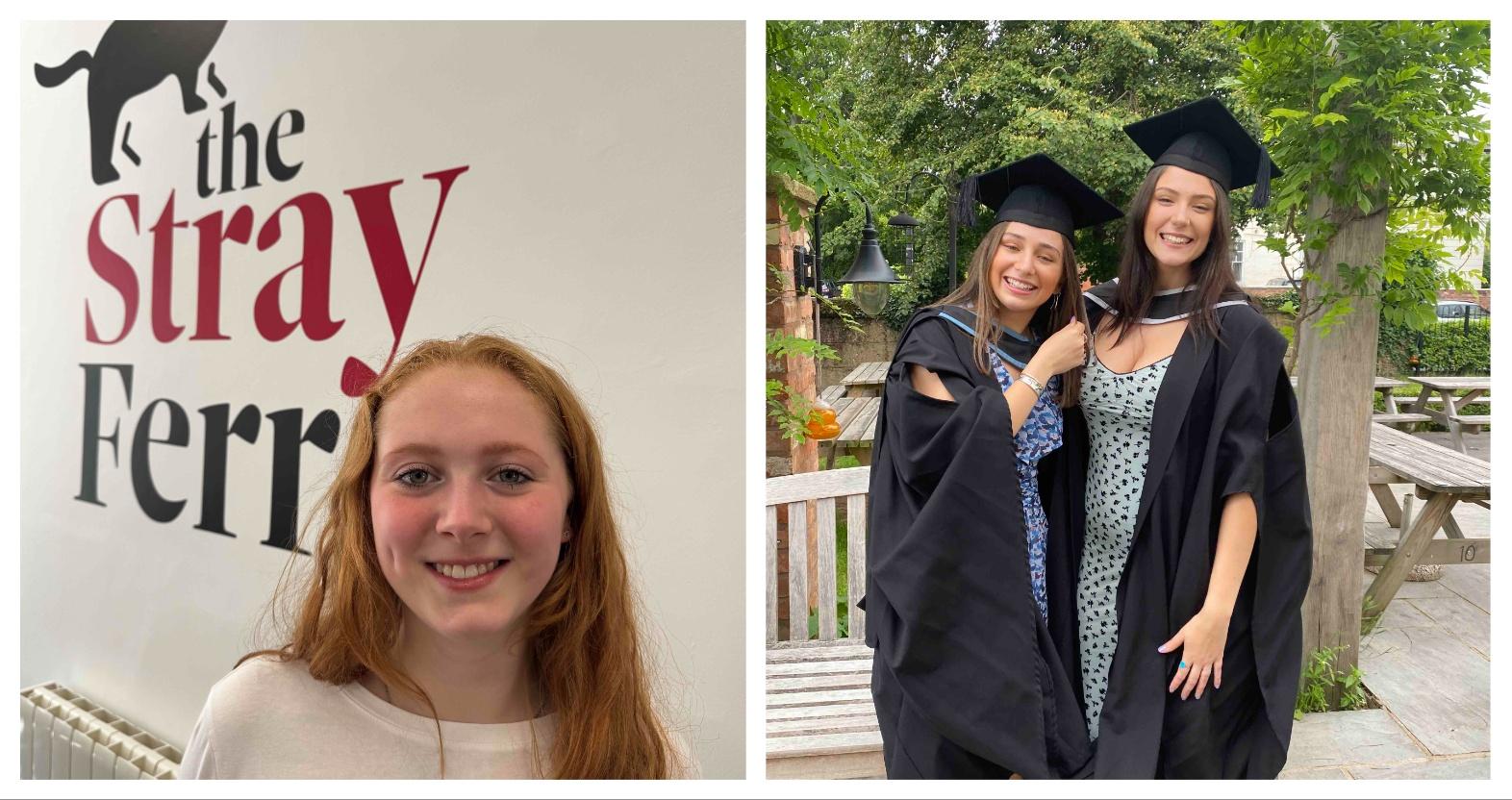
Students Evelyn Skinner, Hana Standen & Daisy Cartwright
What do local employers think?
One employer who believes university is valuable is Adam Cadman, the director of product development for Data, at a York-based multinational compliance company:
Having a degree in these areas is still a strong start but not essential […]it tends to show you are technically proficient and dependable.
I still think university holds value, not only in the degree that is being taught but in the social interaction, relationships and independence that it brings too.
However, Helen Buchan, a regional people partner at Marks and Spencer, says that she feels it is more important to have ‘work experience plus key skills for example, the ability to engage with people, good planning and organising skills and the ability to lead others.’
Another factor to consider is the role of AI, with the risks of replacing graduate jobs. However not everything can be replaced by AI in the workplace.
Adam Cadman says ‘It’s key to have a human in the loop at all stages, as AI is not to be fully trusted.’
Similarly, Helen Buchan says ‘the ability to talk to people and give great service to customers will always be required, this cannot be done by AI.’
What do I think?
I have spent the week compiling this report for the Stray Ferret for work experience. I have been struck by how much my peers are really concerned about the money and the jobs market. A big student loan really does frighten some of the people I interviewed.
What struck me about the employers' responses was that you don't have to have a degree – it's not essential, but there is still value in a degree. There's also value in being human and not an AI learning model!
Olivia Cadman has been with the Stray Ferret this week on a formal work experience placement.
We would like to thank Olivia for her hard work and positive attitude and to thank her school, King James's in Knaresborough.
We are committed to supporting young people who are interested in journalism and to help give them a taste of what life is like in a newsroom.
1