Thank you for your interest in this story
To continue reading this article, subscribe to the Stray Ferret for as little as £1 a week
Already a subscriber? Log in here.
26
Apr
Paying to pee? I know where I’d make cuts... and it wouldn’t be on toilets
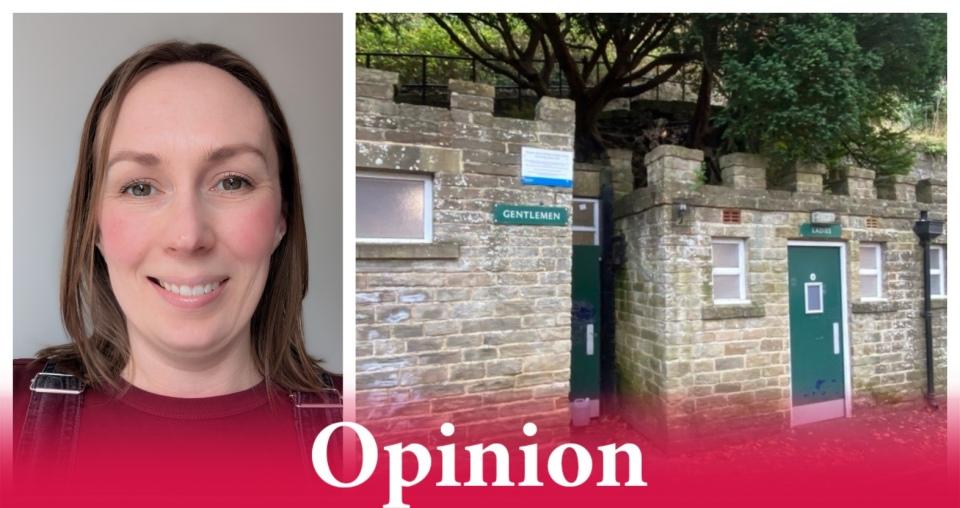
Vicky Carr is a journalist turned writer who grew up in Harrogate and returned in her late 20s to raise her family here. Find her on Instagram @vickycarrwrites.
When did you last use a public toilet in the Harrogate area?
For me, it was last October half term. I was doing the brilliant scarecrow trail around Knaresborough with my family, and before we headed home we stopped off at Conyngham Hall.
You might think it weird that I can pinpoint the exact time and place, but it was the kind of experience that stays with you – and not in a good way.
The building was dark and uninviting, with broken tiles, peeling paint and missing locks. The toilets and sinks had seen far better days and the whole place smelled like – well, like an old, dirty toilet.
Sady, it wasn’t untypical of the few public toilets across the district, in my experience. For an area which relies heavily on tourism, our limited facilities have been letting the side down badly for years.
It seems we’re not alone. Research by the Royal Society for Public Health has found that the number of public toilets in England has declined by 14% over the last decade. This has a disproportionate impact on older people, those with disabilities and medical conditions, families with small children, and women.
The research shows there’s a societal impact, too: an increase in public urination, alongside a decline in footfall in our town centres as people avoid going out if they may not be able to access a toilet when they need to.
Fear not, though: North Yorkshire Council has the solution. It’s introducing a charge of 40p to use public toilets across the county, to cover the cost of running them.
They’ll get an upgrade, which is very welcome news, and the income will be used to help maintain them.
My first thought on hearing this news was that it’s not necessarily a bad thing. When we went to London over Easter, we paid £1 each to use the toilets in the busiest spots and they were in great condition: spotlessly clean, fully stocked with toilet paper and soap, and even a paid cleaner on hand all day.
At 40p, the charge in North Yorkshire will be lower – though for some, even in Harrogate, this could be prohibitively expensive.
But beyond the immediate issue of providing decent toilets for the public to use, there is a more fundamental question here which seems to underpin many decisions made by North Yorkshire Council, and by its predecessors, Harrogate Borough Council and the old county council.
The authority says it lost around £260,000 through providing public toilets in the last financial year. Interestingly, the cost of this per head of population is almost exactly 40p.
We’ve heard similar arguments about a number of services ranging from libraries almost 20 years ago, through garden waste collections a decade ago, to school transport more recently. These services, councils said, cost too much money, and needed to be cut back, run by volunteers, or generate income from people using them.
For each of these, there was a good argument. Why should taxpayers cover the cost of sending children to a school of their choice, rather than their closest school? Why should the council fund garden waste bins for some, when others have no need of them? Why should staff be employed to run small, quiet libraries, when members of the community can do a good enough job without pay?
I get it. Budgets are increasingly tight and local authority funding hasn’t kept pace with the growing cost of – well, everything.
But at the heart of this is the assumption that councils exist not to serve us, but to make money. Services must pay for themselves, otherwise they’re not worth having.
It’s striking that, while the council is insisting we must all pay our pennies to pee because otherwise it loses money, it has no such concerns about pumping further money into its ailing housing development company, Brierley Homes.
In August, the company reported a £3.2 million loss; just last month, the council agreed to throw another £300k its way, on the back of £400k in January.
It’s hard to square those sums against the council’s new 40p to pee charge – a literal drop in the toilet compared with the sums being splashed out elsewhere.
Fundamentally, councils are not businesses, and nor should they be. They shouldn’t exist to make profit (which is lucky, because they’re usually absolutely terrible at it).
Rather, they have the responsibility of spending public money – our money – on services we collectively value. And value should not just be financial.
We choose which services offer value to our communities based not just on what they offer to us, but what the consequences would be if we weren’t to have them. Fly tipping, public health hazards, reduced income for local businesses, social isolation… the list goes on.
As a taxpayer, I’m more than happy for my taxes to be spent on providing decent toilets for everyone to use when they need to, without having to cough up on the spot. And if the council can’t balance the books on this and other services, shouldn’t we taxpayers have some say in which should be prioritised?
Because I know where I’d make the first cut, and it wouldn’t be on the public toilets.
Do you agree with Vicky? Please give us your thoughts in the Comments Section below. We want to hear from you.

7