Thank you for your interest in this story
To continue reading this article, subscribe to the Stray Ferret for as little as £1 a week
Already a subscriber? Log in here.
20
Jun
When Harrogate flirted with Oswald Mosley’s fascists in the 1930s
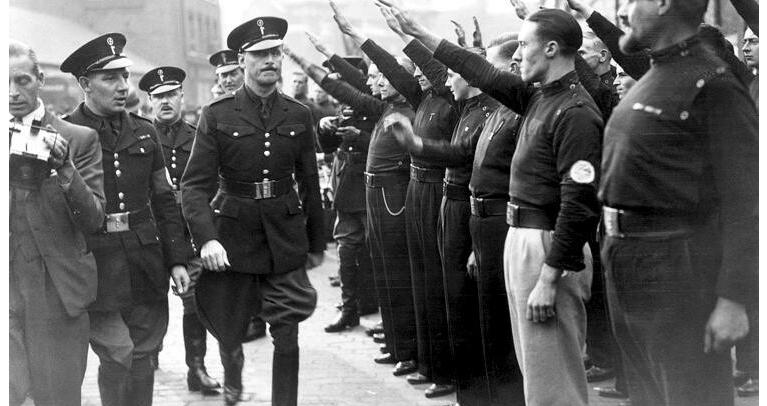
In May 1934, a squad of fascists wearing blackshirt uniforms marched down Parliament Street, crossed the road, turned sharply and entered the Royal Spa Rooms.
A favourably written newspaper report from the time described this dark march through Harrogate as a “spectacular preliminary” to the meeting. Attendees stood for the national anthem and gave fascist salutes in a room adorned with Union Jack flags.
It doesn’t exactly fit with the respectable image that Harrogate carefully manicures like the flower beds on the Prince of Wales roundabout.
While it would be an exaggeration to suggest the town turned fascist in the 1930s, there was support in Harrogate for Oswald Mosley’s notorious British Union of Fascists (BUF) political party, which gained traction alongside the Nazis in Germany and Mussolini’s PNF in Italy. Fascists were welcomed into Harrogate’s most prestigious locations for several well-attended rallies.
Business at the 1934 meeting predictably involved antisemitism. Fascist propaganda officer Vincent Collier declared at the spa rooms (a now-demolished building that was next to the Royal Hall, on the site of the Harrogate Convention Centre today) that an “alien band of financiers held the City of London in an octopus grip”.
The fascists' modus operandi was to rage at perceived threats. These included immigrants, Jews, unions, communists – and Labour and Conservative politicians – who they portrayed as traitors to the British people. Collier told the audience in Harrogate:
We should think of our own nation first before others.
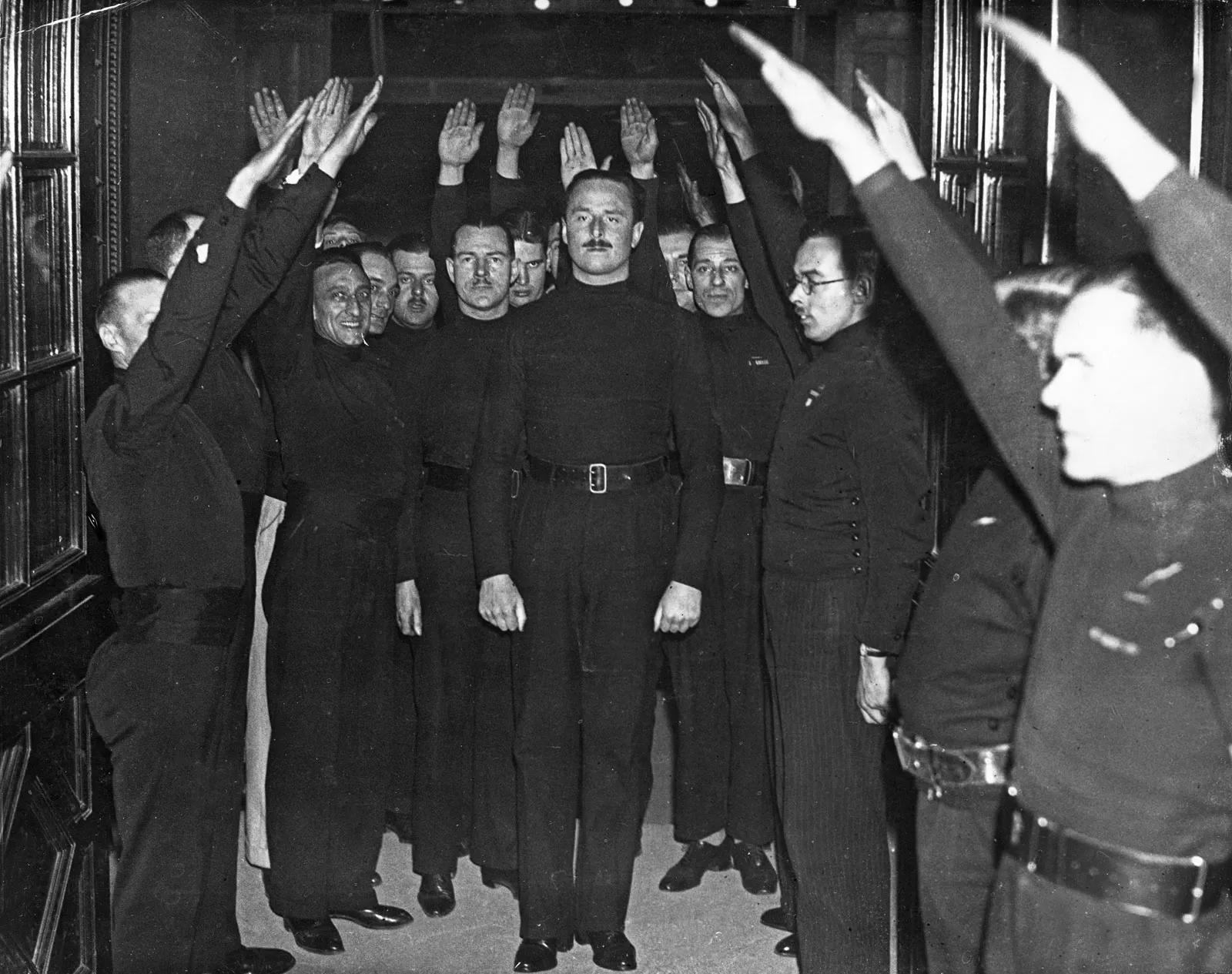
Oswald Mosley and fascists in Bristol
Less bad than jazz
Before the BUF, proto-fascist groups formed in the 1920s, including the British Fascists, which opened a Harrogate branch in 1924.
They held regular meetings here and organised dances at the Prospect Hotel (now The Yorkshire). One feature of the group was that all of its members must be born in Britain.
The BUF launched in 1932. They had an office on Station Parade and Mosley himself was no stranger to the town.
Councillor Samuel Cartwright was a prominent Harrogate town councillor in the 1930s. He complained that the council had initially banned the fascists from holding a rally at the Royal Hall and gave this curious reason. He told a meeting:
I want to ask why the fascists were refused when jazz music has been allowed in variety concerts on Sunday nights. I think it is a great mistake.
However, the BUF would eventually be allowed to hold their notorious blackshirt rallies at the venue. Mosley spoke at at least two of them, in 1935 and 1937.
Mosley, who had been both a Conservative and Labour MP during the 1910s and 1920s, spoke to a crowded audience at the Royal Hall in 1935 and promised to deport “anti-British” Jews from the country if he won power. He claimed the Jewish population in the UK had used “their money, their power, their press” to stifle fascism, which the Harrogate audience lapped up with “a storm of applause”.
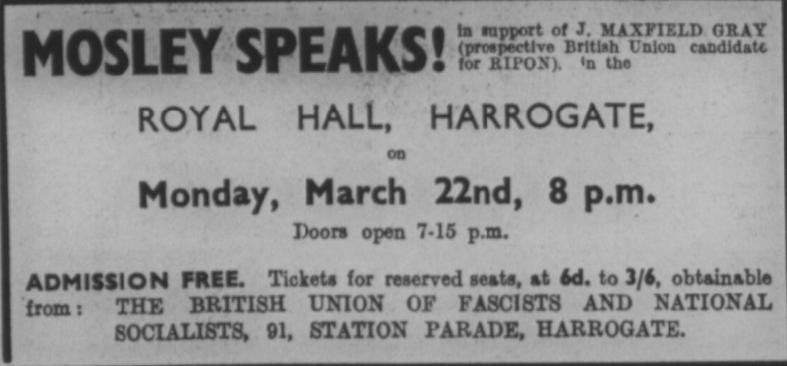
Oswald Mosley Harrogate Royal Hall advert from 1937
The tide turns
As World War II approached, the popularity of the BUF was waning. The government banned the blackshirt uniform and many people felt Mosley was too closely associated with Hitler. Others were put off by their fights with police and protesters.
Historian Martin Pugh’s excellent book on the movement Hurrah for the Blackshirts, also said the BUF were outflanked by rival fascist parties, splitting their appeal.
In 1936, the infamous Battle of Holbeck Moor took place in Leeds. There were violent clashes between antifascists and the BUF, which had provocatively marched through the Jewish areas of Holbeck.
Around 2,000 fascists attended, including BUF members from Harrogate. A woman called Judy Whitham from Harrogate is listed as being hospitalised during the melée.
Sydney Allen was a poultry farmer from Harrogate who is described in Pugh’s book as “an agent of Hitler”. He stood for the BUF in a north Leeds by-election in 1940. But he failed miserably and won less than 3% of the vote, losing his deposit.
The BUF was banned later that year and Mosley spent three years in prison during the war as he was deemed a threat to Britain’s security.
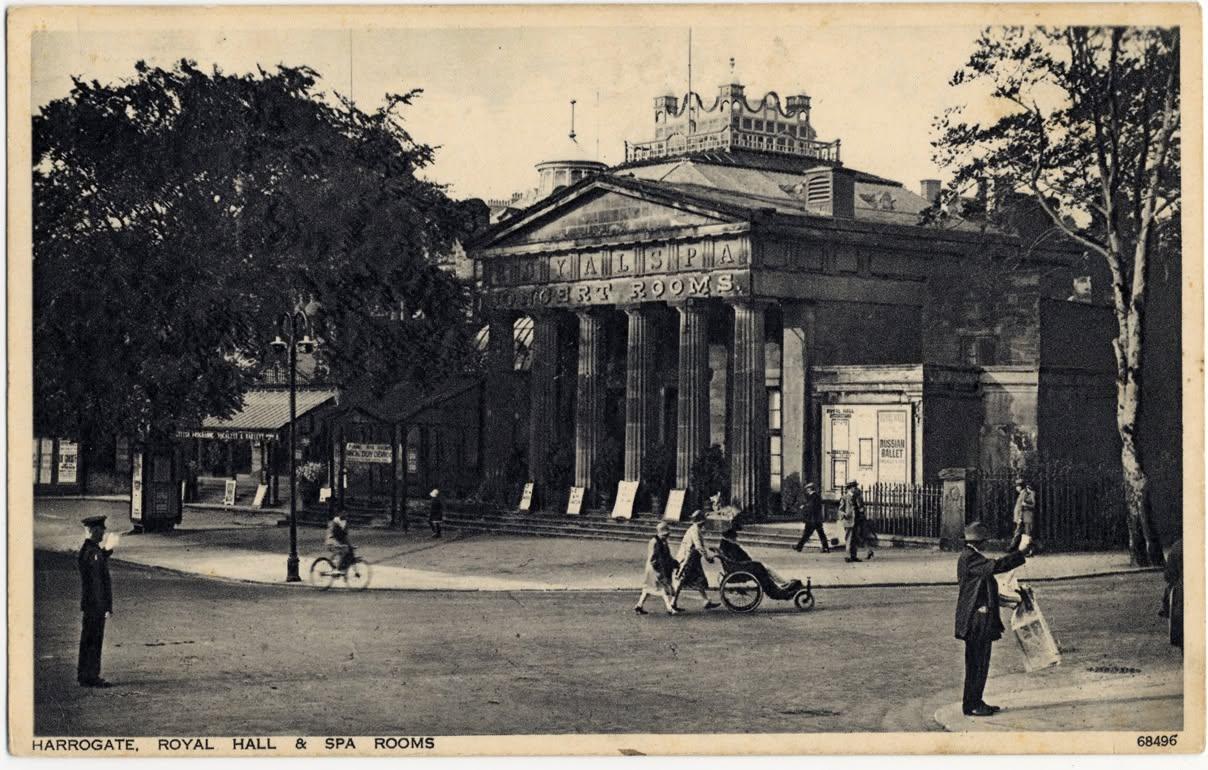
A postcard showing the Royal Spa Rooms during the 1920s.
Warnings of history
Following the appalling attempted murder in Belfast this month, protests were promoted on social media across the UK by Elon Musk and far-right agitators like Tommy Robinson.
The Stray Ferret received a letter from one local resident who was shocked that one of the locations listed for a protest was the Stray.
It appears nobody actually attended but the concerned resident wrote:
They attempt to incite such a horrendous prospect on the Stray. The Stray! Almost a sacred space for all Harrogatonians.
It’s a perfectly reasonable position to take. However, I have found a newspaper article from 1938 reporting that the council permitted Mosley’s BUF to hold at least one rally on the West Park Stray, where loudspeakers were used to deliver their hateful messages.
Residents in Harrogate are sometimes comforted by the assumption that we live in a town unruffled by political extremes. But the town’s flirtation with fascism in the 1930s shows that believing it couldn’t happen here is naive.
Thomas Barrett is a journalist with a keen interest in history. Thomas also writes about the unusual, weird or forgotten stories of Leeds in his email newsletter, Bury the Leeds. You can read or sign up free of charge at https://burytheleeds.substack.com/

5