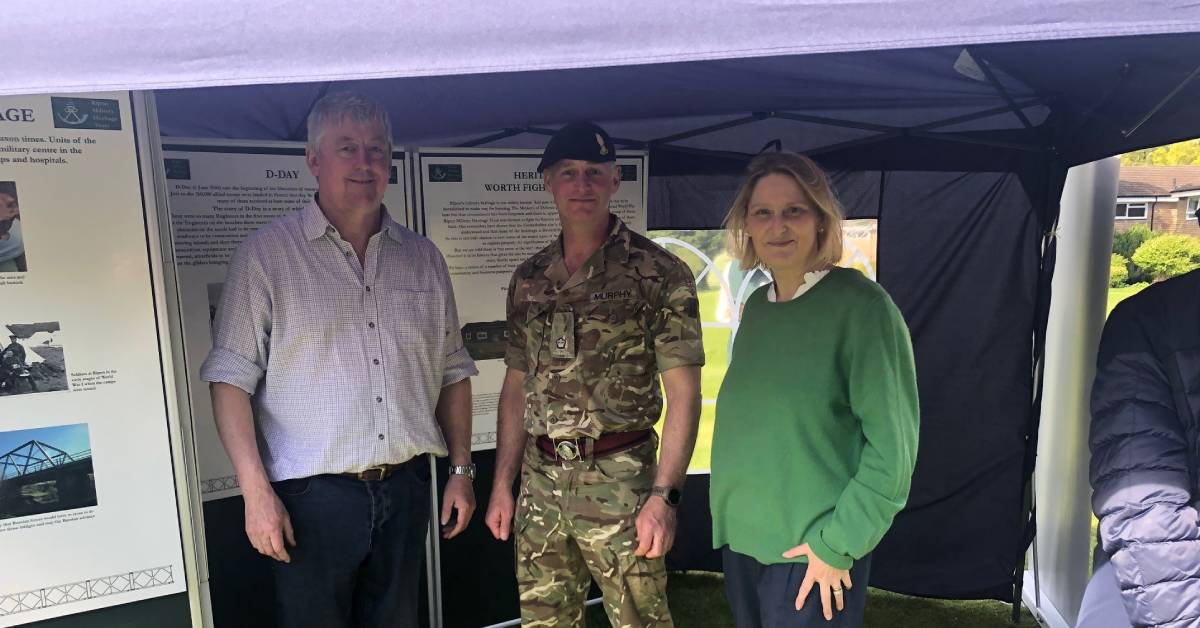
Retired Royal Engineers join fight to save Ripon’s military heritageRipon campaigners prepare for post D-Day battle with the bulldozers
Planning update
Last week, the government agencies Homes England and the Defence Infrastructure Organisation provided an update on the Clotherholme proposals in a planning report published on North Yorkshire Council’s website.
The report pledged to “work with the Ripon Military Heritage Trust on a heritage strategy which will balance the urgent need for new homes for local people with a strategy for preserving and recording the unique history and heritage of the barracks”.
The trust’s continuing concerns
But the trust, which has launched a website as part of a campaign to preserve key aspects of the site, believes the agencies have shown little desire to co-operate since Harrogate Borough Council granted planning permission in February last year and their pledges remain vague and opaque.
Trust chairman Guy Wilson said:
“We are hugely disappointed that after 15 months of engagement with Homes England, the current outline planning application lacks any provision for the preservation of even a single example of the rare and unique huts at Deverell Barracks.
“Neither has any land been allocated to allow for the relocation and re-use of these heritage assets. Both were specific requests that the Harrogate Borough Council planning committee called for in February 2023.
“It has sadly become apparent that none of the parties to this development has any real interest in preserving the heritage of the site and none has made any attempt to work constructively with us. All they are interested in is appearing to do enough to get their present plans passed without alteration, in which case the result will be that significant heritage assets will be lost and this we very much regret.”
The planning update said the housing scheme will preserve the main military roads and names as well as provide information signs
Trustee Michael Furse told the Stray Ferret:
“The city has a rich and deep military history and has enjoyed a long and close relationship with the Royal Engineers.
“We and many Ripon residents strongly believe that the important heritage assets at the barracks site are worth fighting for.”
Main image: Field-Marshal Montgomery recognised the important role that Ripon’s Royal Engineers played in the installation of Bailey Bridges, such as this one in Italy. Picture Wikipedia
Read more:
Priceless military heritage to be protected at Ripon development siteFears that priceless elements of Ripon’s rich military heritage could be flattened to make way for the 1,300-home Clotherholme scheme have been allayed.
Jane Furse, a trustee of the Ripon Military Heritage Trust, which has plans to create heritage trails on the development site, told the Stray Ferret:
“We were concerned that some extremely rare huts on the Deverell Barracks part of the site, and other historically important structures, would be demolished, but I’m relieved to say that this will not be the case.
“These huts are among the few surviving of their kind in the UK and help to tell the story of the vital national and international role that Ripon’s Royal Engineers played in just about every aspect of World War II and subsequent conflicts.
“This included training British and allied troops in the erection and use of Bailey Bridges in theatres of war such as Sicily and France and bomb disposal, that saved the lives of civilians and military personnel around the world.”
Minutes of Harrogate Borough Council’s February 23 planning meeting at which Homes England was seeking outline approval to progress development of the huge Clotherholme scheme, confirm that the huts and other structures will have protection.
Under the provisions of a Section 106 agreement the developer is required to put in place a strategy to ‘secure military heritage within the site.’

Jane Furse of Ripon Military Heritage Trust pictured at the barracks site
The planning meeting minutes also say:
“Prior to the commencement of works to each phase of development, a record (including photographs, drawings and summary of historic analysis) shall be made of a representative selection of buildings with military heritage on site and shall be submitted to and approved in writing by the local planning authority. Copies of this record shall be placed on the North Yorkshire Historic Environment Record.”
Ms Furse, an architectural historian and former inspector of historic buildings with English Heritage (now Historic England) pointed out:
“Inclusion within the S 106 agreement means that the significance of military heritage assets at the site has been formally recognised and that is very welcome news.
“It means that we can go forward, in liaison with Homes England and other parties, to progress plans for military heritage trails at Clotherholme that alongside other heritage attractions, will add to the city’s development as a tourist destination.”
Bomb disposal and the American connection
The wooden huts at Deverell Barracks are of heritage importance, because they are identical to ones that were located at the nearby Harper Barracks which became the home of the Royal Engineers’ School of Bomb Disposal in 1941.
Setting up of the national school in Ripon, soon saw Royal Engineers based in the city providing vital training and passing on know-how to the Americans, in the wake of Japan’s attack on Pearl Harbour, the USA naval base.
Ms Furse said:
“The Royal Engineers sought out examples of every known enemy bomb and developed countermeasures to defuse them. The School developed a rigorous training programme in bomb identification and disposal methodology.
“The Americans, although aware of the threat of unexploded bombs, had no proper procedures for safe disposal and the aftermath of the bombing of Pearl Harbour on December 7 1941, meant that for the first time, they were faced with unexploded bombs scattered throughout their bases and the harbour.
“On December 9, the British Military Attache’s office in Washington received a request for a joint personnel exchange – an early example of the ‘special relationship’ between ourselves and the USA.
“A group of eight hand-picked American soldiers headed by Major Thomas J Kane, travelled to Ripon to train with the Engineers, arriving on February 1 1942.
“After six weeks of attending lectures and demonstrations, all of the U.S. Army ordnancemen passed the course and were made honorary Royal Engineers – they were even given official RE patches and allowed to wear them on the sleeves of their American uniforms.”
The expertise gained from the Royal Engineers in Ripon subsequently saw Major Kane set up the USA’s first Bomb Disposal School in Maryland.
Read more:
Ripon councillors consider judicial review on 1,300-home Clotherholme plan
Ripon City Council is to take legal advice on the merits of seeking a judicial review of Harrogate Borough Council’s handling of the 1,300-home Clotherholme planning application.
The Homes England development on Ministry of Defence land at Claro Barracks, Deverell Barracks and Laver Banks was granted outline approval on February 23 on the casting vote of planning committee chair and Conservative councillor Rebecca Burnett.
This came after votes were tied at six for and six against supporting a recommendation to defer the plans to officers for approval subject to conditions.
At the planning meeting no reference was made by officers to a traffic assessment commissioned by Ripon City Council in 2020, because of fears that additional vehicle movements generated by the barracks scheme would cause permanent gridlock across Ripon.
A subsequent report from the consultant, who carried out the assessment, contained recommendations on a range of mitigation measures that could be taken at key junctions and traffic hotspots to reduce pressure on Ripon’s roads.
In the light of the report, the city council called on Homes England to reduce the number of houses in the development to an initial 800, with the option to seek approval for a further 500 once the traffic impact of the first phase of the scheme had been assessed.
At Monday night’s full Ripon City Council meeting, Independent council leader Andrew Williams said:
“It is clear that our traffic survey and the correspondence that we had with Harrogate Borough Council planners was totally ignored.
“They have ridden roughshod over the wishes of people living in the city, leaving them with a potential problem to deal with for years to come.”
Ripon Liberal Democrat county and city councillor Barbara Brodigan told the meeting:
“I attended the planning committee to speak on behalf of the Ripon Spa Residents Action Group about the concerns we have about traffic, but it appeared to me that this was a done deal.
“The city council’s own traffic assessment wasn’t even raised by officers.”
City councillors unanimously supported a proposal put by Cllr Williams and seconded by Cllr Brodigan, to take initial legal advice on the merits of seeking a judicial review of Harrogate Borough Council’s handling of the planning application.
At the February 23 planning meeting, David Rowlinson, speaking on behalf of Homes England, said:
“We’re not new to this site, we’ve been working on it for five years. We’ve looked at this very thoroughly and worked with North Yorkshire County Council’s highways department to get their on-the-ground views.
“We feel we’ve robustly assessed the impacts and come up with the best solution possible for Ripon.
“North Yorkshire County Council has confirmed there is no defensible reason to refuse the application on highways and transport grounds.”
Read more: