Will the crucial role of Ripon’s Royal Engineers in the D-Day landings on the beaches of Normandy be lost in the sands of time?
As the 80th anniversary of this key event in world history fast approaches and features in media coverage across the globe, Ripon Military Heritage Trust is facing a battle with the bulldozers on the home front.
The Ripon barracks site, which is due to be vacated by 21 Engineer Regiment of the Royal Engineers in two years to make way for the 1,300-home Clotherholme development, is a time capsule that helps to tell the story of world war and cold war invention, ingenuity and innovation.
The area uniquely links priceless relics of the 1914-1918 and 1939-1945 conflicts that are of major historical importance.
Heritage assets currently located there include extremely rare accommodation huts built in 1939, along with bridges and structures, such as a concrete weir constructed on the River Laver to turn the turbines of a power station serving a huge World War One army camp.

The battle cry of Ripon Military Heritage Trust can be seen in a banner hanging high above High Skellgate
In the wake of the Japanese aerial bombardment of the USA fleet at Pearl Harbour in December 1941, the Americans came to Ripon to learn from the Royal Engineers how to deal with unexploded ordnance.
It was a Trans-Atlantic training arrangement and helping-hand from across the sea, that emphasised the growing ‘special relationship’ between the two countries.
Ripon was also the base where allied military personnel from the USA, Canada and Europe, were trained in the methods of installing Bailey Bridges.
Ripon’s role recognised by top military figures
The importance of this then revolutionary, new bridging system was highlighted in a letter to the Royal Engineers from Field-Marshal Montgomery who wrote:
Planning update
Last week, the government agencies Homes England and the Defence Infrastructure Organisation provided an update on the Clotherholme proposals in a planning report published on North Yorkshire Council’s website.
The report pledged to “work with the Ripon Military Heritage Trust on a heritage strategy which will balance the urgent need for new homes for local people with a strategy for preserving and recording the unique history and heritage of the barracks”.
The trust’s continuing concerns
But the trust, which has launched a website as part of a campaign to preserve key aspects of the site, believes the agencies have shown little desire to co-operate since Harrogate Borough Council granted planning permission in February last year and their pledges remain vague and opaque.
Trust chairman Guy Wilson said:
“We are hugely disappointed that after 15 months of engagement with Homes England, the current outline planning application lacks any provision for the preservation of even a single example of the rare and unique huts at Deverell Barracks.
“Neither has any land been allocated to allow for the relocation and re-use of these heritage assets. Both were specific requests that the Harrogate Borough Council planning committee called for in February 2023.
“It has sadly become apparent that none of the parties to this development has any real interest in preserving the heritage of the site and none has made any attempt to work constructively with us. All they are interested in is appearing to do enough to get their present plans passed without alteration, in which case the result will be that significant heritage assets will be lost and this we very much regret.”
The planning update said the housing scheme will preserve the main military roads and names as well as provide information signs
Trust display
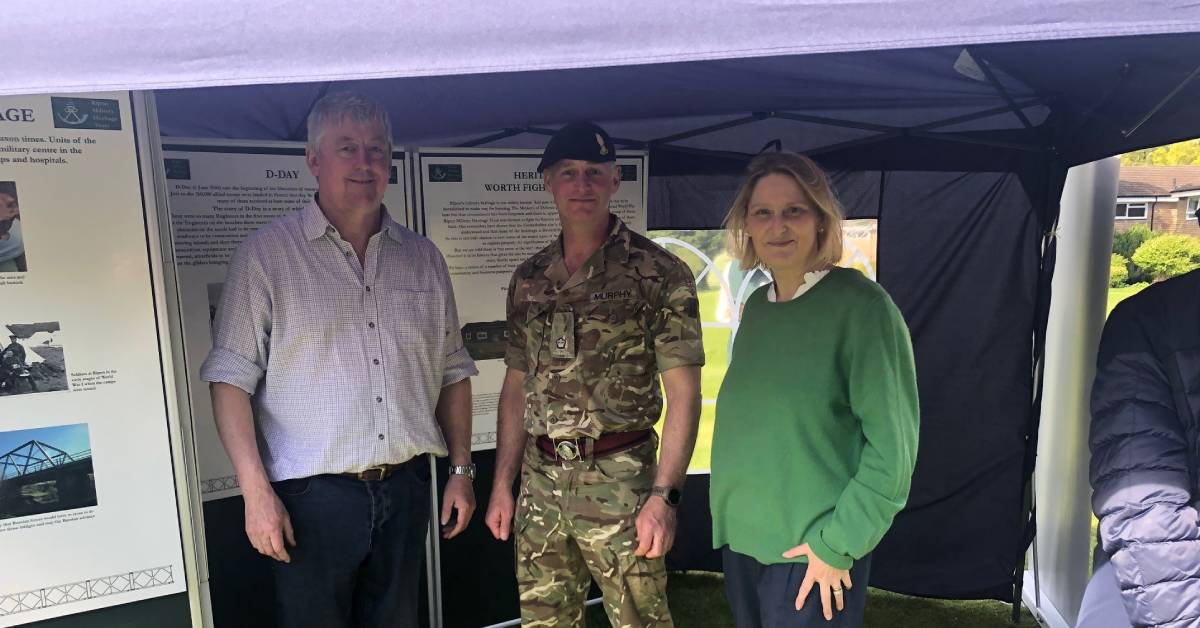
Trustees Michael and Jane Furse of Ripon Military Heritage Trust, showed Major Daryl Murphy, the second-in-command of Ripon’s Royal Engineers the newly-created display.
Trustee Michael Furse told the Stray Ferret:
“The city has a rich and deep military history and has enjoyed a long and close relationship with the Royal Engineers.
“We and many Ripon residents strongly believe that the important heritage assets at the barracks site are worth fighting for.”
Main image: Field-Marshal Montgomery recognised the important role that Ripon’s Royal Engineers played in the installation of Bailey Bridges, such as this one in Italy. Picture Wikipedia
Read more:
- The countdown is on for Ripon’s D-Day anniversary event
- Rallying call from Ripon Military Heritage Trust

‘Heritage Worth Fighting For’ is the battlecry of Ripon Military Heritage Trust, as it steps up its campaign to save priceless elements of the city’s world war history from the bulldozer.
The trust, which was established last year, has created a website to raise awareness of its work and attract support from the public and interested parties locally, nationally and internationally.
The heritage items that they are fighting to save include buildings, bridges and other structures that help to tell the story of the strategic role that Ripon played in two world wars and other conflicts.
Each of the heritage assets are located on the Ripon barracks site, where the 1,300-home Clotherholme development led by Homes England – the government’s housing and regeneration agency – is due to begin in 2026, when the Royal Engineers vacate the base that has been their home for decades.

Guy Wilson (fourth from left) is pictured with fellow trustees Lt Col (Retd) Bob Lisle, Jane Furse, Stuart Martin and Michael Furse. Picture RMHT
Chairman of trustees Guy Wilson is, along with fellow trustees, using the website to make a passionate rallying call.
Mr Wilson, who was previously responsible for bringing the Royal Armouries Museum to Leeds in 1988, told the Stray Ferret:
“We need help and support from the public in a number of ways. Most urgent is our need to wake up those in positions of power and influence to the importance of saving Ripon’s unique World War Two heritage.
“Currently the landowners — the Ministry of Defence — and the local planners have taken a Pontius Pilate attitude and washed their hands of any active involvement leaving the trust to deal on its own with the developers — Homes England — who have so far refused to contemplate any change from the submitted development plans.
“If this situation continues the heritage will be lost. Instead ,we need positive engagement and with that we believe that a group of barrack buildings can be saved in a way which would benefit both Ripon and the proposed development.
Mr Wilson added:
“If people want to help they should get in touch with us via our website and be prepared to write letters to their MP, to the planning authority, to the Ministry of Defence and to any relevant contacts they may have. There is also talk locally of organising petitions and other direct actions to show support for the heritage and we expect more to develop on this front soon.”
D-Day for decision makers
Mr Wilson said the forthcoming 80th anniversary of D-Day on June 6 presented an opportunity to make the case to a wider audience because of the link between the threatened heritage in Ripon and the success of D-Day.
He added:
“We hope to encourage debate both locally and nationally about the mismatch between the occasional official rhetoric about the debt we owe to the ‘finest hour’ generation and the stark reality of official indifference to the fate of highly significant historic assets that remain to us from that period.
“So we will be encouraging all parts of the news and media world to get involved and to cover the story, we’ll be writing letters to newspapers and journals ourselves, and we’ll be reporting on our success, or lack of it , in seeking the engagement of all relevant parties in a proper and constructive process to save Ripon’s military heritage.”
The Royal Engineers’ vital role in the Second World War
During the Second World War, the School of Military Engineering was relocated from Chatham to Ripon. With it came the ancillary training establishments which taught critical skills such as bomb disposal and anti-tank warfare.
Combat engineers, both British and allied, were trained at Ripon in such skills as bridging and mine clearance. US Army Engineers came to the city after Pearl Harbour to learn how to defuse unexploded bombs and then a US section of the School of Military Engineering was established in Ripon so allied forces could be taught the same things.
On D-Day, some 25% of the troops that landed in Normandy were engineers, far more than normal for combat, but essential as the engineers had so much to do to get the troops safely ashore and moving inland.

British and allied forces were taught in Ripon how to install Bailey Bridges, such as this one in Imola, Italy, which is being crossed by a Sherman Firefly tank. Picture: Wikipedia
Mr Wilson said:
“Not all of them were trained in Ripon but what happened in Ripon influenced every one of them. And there is still much we do not understand and need to find out. For instance, there was an organisation called the Experimental Anti-Tank Establishment.
“We know it was testing anti-tank mines at Ripon. And in a lecture given in December1945 Major General Inglis noted that in 1942 “a number of curious devices such as snakes, flails, rollers and ploughs were being developed by the Anti-Tank Experimental Establishment. This suggests that the Experimental Anti-Tank Establishment and thus Ripon may have had a hand in the early development of what became known as ‘Hobart’s funnies’, those altered ‘engineer’ tanks which proved their worth on and after D-Day.”
Funding for the trust’s work
Mr Wilson added:
“Currently the trust is looking to raise only sufficient money to fund our continuing public relations campaign. A modest £5,000 will see us through this year. Beyond that we cannot start any campaign until we know what we are allowed to do.
“The what and where and how has to be agreed before we can cost any project and start fund-raising for it. And currently no one will properly engage with us to produce the first, essential requirement – a thorough assessment of the significance of the Ripon site and its surviving heritage assets.
“We are, therefore, stuck at the starting post and the danger is that, suddenly the development plans will be passed and demolition will begin before we have had tine to develop a proper scheme to save what is most important.”
Support from Ripon City Council
The leader of Ripon City Council, Councillor Andrew Williams, said:
“We are unanimous in our support for all that the trust is doing and fellow North Yorkshire councillor Barbara Brodigan and I have attended a number of meetings that the trust has held with Homes England, to make the city’s feelings known.”
He added:
“The military heritage within the barracks site must be maintained. It not only belongs to the people of Ripon, but to the nation and is a unique reminder of the part that our Royal Engineers played in fighting for our freedom and the liberation of Europe.
“As well as being a means of educating future generations about the horrors of war, the assets on the barracks site are part of Ripon’s wider heritage dating back 1,351 years to the establishment by Wilfrid of the cathedral and can play an important role in our development as a destination for heritage-based tourism.”
What Homes England says
In a previous statement Homes England, said:
“We remain committed to delivering a military heritage strategy as part of our wider proposals for the site and continue to discuss options with the local planning authority and the Ripon Military Heritage Trust.”
The government housebuilding agency added:
- Details for the heritage strategy, its funding, and potential use of the existing military structures continue to be fine-tuned as part of the planning application process.
- As part of ongoing discussions with North Yorkshire Council, Homes England and The Defence Infrastructure Organisation have committed to spending £100.000 towards the progression of the submitted heritage strategy. The council has asked Homes England / the DIO to continue engagement with Ripon Military Heritage Trust over the submitted heritage strategy and a number of options are now being explored as part of those discussions.
Read more:
- Trust fights to save Ripon’s priceless military heritage
- Ripon volunteers prepare for D-Day anniversary

With the clock ticking down to the 80th anniversary of D-Day, an army of Ripon volunteers has spent thousands of hours engaged in a military-style operation as the city prepares for the landmark celebration and commemoration.
On June 6 and in the weeks running up to it, the fruits of their collective labours over an estimated 100,000 hours, will be seen in one of the largest events to be held anywhere in the UK.
The stunning centrepiece, is a life-size model Churchill AVRE tank, recreated with hundreds of thousands of stitches from the non-stop knitters of Ripon Community Poppy Project, working in collaboration with Richard Thomson and Gordon Woods of Ripon’s Men’s Shed, who have built the wooden frame of the mighty model war machine.
It is 24 feet long, nine feet wide and seven feet high and timber valued at £2,500 was donated for its construction by MKM Building Supplies.

Stuart Martin (centre) and Hazel Barker of Ripon Community Poppy Project are pictured with Richard Thomson of Ripon Men’s Shed on board the replica tank before the turret was fitted.
Known for its bunker busting capabilities, the tank has been painstakingly recreated in wool and wood in a hangar at Claro Barracks, where space was made available by the 21 Engineer Regiment.
Richard, a former Royal Electrical and Mechanical Engineer who spent part of his army career based at the barracks, said:
“This type of tank struck terror in the hearts of the enemy when it came into sight, because of the size of shell that it fired and the destruction that it brought to those unfortunate enough to get in its way.”
With transportation being provided free of charge by Ripon Farm Services, the giant replica will be moved to a number of locations in the city, starting with the Ripon Inn on April 30 and culminating on June 6, with placement on the piazza at Ripon Cathedral, where Jack Churchill, the great-grandson of wartime leader Sir Winston, will light an 80th anniversary D-Day beacon at 9.15 pm.
D-Day 80th anniversary concert
Before the beacon is lit a concert will be held in the cathedral at 7pm. It will feature Ripon City Band, The Duchy Bells, The Dishforth Military Wives Choir and Charlotte Potter.
Proceeds will be shared between Ripon Community Poppy Project and Help the Heroes, the armed forces and veterans charity.
Tickets costing £15 are now on sale online from Eventbrite and from Ripon’s Stuff 4 Offices in Fishergate and the Wakeman’s Cafe on Market Place South.

Alwyn Hartley of Ripon Community Poppy Project working on the huge D-Day 80th anniversary display
Ripon and the Royal Engineers
The anniversary of the D Day landings in Normandy that led to the liberation of Europe and, ultimately, the end of World War II, has special significance in Ripon thanks to a long and treasured association with the Royal Engineers, who have had Freedom of the City since 1949.

The Royal Engineers’ annual freedom march through Ripon has taken place since 1949.
The Royal Engineers provided the technical skill and engineering expertise that paved the way to allied victory.
The advance of troops from the beaches of northern France and across Europe was made possible by their construction, among other structures, of Bailey Bridges, using techniques perfected on the training grounds of Ripon barracks.

A Sherman Firefly tank on a Bailey Bridge constructed across the Santerno River river in Italy in April 1945. Picture Wikipedia
The Royal Engineers’ world-leading bomb disposal team in Ripon, which taught the Americans how to deal with unexploded ordnance in the wake of Japan’s attack on Pearl Harbour in December 1941, also proved a fundamental factor in maintaining the military momentum.
Stuart Martin, co-founder with Hazel Barker of the Ripon Community Poppy Project, said:
“The city’s long and deep association with the Royal Engineers makes this year’s commemoration and celebration of D Day extra special.
“By coincidence, this year also sees the 75th anniversary of the Engineers being granted Freedom of the city and the 75th anniversary of 21 Engineer Regiment.”
A military-style operation
The former mayor added:
“In a military-style, meticulously-planned operation that started last year, the Community Poppy Project has asked for and received help from individuals, businesses and organisations across the city and all have given their time, materials, labour and logistical advice free of charge.
“They include Jennyruth Workshops, whose workers have cut materials to size for various displays, Calverts Carpets, which has provided imitation grass for display areas and Tates garden centre which is helping with logistics.
He added:
“It has been a magnificent community-wide project collectively involving almost 100,000 hours of volunteer input and has been made possible because of the generosity of the city’s organisations and businesses.”
Main image: The replica Churchill AVRE tank. Picture Ripon Community Poppy Project.
Read more:
Fitting send-off for Harrogate’s humble D-Day veteran
A bugler from the Royal Marines today marked the final journey of Harrogate’s humble D-Day veteran, who has died at the age of 97.
John Rushton, known as Jack to friends, passed away peacefully at Harrogate District Hospital after a visit from his family on New Year’s Day.
There was a fitting send-off for Mr Rushton today, which began with a procession from his former home on Beech Road to St Robert’s Church for a funeral service.
The procession then headed to Stonefall Crematorium on Wetherby Road where it was met by representatives from the military.
A bugler played The Last Post in front of a packed crown to mark the committal.

Jack on his 96th birthday and during his military service.
Son’s tribute
Dave Rushton, one of John’s four sons, said:
“We are very sad but my dad has left a great legacy and history. We have had so many goodwill messages, which has been an enormous help.
“He fought the illness really hard, he fought right to the end. I want to put on record our thanks to the staff on Wensleydale Ward and at Lister House care home in Ripon.
“I think people will remember him for his character. So many people have told me how much of a character he was, even if he never thought he was a hero.
“We did manage to get in a trip back in 2019 to Normandy to mark the 75th anniversary of D-Day. We had hoped to go again but we certainly ended on a high.
“I already know a lot about his life but since his passing I have learned a lot more about the affection people held him in.”

A buglar played The Last Post for Mr Rushton.
A British Army spokesman said:
“We are indebted to the bravery of Mr Rushton and his comrades. Our thoughts are with Mr Rushton’s family and friends at this difficult time.”
David Houlgate, vice chair of the Knaresborough branch of the Royal British Legion, said:
“What I will say is clearly he was in a sense a true hero of this country. John defended this country and helped to free Europe from tyranny.”

Military Standards for the committal.
The remarkable life of John ‘Jack’ Rushton
Mr Rushton was born on May 24, 1924 in Doncaster, where he was brought up and educated before leaving school to become an apprentice joiner.
he was too young to enlist at the outbreak of World War II so he joined the Home Guard before volunteering for service shortly after his 18th birthday.
On the night of June 5, 1944, he set off from Portsmouth, having been sent in place of another marine who had fallen ill.
The crossing was made in a flat bottomed tank landing craft, and as the weather was poor, he sheltered with a comrade underneath one of the tanks, lying on top of the ammunition.
It was such a rough crossing, he later said he preferred being shot at in France to staying on board.
Arriving on the Normandy beach at 6am on June 6 he proceeded to deploy and arm his unit’s tanks and guns and spent much of the assault without his helmet or rifle as they impeded his tasks.
During that day, he narrowly avoided death three times, including when he ran over an anti-tank mine several times. He often said with a wry smile that only the good die young. He also said that the real heroes are the ones who didn’t return home.

Mr Rushton with his honours.
Having been promoted to sergeant, Jack was then sent to India, travelling by ship and often sleeping on riveted steel decks. On arrival in Bombay his unit was tasked with keeping the peace during the country’s internal struggles, and later training to join the war against Japan further east.
In 1945 he was sent to Malaysia to await deployment to the battlefront, however the atomic bomb spared him the ordeal of another fight.
After the war was over, his unit was sent back to India to quell a naval mutiny. As a result, he didn’t make it home until 1946, when he was demobbed, and returned to Doncaster.
He moved jobs and towns before he settled in 1972 with a final family move to Harrogate College of Further Education.
Jack retired in 1988 and turned to his interests in the local brass bands and the Royal Naval Association. He was widowed in 2012 after almost 61 years of marriage, which produced four children, four grandchildren, and four great-grandchildren.