New details of Ripon’s 1,300-home Clotherholme scheme releasedWork on the 1,300-home Clotherholme scheme in Ripon is expected to begin next year and last until 2037, according to a newly published update.
Land at Claro Barracks, Deverell Barracks and Laver Banks will be bulldozed to make way for the homes, a primary school and a neighbourhood centre with shops, a café and a community space.
Four city-centre junctions will be improved and Clotherholme Road, Kirkby Road, College Road and Trinity Lane will be redesigned to prioritise pedestrian safety and encourage cycling.
Homes England, the public body that funds new affordable housing, and the Defence infrastructure Organisation, which is part of the Ministry of Defence, provided the update in a planning report published on North Yorkshire Council’s website.
Councillors granted planning permission subject to conditions in February last year, shortly before Harrogate Borough Council was abolished. Six councillors voted in favour and six voted against, which meant the committee chair’s casting vote in favour proved decisive.
The new planning report says the barracks scheme will create an “exemplar new sustainable community” on brownfield land on the edge of Ripon. Here are some of the key details.
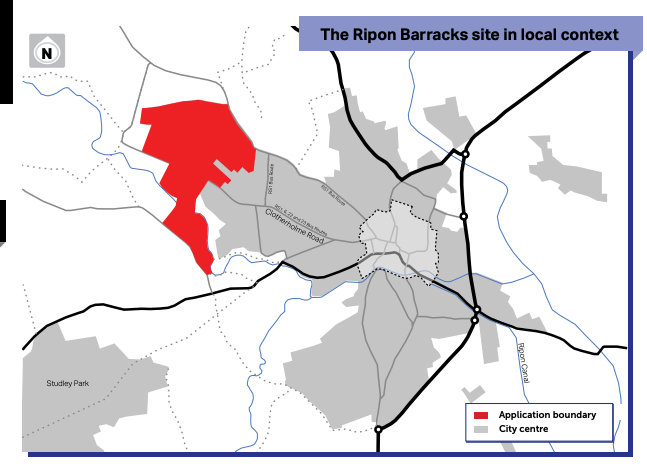
The red section indicates where will be affected.
30% affordable homes and new school
Clotherholme will include 1,300 homes, 30% of which will be classed as affordable. The report said:
“That’s 370 new affordable homes for local people, split between affordable rent and shared ownership
“We’ll also build a new primary school next to a new local neighbourhood centre with shops, a café, employment and training facilities and community space. We’ll provide new improved open space at Laver Banks which will be accessible to the whole community.”
A total of 5% of the site will be dedicated to custom build homes providing up to 60 extra care / assisted living homes.
Developers are obliged to pay to mitigate for the impact of their development on local infrastructure through legally binding contracts negotiated with councils known as section 106 agreements.
The new planning report says the proposals for financial contributions include:
- £2.7m towards a two-form entry primary school, which will be built at the neighbourhood centre in the middle of Clotherholme.
- £1.9m towards the expansion of local secondary education.
- £1.07 million towards improved healthcare buildings and facilities in Ripon.
The report adds:
“We’ll provide traffic-free routes to school across the whole development, which connect into existing walking and cycling routes, and we’ll make sure the school has playing fields too.
“The school will be built and opened early in the development timeline, meaning that families moving to Clotherholme will have school places for their children, and other local schools won’t be put under pressure.”

Major transport schemes in Ripon
The report says there will be “24 separate improvements to the road network agreed with North Yorkshire Council to make sure that Ripon keeps moving”.
They include improvements to four city-centre junctions “before the first home is occupied at Clotherholme”.
The four junction improvements are:
- Traffic flow improvements at the clocktower junction
- Traffic flow improvements at Coltsgate Hill junctions on North Street
- Signalling improvement at Skellgate junction
- Priority changes at Westgate Street/ Blossomgate
The report adds:
“We will install state-of-the-art signal control as part of these upgrades which allow real-time monitoring of traffic build-up and management of the signals to reduce congestion and maximise traffic flow.
“Our proposals also include the provision of a one-way scheme at Kirkby Road (westbound), College Road (eastbound) and Trinity Lane (southbound). Blossomgate, east of Marshall Way, will also become one-way.”
The report says there will be £793,000 towards delivering a phased bus service for Clotherholme over a four-year period, adding:
“We will redesign Clotherholme Road, Kirkby Road, College Road and Trinity Lane to prioritise pedestrian safety and encourage cycling, and we will introduce traffic-calming measures to reduce vehicle speeds. Our package of transport and active travel proposals have already been agreed in principle with North Yorkshire Council.”
12-year timeline

The report says the Ministry of Defence “has confirmed that they are in the process of agreeing a transfer of the land at Ripon barracks to Homes England”, adding:
“Following transfer, the land will be redeveloped by Homes England and partners in phases commencing with Deverell Barracks and moving to Claro and Laver Banks once the army has fully vacated to ensure the growth of a sustainable community.
Indicative phasing plan Indicative phasing Phase 1 2025 – 2029 Phase 2 2028 – 2033 Phase 3 2027 Phase 3 2027 Phase 4 2027 – 2028 Phase 5 2027 and 2029 Phase 6 2028 – 2033 Phase 7 2030 – 2032 Phase 8 2031 – 2037 Phase 9 2029 – 2033 The phasing plan on page 15 shows the order in which we’re intending to develop parcels of land at Ripon Barracks.
A developer partner will be appointed in 2025 and between 50 and 100 homes per year will be built meaning that the full redevelopment will take around 13 to 14 years to complete.
“There will be a series of key milestones throughout redevelopment including the opening up of Laver Banks for public use in 2027, phased provision of the local centre between 2028 and 2033 as well as the new primary school which is due to open in 2028.”

Green space
The report says nearly 50% of Clotherholme will be public green space, which is the equivalent to about 55 football pitches. Of this 39.6 hectares, nearly 7.5 hectares will be playing fields.
The report says Homes England and the Defence Infrastructure Organisation are writing a biodiversity net gain delivery plan “which sets out our approach to habitat preservation and creation of on-site and off-site biodiversity to achieve a target of 10% net gain”.
It adds:
“We will be providing playing fields at the new primary school which could be available for community use too. We’ll separately provide 11 sports pitches as part of Laver Banks improved open space (including a senior and junior football pitch and club house), and are looking to collaborate with local clubs to make sure we’re providing what is needed.
“We will also be paying towards the upkeep of these facilities — all part of the site-wide stewardship strategy we’re producing. We will also provide financial contributions towards the off-site provision of rugby, cricket, hockey and 3G sports pitches, for the benefit of sport in Ripon.”
Read more:
Troops rallied in fight to save Ripon’s priceless military heritage‘Heritage Worth Fighting For’ is the battlecry of Ripon Military Heritage Trust, as it steps up its campaign to save priceless elements of the city’s world war history from the bulldozer.
The trust, which was established last year, has created a website to raise awareness of its work and attract support from the public and interested parties locally, nationally and internationally.
The heritage items that they are fighting to save include buildings, bridges and other structures that help to tell the story of the strategic role that Ripon played in two world wars and other conflicts.
Each of the heritage assets are located on the Ripon barracks site, where the 1,300-home Clotherholme development led by Homes England – the government’s housing and regeneration agency – is due to begin in 2026, when the Royal Engineers vacate the base that has been their home for decades.

Guy Wilson (fourth from left) is pictured with fellow trustees Lt Col (Retd) Bob Lisle, Jane Furse, Stuart Martin and Michael Furse. Picture RMHT
Chairman of trustees Guy Wilson is, along with fellow trustees, using the website to make a passionate rallying call.
Mr Wilson, who was previously responsible for bringing the Royal Armouries Museum to Leeds in 1988, told the Stray Ferret:
“We need help and support from the public in a number of ways. Most urgent is our need to wake up those in positions of power and influence to the importance of saving Ripon’s unique World War Two heritage.
“Currently the landowners — the Ministry of Defence — and the local planners have taken a Pontius Pilate attitude and washed their hands of any active involvement leaving the trust to deal on its own with the developers — Homes England — who have so far refused to contemplate any change from the submitted development plans.
“If this situation continues the heritage will be lost. Instead ,we need positive engagement and with that we believe that a group of barrack buildings can be saved in a way which would benefit both Ripon and the proposed development.
Mr Wilson added:
“If people want to help they should get in touch with us via our website and be prepared to write letters to their MP, to the planning authority, to the Ministry of Defence and to any relevant contacts they may have. There is also talk locally of organising petitions and other direct actions to show support for the heritage and we expect more to develop on this front soon.”
D-Day for decision makers
Mr Wilson said the forthcoming 80th anniversary of D-Day on June 6 presented an opportunity to make the case to a wider audience because of the link between the threatened heritage in Ripon and the success of D-Day.
He added:
“We hope to encourage debate both locally and nationally about the mismatch between the occasional official rhetoric about the debt we owe to the ‘finest hour’ generation and the stark reality of official indifference to the fate of highly significant historic assets that remain to us from that period.
“So we will be encouraging all parts of the news and media world to get involved and to cover the story, we’ll be writing letters to newspapers and journals ourselves, and we’ll be reporting on our success, or lack of it , in seeking the engagement of all relevant parties in a proper and constructive process to save Ripon’s military heritage.”
The Royal Engineers’ vital role in the Second World War
During the Second World War, the School of Military Engineering was relocated from Chatham to Ripon. With it came the ancillary training establishments which taught critical skills such as bomb disposal and anti-tank warfare.
Combat engineers, both British and allied, were trained at Ripon in such skills as bridging and mine clearance. US Army Engineers came to the city after Pearl Harbour to learn how to defuse unexploded bombs and then a US section of the School of Military Engineering was established in Ripon so allied forces could be taught the same things.
On D-Day, some 25% of the troops that landed in Normandy were engineers, far more than normal for combat, but essential as the engineers had so much to do to get the troops safely ashore and moving inland.

British and allied forces were taught in Ripon how to install Bailey Bridges, such as this one in Imola, Italy, which is being crossed by a Sherman Firefly tank. Picture: Wikipedia
Mr Wilson said:
“Not all of them were trained in Ripon but what happened in Ripon influenced every one of them. And there is still much we do not understand and need to find out. For instance, there was an organisation called the Experimental Anti-Tank Establishment.
“We know it was testing anti-tank mines at Ripon. And in a lecture given in December1945 Major General Inglis noted that in 1942 “a number of curious devices such as snakes, flails, rollers and ploughs were being developed by the Anti-Tank Experimental Establishment. This suggests that the Experimental Anti-Tank Establishment and thus Ripon may have had a hand in the early development of what became known as ‘Hobart’s funnies’, those altered ‘engineer’ tanks which proved their worth on and after D-Day.”
Funding for the trust’s work
Mr Wilson added:
“Currently the trust is looking to raise only sufficient money to fund our continuing public relations campaign. A modest £5,000 will see us through this year. Beyond that we cannot start any campaign until we know what we are allowed to do.
“The what and where and how has to be agreed before we can cost any project and start fund-raising for it. And currently no one will properly engage with us to produce the first, essential requirement – a thorough assessment of the significance of the Ripon site and its surviving heritage assets.
“We are, therefore, stuck at the starting post and the danger is that, suddenly the development plans will be passed and demolition will begin before we have had tine to develop a proper scheme to save what is most important.”
Support from Ripon City Council
The leader of Ripon City Council, Councillor Andrew Williams, said:
“We are unanimous in our support for all that the trust is doing and fellow North Yorkshire councillor Barbara Brodigan and I have attended a number of meetings that the trust has held with Homes England, to make the city’s feelings known.”
He added:
“The military heritage within the barracks site must be maintained. It not only belongs to the people of Ripon, but to the nation and is a unique reminder of the part that our Royal Engineers played in fighting for our freedom and the liberation of Europe.
“As well as being a means of educating future generations about the horrors of war, the assets on the barracks site are part of Ripon’s wider heritage dating back 1,351 years to the establishment by Wilfrid of the cathedral and can play an important role in our development as a destination for heritage-based tourism.”
What Homes England says
In a previous statement Homes England, said:
“We remain committed to delivering a military heritage strategy as part of our wider proposals for the site and continue to discuss options with the local planning authority and the Ripon Military Heritage Trust.”
The government housebuilding agency added:
- Details for the heritage strategy, its funding, and potential use of the existing military structures continue to be fine-tuned as part of the planning application process.
- As part of ongoing discussions with North Yorkshire Council, Homes England and The Defence Infrastructure Organisation have committed to spending £100.000 towards the progression of the submitted heritage strategy. The council has asked Homes England / the DIO to continue engagement with Ripon Military Heritage Trust over the submitted heritage strategy and a number of options are now being explored as part of those discussions.
Read more:
Ripon’s military heritage under threat again after U-turnRipon’s priceless military heritage assets are under threat once more after an about-turn from the government’s housing and regeneration agency Homes England.
Ripon played a major role in both world wars and the Cold War. The poet Wilfred Owen was among thousands stationed in the city during the First World War and the Laver Banks site played a pioneering role in military bridges. Further details are available here.
Military and civic organisations campaigned to preserve this heritage when plans were revealed to build 1,300 homes at the city’s barracks, which will be the biggest single residential development in Ripon’s history.
They thought the section 106 agreement agreed with developers when the project was approved last year would do this but Jane Furse (pictured below) a trustee of Ripon Military Heritage Trust, told the Stray Ferret:
“Homes England has said that the military heritage aspects of the barracks site has not been included in the section 106 agreement that they have been drawing up with North Yorkshire planners.
“This comes as a massive disappointment after we have fought so hard to ensure that the extremely rare and historically-important assets currently on the proposed housing development site have the legal protection that would be afforded through the 106 agreement.
“Homes England’s actions fly in the face of a democratic decision made at a Harrogate Borough Council meeting last February, when members agreed that a legally-binding agreement needed to be in place to protect the site’s military heritage.”

Ms Furse added:
“Ripon, as a military city played a crucial role in both world wars and the subsequent cold war period in areas ranging from bomb disposal to the development of Bailey Bridges that were used in many different theatres of war.
“Its Royal Engineers received the Freedom of the City in 1949 in thanks for their worldwide service and it is rather ironic, in a year when we will be marking the 80th anniversary of the D-Day landings, to find ourselves in an uncertain position with regard to the heritage that Ripon has built over decades, and which now could be lost to a housing development
“Our fight goes on and we will be pressing North Yorkshire Council to call on Homes England to carry out the wishes of the councillors who represent Ripon and the wider area.”

This heavy girder bridge over the River Laver on the barracks site was the successor to the Bailey Bridge.
At the Harrogate Borough Council planning meeting in February at which Homes England was effectively given the green light for the 1,300-home development to be known as Clotherholme, councillors agreed a clause, referring to: ‘provision within the s106 to secure a strategy to secure military heritage within the site.’
Without this in place any plans to preserve and promote Ripon’s military history and develop a trail that has potential to attract heritage tourists to the city will remain in doubt.
The Stray Ferret is seeking a response from Homes England.
Main image: Rare huts that were home to Second World War soldiers are among the heritage buildings the trust is trying to preserve. Picture RMHT
Read more:
New Dene Park council houses the most energy efficient in North YorkshireFive new homes in Harrogate are the most energy efficient properties ever developed by North Yorkshire Council, the local authority said today.
The three houses and two flats, which have been built on the site of a former car park in Dene Park, in the Woodfield area of Bilton, have air source heat pumps, solar panels, triple glazing and insulation.
The homes, which were developed for £1 million as part of a council scheme to turn redundant land into social housing, will be let to local people.
The scheme sees the council in-house development team obtain unused land, dilapidated garages and anti-social behaviour hotspots, then build properties and let them as social housing.
The Harrogate homes are the latest in more than 50 to be built on in the former Harrogate and Craven district areas over the last eight years.
The largest house will produce 0.3 tonnes of carbon dioxide a year, compared to an average home creating six tonnes.
Cllr Simon Myers, the council’s Conservative executive member for housing, said:
“This scheme is delivering new social rented affordable homes which make a big difference to the lives and well-being of local families. It is a scheme that has been running in Harrogate and Craven for many years and we hope to expand it across the county.
“Added to that these new homes in Harrogate are the most energy efficient we have developed, reducing fuel and lighting costs for the tenants, making them truly affordable homes.”

Cllr Simon Myers (centre) outside the new Harrogate homes with the council’s assistant director of housing, Andrew Rowe (left) and corporate director for community development, Nic Harne.
Kirsty Birbeck, manager for provider management at government housing agency Homes England, which contributed a £225,000 grant, said:
“As the government’s housing and regeneration agency, increasing the supply of quality affordable homes remains one of our key objectives and we are committed to supporting ambitious housebuilders of all sizes to build those homes and communities.
“This investment through the affordable homes programme does just that, enabling North Yorkshire Council to build five much needed new homes the people of Harrogate can be proud of.”
Read more:
Council to bid for government funding to progress Harrogate social housing schemesNorth Yorkshire Council is set to bid for government funding to progress five social housing schemes in the Harrogate district.
The authority is set to apply for a grant from Homes England to help fund the projects, which include new build houses and conversion of a former Robert Street homeless hostel.
In a report due before senior councillors on Tuesday, council officers said the move would help to meet “huge demand” for social rented housing in Harrogate.
Currently, the council has 2,196 households on its housing waiting list in Harrogate alone.
Vicky Young, the council’s housing policy and strategy officer, said in her report:
“The tenure of the new build units will be social rent.
“There is huge demand for social rented accommodation in the Harrogate locality, with 2,196 households currently registered on the Harrogate waiting list.”
Among the projects in the councils bid include new build homes on Poplar Grove and Gascoigne Crescent in Harrogate, Springfield Drive in Boroughbridge and Kingsway in Huby.
Read more:
Each of the homes are estimated to cost £375,000 to construct.
Meanwhile, the council also estimates that a plan to convert Cavendish House on Harrogate’s Robert Street into six flats would cost £400,000.
The former homeless hostel will be converted into a shared ownership property.
Councillors approved the conversion of the hostel in September. At the time, the council said in a report that the property would help to deliver “much needed affordable housing”.
It said:
“The building has been empty since November 2021. As such, it has a negative impact on residential amenity and increasingly risks attracting anti-social behaviour.
“The development proposals will deliver much needed affordable accommodation in a redundant building and a highly sustainable location, complying full with national and local planning policy guidance.”
The bid to Homes England would help towards 30% of the total cost of the five schemes.
According to the report, the projects would cost £1.9 million to build.
Senior councillors will discuss the bid at a council executive meeting on October 17.
Homes England earmarks £10m for major Ripon housing site contributionsA total of £10 million has been budgeted to cover items in a Section 106 agreement being drawn up by Homes England for the 1,300-home Clotherholme development at the Ripon Barracks site.
The money will fund a number of areas, including off-site highway adjustments and contributions towards primary and secondary education provision and primary healthcare.
In addition, under the legally-binding agreement, the government’s housing and regeneration agency, is required to put a strategy in place to “secure military heritage within the site”.
On Monday, Homes England project manager Martin Wilks and senior planning and enabling manager David Rowlinson, met with city councillors to provide a progress report on the major scheme, that will eventually increase Ripon’s population by 20%.
In February, Harrogate Borough Council planning committee said it was minded to grant planning consent for the Clotherholme scheme and Mr Wilks, pointed out:
“The next stage on the planning process is to present the Section 106 agreement to North Yorkshire Council for approval.”
He added:
“The Section 106 monies have been set at £10 million to cover areas including off-site traffic interventions and contributions to education provision,”
The 21 Regiment of the Royal Engineers is scheduled to vacate the site by March 2026 and enabling works for the homes development will start in 2025.
In the meantime, Homes England is drawing up a sustainable drainage plan for the scheme with Yorkshire Water and working on a design guide for the development with Ripon Civic Society.
Meetings have been held with Ripon Military Heritage Trust regarding the protection and preservation of historically-important buildings and bridges on the site and a further meeting with them is planned for November 7.
Matters raised by councillors included the significance of the site’s rich military Heritage, increased traffic generation and the impact it will have on the city’s roads infrastructure and the additional strain that an increase in population will put on healthcare provision.
In view of the number of issues put forward, it was agreed that Mr Wilks and Mr Rowlinson will hold further meetings with councillors to focus on specific concerns that they have in relation to the development.
Read more:
Employees to get little from Ilke Homes settlement, document revealsA new document published by the administrators of failed housebuilder Ilke Homes has revealed that its debts are far greater than previously believed, and that employees stand to gain little from any settlement.
Ilke Homes collapsed into administration in June, causing the loss of 1,100 jobs and leaving a long list of creditors wondering when they might get any money back – and how much they might receive.
A Statement of Affairs published on the government’s Companies House website two weeks ago appeared to show that the company left debts of about £320 million, but it transpires that that figure applied only to Ilke Homes Limited (IHL), which is one of three companies currently in administration by AlixPartners.
The other two, Ilke Homes Land Limited (IHLL) and Ilke Homes Holdings Limited (IHHL), were part of the same operation and have also left debts, of £52.8 million and £23.9 million respectively.
The total combined sum of the three companies’ debts amounts to £397.95 million.
Read more:
The document also details how much various creditors are likely to receive. For example, IHL owes 1,061 employees a total of £724,614 in the form of holiday pay and pension arrears – an average debt of £683 per person – but the statement lists this debt as being payable at “nil” pence in the pound, meaning they will get nothing.
By contrast, secured creditors will receive the full amount owed to them. For example, IHL is expected to repay the whole of its £221,000 debt to Barclays Bank, but none of its £2.2 million debt to HMRC. In all, it is expected to repay £326,000, or just 0.1%, of its £321 million total debt.
IHLL is expected to repay its debts to secured creditors Redlawn Land Ltd (£7.7 million) and Barclays Bank (£5.4 million) in full. Claims from HMRC of £279,743 and from former employees of £43,258 are also expected to be paid in full, but other unsecured creditors are expected to receive just £694,000 of the £39.4 million they are owed.
In the case of IHHL, the amounts of repayments to unsecured creditors, who are collectively owed nearly £23.9 million, are listed as “uncertain”.
The three Ilke companies collectively owe Homes England £68.7 million, a sum which appears on all three of their balance sheets due to a system of cross-guarantees. Of this debt, IHL will repay £105,000, IHLL will repay £1.005 million, and IHLL will repay just £30,000. In total, Ilke will repay just £1.14 million of its £68.7 million debt to the government agency.
In all, the three Ilke Homes companies are expected to pay off £15,478,001 of their debts – or just 2.9% of the total.
This story was updated on September 20. A previous version wrongly stated that Ilke’s total debts exceeded half a billion pounds. This was because the £68.7 million that Ilke owes to Homes England appears as a liability on the balance sheets of all three Ilke companies, as they have all guaranteed it, and so was counted three times instead of just once.
Ripon military heritage trail plans backed by city councilRipon councillors have given their unanimous backing to proposals for a heritage trail focused on the city’s unique military history.
At Monday’s full council meeting, Guy Wilson and Jane Furse of Ripon Military Heritage Trust, provided an update on work that the charity is doing in a bid to save buildings and bridges at the the Ripon barracks site, where Homes England has planning consent to build the 1,300 homes development known as Clotherholme.
The trust wants to ensure that heritage structures that tell the story of the crucial role that Ripon played in World War II and the Cold War are not destroyed.
These include a number of rare huts on the Deverell Barracks section of the site that date back to 1939 and are among only a handful still in existence.
The trust wants to preserve seven of the huts for future relocation to a site next to the Laver Banks training area.
But to do this, they need approval for the buildings to to be dismantled and kept in the storage depot at Deverell Barracks.
The trust’s plan also involves the phased development of a military heritage centre alongside countryside trails which will interpret the city’s unique military heritage, while providing a gateway to the Clotherholme scheme.
Trust chair Mr Wilson said:
“We have presented our ideas to Homes England and are now seeking the support of the city council.”
Councillor Stuart Flatley said:
“These plans are mind blowing for Ripon. Military history is massive and this has to be good for the whole community.”
Councillor Pauline McHardy added:
“This is a wonderful idea. Many people who live in Ripon used to serve at that site and have a lasting connection to it.”
The proposals were welcomed by city council leader Andrew Williams, who said:
“We share the aspirations of Ripon Military Heritage Trust and will continue to offer it our full support.”
It was agreed that North Yorkshire Council planners will be called upon by the city council to ensure that heritage infrastructure on site is protected and preserved.
Priceless military heritage to be protected at Ripon development siteFears that priceless elements of Ripon’s rich military heritage could be flattened to make way for the 1,300-home Clotherholme scheme have been allayed.
Jane Furse, a trustee of the Ripon Military Heritage Trust, which has plans to create heritage trails on the development site, told the Stray Ferret:
“We were concerned that some extremely rare huts on the Deverell Barracks part of the site, and other historically important structures, would be demolished, but I’m relieved to say that this will not be the case.
“These huts are among the few surviving of their kind in the UK and help to tell the story of the vital national and international role that Ripon’s Royal Engineers played in just about every aspect of World War II and subsequent conflicts.
“This included training British and allied troops in the erection and use of Bailey Bridges in theatres of war such as Sicily and France and bomb disposal, that saved the lives of civilians and military personnel around the world.”
Minutes of Harrogate Borough Council’s February 23 planning meeting at which Homes England was seeking outline approval to progress development of the huge Clotherholme scheme, confirm that the huts and other structures will have protection.
Under the provisions of a Section 106 agreement the developer is required to put in place a strategy to ‘secure military heritage within the site.’
Jane Furse of Ripon Military Heritage Trust pictured at the barracks site
The planning meeting minutes also say:
“Prior to the commencement of works to each phase of development, a record (including photographs, drawings and summary of historic analysis) shall be made of a representative selection of buildings with military heritage on site and shall be submitted to and approved in writing by the local planning authority. Copies of this record shall be placed on the North Yorkshire Historic Environment Record.”
Ms Furse, an architectural historian and former inspector of historic buildings with English Heritage (now Historic England) pointed out:
“Inclusion within the S 106 agreement means that the significance of military heritage assets at the site has been formally recognised and that is very welcome news.
“It means that we can go forward, in liaison with Homes England and other parties, to progress plans for military heritage trails at Clotherholme that alongside other heritage attractions, will add to the city’s development as a tourist destination.”
Bomb disposal and the American connection
The wooden huts at Deverell Barracks are of heritage importance, because they are identical to ones that were located at the nearby Harper Barracks which became the home of the Royal Engineers’ School of Bomb Disposal in 1941.
Setting up of the national school in Ripon, soon saw Royal Engineers based in the city providing vital training and passing on know-how to the Americans, in the wake of Japan’s attack on Pearl Harbour, the USA naval base.
Ms Furse said:
“The Royal Engineers sought out examples of every known enemy bomb and developed countermeasures to defuse them. The School developed a rigorous training programme in bomb identification and disposal methodology.
“The Americans, although aware of the threat of unexploded bombs, had no proper procedures for safe disposal and the aftermath of the bombing of Pearl Harbour on December 7 1941, meant that for the first time, they were faced with unexploded bombs scattered throughout their bases and the harbour.
“On December 9, the British Military Attache’s office in Washington received a request for a joint personnel exchange – an early example of the ‘special relationship’ between ourselves and the USA.
“A group of eight hand-picked American soldiers headed by Major Thomas J Kane, travelled to Ripon to train with the Engineers, arriving on February 1 1942.
“After six weeks of attending lectures and demonstrations, all of the U.S. Army ordnancemen passed the course and were made honorary Royal Engineers – they were even given official RE patches and allowed to wear them on the sleeves of their American uniforms.”
The expertise gained from the Royal Engineers in Ripon subsequently saw Major Kane set up the USA’s first Bomb Disposal School in Maryland.
Read more:
200-home Pannal Ash scheme ‘fails to address infrastructure’, say residentsA plan for 200 homes at Harrogate’s former police training centre “fails to address” increased pressure on infrastructure in the area, say residents.
The plans from Homes England and Countryside Properties include the conversion of several former training centre buildings into 16 homes and building 184 new properties.
Homes England, which is the government’s housing agency, already had permission to build 161 homes on the site but wanted to increase this by 23% to 200 homes by building on three planned football pitches and one cricket field.
Harrogate Borough Council granted outline permission for the scheme to go ahead in December 2021.
But Harlow and Pannal Ash Residents’ Association has criticised the plan.
In a letter to the council, the group raised concern over the “over-intensification” of affordable housing, the impact on carbon emissions and disruption caused by construction traffic.
Read more:
Hapara added the proposal did not address how the increased pressure on infrastructure will be addressed.
It said:
“Disappointingly, this application, like many others, fails to specifically address the increased pressure that will be placed on infrastructure. Where do children go to be educated when schools in the vicinity are already at capacity?
“Where will people receive primary medical care when there are no doctors’ surgeries in the area?
“Will people really catch a bus into town rather than take their cars when the nearest stop is 1km away?”
Homes England appointed Countryside Properties in a £63 million contract to build the homes and a reserved matters application has now been submitted for the scheme.
This includes details such as landscaping, how the homes will look, and the site layout.
The developers said in a planning statement that the scheme will be of “high quality”.
It said:
“Careful consideration has been given to the detailed design of the proposal to ensure that it creates a high-quality and distinctive development that establishes a strong sense of place and provides an attractive and comfortable place to live.”