A horticultural nursery near Harrogate is to reopen after almost eight years.
Cliff Bank Nursery at North Rigton was run for years by Joe Maiden, who appeared on radio gardening shows for 40 years until his death in 2015.
Ben Preston, who was previously head gardener at York Gate Garden, and NHS worker Laura Kennedy have spent a year restoring the Harrogate Road site, which will re-open on Saturday, May 27.
The nursery will specialise in rare woodland plants, unusual perennials and ornamental grasses as well as offering a yearly selection of hardy annuals.
Mr Preston and Ms Kennedy, both 35, took on the challenge to bring the derelict nursery back to life in March last year.

Ben Preston and Laura Kennedy
They have cleared the overgrown site, installed new polytunnels and created selling space. A derelict glasshouse has also been refurbished.
The couple plan to grow everything at Cliff Bank by propagating from seed, cuttings and divisions.
Mr Preston, who is originally from Boston Spa, worked at gardens across the UK, including Goldsborough Hall, near Knaresborough, before overseeing the expansion of York Gate Garden as head gardener fro 2017 to 2022. He is also a lecturer at Yorkshire School of Garden Design.
Ms Kennedy has worked in the NHS for nine years.
Mr Preston said:
“We’re really happy to be re-opening the gates at Cliff Bank. It has seen many horticultural chapters over the years and hopefully we’ll be here for many years to come growing unusual plants and providing inspiration and knowledge for gardeners.
“Being a local lad and having a passion for plants, it has been a dream to open our own nursery so close to where I grew up. Our aspiration is to become a popular local nursery with a national reputation for growing interesting and unusual plants here in Yorkshire.’

The greenhouse pre-renovation

The renovated greenhouse
Ms Kennedy added:
“We’ve got huge plans for Cliff Bank and I can’t wait to see them come to fruition, but in the meantime, we look forward to welcoming the gardeners of Leeds and Harrogate over the summer.”
Cliff Bank will open Wednesday to Saturday from 9am to 4:30pm until October.
Read more:
- Chainsaw sculpture completed at Ripon’s Himalayan Garden
- Man jailed for 140mph Harrogate police pursuit after being banned from driving
Business Breakfast: New Diploma qualification launched by Yorkshire School of Garden Design
It’s time to join the Stray Ferret Business Club. The third in our series of networking events in association with The Coach and Horses in Harrogate is a lunch event on March 30 from 12.30pm.
Don’t miss out on this chance to network with businesses from across the Harrogate district. Get your tickets by clicking or tapping here.
The Yorkshire School of Garden Design is to offer a new Diploma in Planting Design.
The year-long Diploma will be launched at the school’s Spring Open Day this Saturday and is an opportunity for those with a passion for plants to explore a career in garden design.
The school at Harewood House was launched less than a year ago and specialises in teaching professionals the art of garden design.
The course will cover topics ranging from plant taxonomy, through the history of horticulture in design, to the art and science of designing plants in a wide range of settings.
Yorkshire School of Garden Design founder Alistair Baldwin said:
“Our new diploma is the perfect opportunity for budding designers, amateur gardeners, professionals and all those passionate about the fundamentals of planting design.”
“The course will provide a careful blend of creativity, design principles, botany and taxonomy, the sociability of plants in sustainable communities, and insights into the work of the world’s leading practitioners in the world of planting design.
“Our proximity to many of Yorkshire’s finest gardens, landscapes and plant collections, not to mention the glorious gardens at Harewood, will also provide unrivalled opportunities to expand the learning process. Throughout the twelve months, our students will be encouraged to explore and gain first hand insight from our surroundings in the company of experts, supplemented by trips out to first class regional gardens and a study tour in the south of England.”
Read More:
- Business Breakfast: two Harrogate small businesses win regional awards
- Local Tories and Lib Dems urge new council to back £49m Harrogate Convention Centre upgrade
A partner at Jones Myers has been named ‘Lawyer of the Year’ in Northern Powerhouse Awards.
Kate Banerjee won the award in the Private Client category. Judges selected Kate, who heads the Harrogate firm’s internationally renowned children’s department, from a shortlist of eleven lawyers across the North of England.
With almost three decades of experience in children law, Kate has expertise in international child abduction. Her specialisms include contact, residence, and adoption.
Kate said:
“I am proud and honoured to receive this prestigious recognition which is attributable to the commitment of our highly experienced and respected team.
“An enormous and heartfelt ‘thank you’ to my colleagues who consistently provide the best bespoke solutions for our valued clients.”

Kate Banerjee, partner at Jones Myers Solicitors, with her award
Harrogate council allocates £55,000 for advice on horticultural nursery relocationHarrogate Borough Council is set to spend £55,000 on consultants and other professionals to help develop a new horticultural nursery to the north-west of the town.
In December, the council revealed it had identified an unspecified site in the Hampsthwaite and Killinghall ward to build a new nursery, which will pave the way for its current site in Harlow Hill to be sold for housing.
A report that will go before Conservative councillor Graham Swift, the council’s cabinet member for resources enterprise and economic development, next week, says the council now needs professional consultation and site investigations to complete the next phase of the project.
It asks Cllr Swift to approve £20,000 being spent on a consultant partner and £35,000 to undertake initial site surveys, investigations, planning fees and other works.
The council, which will be abolished at the end of next month, has said the construction of a new nursery will be financed through capital investment funding, money raised from the sale Harlow Hill nursery and income generated from the nursery.
The project will transfer to the new North Yorkshire Council after April 1.
Why does the council want to move from Harlow Hill?
Harlow Hill nursery is where Harrogate Borough Council grows flowers for its award-winning displays across the district. It also sells plants to members of the public to bring in revenue.
The nursery is a significant earner for the council with its 2020/21 annual report saying it brought in income of £153,477.
However, the council says it the facility is “no longer fit for purpose” and is unsuitable for redevelopment.
Read more:
- Harlow Hill and Pannal Ash residents bracing themselves for ’15 years of disruption’
- Losing horticultural nursery will be ‘big, sad loss’ for Harlow Hill, says councillor
- 62 homes set to be built at council’s Harlow Nursery
The land is accessed off either Otley Road or Harlow Moor Road. The council’s Harrogate district Local Plan 2014-35, which sets out where development can take place, says 40 homes can be built there.
A council report published last year recommended 62 “high-quality, carbon efficient” homes are built.
The authority is currently inviting expressions of interest in the land prior to a sale.
An emotional move for residents
Liberal Democrat member for Harlow & St Georges Division on North Yorkshire County Council, Michael Schofield, previously told the Local Democracy Reporting Service the move away from Harlow Hill will be keenly felt by residents as many have walked there to buy plants for decades.
He said people enjoyed visiting and walking through the Pinewoods and Valley Gardens afterwards.
He added the nursery also served as part of a horticultural trail as it connects with RHS Garden Harlow Carr and the charity nursery Horticap.
Cllr Schofield said:
Harrogate council set to agree to buy land for new horticultural nursery“I understand what people may call progress but we have three fantastic horticultural sites all within walking distance of each other. That inspires people. Residents living here will be very sad to see it go.”
A new home for Harrogate Borough Council‘s nursery could be bought by the authority if a proposal is accepted next week.
The council’s cabinet is set to approve plans to buy the land to relocate its Harlow Hill nursery — but the location remains under wraps.
Details of the proposed piece of land and its cost have not been revealed as the council argues they are commercially sensitive. However, documents published ahead of the meeting next Wednesday say the ward affected by the proposed purchase is Hampsthwaite and Killinghall.
The ward covers both villages, along with land to the south across Penny Pot Lane and down to the northern edge of Beckwithshaw.
The report by commercial and transformation officer Jennie Atherton said:
“Whilst the agreed value is slightly over the asking price, this is proportionate as the transfer would not be subject to an overage clause. This provides security for the council moving forward with the proposed development or an alternative use.
“Furthermore, the difference in value price secures the preferred site that could facilitate future operational needs of the horticultural nursery and enable the service to develop and maximise commercial opportunity including targets to bring net costs to zero and payback the capital investment in full.”
Harrogate Borough Council’s current nursery was described in the report as “no longer fit for purpose”. It was included in the local plan as a site for residential development and the council has agreed to invite expressions of interest in the site.
It has said any sale would be conditional on a new nursery site being available first.
Read more:
- Fears for trees over plans to build 62 houses at Harrogate plant nursery
- New Pannal business park rejected
Next week’s decision would allow officers to proceed with site searches and stage one of the Royal Institute of British Architects‘ eight-phase plan of work for delivering projects.
While the purchase of the site could complete before Harrogate Borough Council is replaced by the new unitary North Yorkshire Council in April, work to develop the new nursery is likely to take longer.
The report said:
Yorkshire School of Garden Design set to launch at Harewood House“The business case demonstrates that building a modern facility on a new site is the better value option with the potential for significant growth and opportunity.
“It is anticipated that the development and construction of the new nursery will be financed by a combination of several elements: capital investment funding, capital receipt from the sale of the existing Harlow Hill site, and nursery revenue and commercial opportunity.
“Note that whilst sufficient funding is approved within the Harrogate Borough Council capital investment programme to cover the purchase of the land and initial RIBA stage, further funding would need to be agreed once the authority has transitioned to North Yorkshire Council for subsequent RIBA development stages and the actual build of the new facility.”
A top North Yorkshire garden designer is launching a new school at Harewood House which will focus on northern landscapes.
Alistair Baldwin decided to set up the Yorkshire School of Garden Design after realising there were no similar schools in the north.
Opening its doors in August, the facility will offer a range of short courses throughout the year.
These will be aimed at garden design enthusiasts and those wanting to learn more about all aspects of the art, from landscaping to planting.
The school’s flagship professional Diploma in Garden Design, which will be delivered over an academic year, begins in September.
Mr Baldwin said:
“For too long the budding designers of the north have had little local choice when looking for a learning experience to broaden their skills and launch them into the profession.
“More often than not, students have had to make the journey to London to find the right course and I thought that needed to change.
“I have lived and worked in North Yorkshire for over three decades and have developed an acute understanding of how the terrain, geology, even climate and the way of working is very different in this part of the UK.
“The process within which gardens are designed and built in this magnificent landscape is very different to the south. So I want to share everything I have learned over the last 35 years and inspire a new generation.”

Alistair Baldwin. Photo: Eva Nemeth
The school will be based at Harewood House, which has more than 100 acres of parkland designed by eminent 18th century landscape architect Sir Lancelot Capability Brown.
Trevor Nicholson, head gardener at Harewood House, said:
“We are absolutely delighted that the Yorkshire School of Garden design will have its base at Harewood House, which we think is a fitting and inspirational venue for a school, which hopes to train the design professionals of the future.
“I am incredibly excited to welcome guests and inspire them with Harewood’s beautiful landscapes.”
Read more:
- Stray Gardener: Top tips for successful propagation
- Sensory garden for visually impaired to open in Harrogate
Mr Baldwin trained in garden design in Leeds. After graduating, he built an award-winning landscape design practice in Richmond, which delivers high-spec public and private gardens throughout the UK, as well as internationally.
Having spent 12 years teaching landscape and garden design at Leeds Beckett University, while also running his practice, he has a wealth of experience in nurturing the next generation of garden design talent.
Mr Baldwin added:
“I am delighted to announce that I will be joined by an eminent team of world class design consultants, who will work with me to deliver the courses.
“Having a team of practising garden designers, all of whom have experience in creating rich and well-crafted gardens, means that students will get essential practical advice and insight straight from the horse’s mouth.”

The Terrace at Harewood House. Photo: Harewood House Trust and Lee Beal
Thousands of visitors will descend on Harrogate next weekend as the annual RHS Harlow Carr Flower Show takes place.
Running from Thursday, June 23 to Sunday, June 26, it will feature talks and demonstrations by gardening experts as well as stalls, displays and more.
Among those on the line-up is Martin Fish, the renowned horticultural writer, broadcaster and RHS judge, who will share advice from more than 30 years of gardening.
He will be joined by celebrity floral designer Jonathan Moseley, offering visitors inspiration and tips to create stunning cut flower displays.
The show will also feature live music as visitors explore the gardens.
Tickets for the event have sold out, but organisers said some last-minute cancellations may allow more to be released via the website.
Read more:
- RHS Harlow Carr to convert bungalow into staff offices
- Harrogate distillery wins RHS branded drinks licence
National Open Gardens: Gardens taking part across the Harrogate district this summer
The temperatures have risen across the Harrogate district this week and that summer feeling has well and truly kicked in.
And what better time than to enjoy some of the stunning flora and fauna that our area has to offer.
There are lots of gorgeous gardens to explore over the next few months as part of the National Garden Scheme.
The initiative gives visitors unique access to over 3,500 exceptional private gardens in the UK and raises impressive amounts of money for nursing and health charities. The scheme also promotes the physical and mental health benefits of gardens.
We have put together a list of the participating gardens in our district from now until August:
Birstwith Hall, Birstwith

When: Sunday, June 19, 2pm-5pm
Admission: Adults £5, children go free
About: A charming and varied four-acre garden nestling in a secluded Yorkshire dale.
A formal garden and ornamental orchard, as well as extensive lawns leading to a picturesque stream and a large pond. There is also a walled garden and Victorian greenhouse.
The gardens can also be visited by arrangement.
Yorke House and White Rose Cottage, Dacre Banks

When: Sunday, June 26, 11am-5pm
Admission: Adults £5, children go free
About: An award-winning English country garden in the heart of Nidderdale.
A series of distinct areas flowing through two acres of ornamental garden. There are also colour-themed borders, as well as a natural pond and stream with delightful waterside plantings. Secluded seating areas and attractive views.
The adjacent cottage has a recently developed garden designed for wheelchair access. There is a large collection of hostas and an orchard picnic area.
The gardens can also be visited by arrangement.
Prospect House, Burton Leonard

When: Friday, June 24, 1-.30am-2pm
Admission: Adults £35, children go free
Booking: A limited number of tickets have been made available for this special event. Tickets must be booked in advance here
About: Following a welcome by the owner, there will be talks on the development of the garden, the creation of a cutting garden and colour-themed borders plus demonstration of cut flower arrangements in the potting shed. Buffet lunch included.
Prospect House features a one-acre walled, landscaped garden with ornamental pond, pergola, large oval lawned area, cutting and vegetable beds.
There is a colour-themed herbaceous long border, ‘hot’ borders, and a physic bed. There is also mature hedging, trees and seasonal interest throughout. Additional new planting areas are being established.
A renovated outhouse has been converted into a potting area used for garden workshops.
The gardens can also be visited by arrangement.
Cobble Cottage, Whixley

When: Sunday, July 3,11pm-5pm
Admission: Adults £4, children go free
About: An imaginatively designed, constantly changing, small cottage garden full of decorative architectural plants and old family favourites.
There is an Interesting water garden, containers and use of natural materials. It also features a black and white courtyard garden and Japanese-style garden with growing willow screen.
The gardens can also be visited by arrangement.
Group openings – gardens that open on the same day
Grafton gardens, Marton-cum-Grafton

Well House.
When: Sunday, July 3,11am-5pm
Admission: Adults £6, children go free
About: These two gardens in adjacent rural villages are also connected by a public footpath.
Paddock House is on an elevated site with extensive views down a large sloping lawn to a wildlife pond. A plant lover’s garden where the house is encircled by a profusion of pots and extensive plant collections combining cottage gardening with the Mediterranean and Tropical. A curved terrace of Yorkshire stone and steps using gravel and wood sleepers leads to many seating areas culminating in a cutting garden and small greenhouse.
Well House, in Grafton, nestles under the hillside, with long views to the White Horse. This one-and-a-half acre garden was begun 40 years ago and is constantly changing. A traditional English cottage garden with herbaceous borders, climbing roses and ornamental shrubs with a variety of interesting species. Paths meander through the borders to an orchard with ducks. Refreshments are available at The Punch Bowl pub, a five-minute walk from Well House.
Dacre Banks and Summerbridge Gardens

Woodlands Cottage.
When: Sunday, July 10,12pm-5pm
Admission: Adults £10, children go free
About: Dacre Banks and Summerbridge Gardens are situated in the beautiful countryside of Nidderdale and designed to take advantage of the scenic Dales landscape.
The gardens are linked by attractive walks along the valley, but each may be accessed individually by car.
Low Hall has a romantic walled garden set on different levels around the historic C17 family home (not open) with herbaceous borders, shrubs, climbing roses and a tranquil water garden. The gardens can also be visited by arrangement.
Riverside House is an atmospheric waterside garden on many levels, supporting shade-loving plants and features a Victorian folly, fernery, courtyard and naturalistic riverside plantings. The gardens can also be visited by arrangement.
Woodlands Cottage is a garden of many rooms, with exquisite formal and informal plantings, and an attractive wildflower meadow which harmonises with mature woodland. The gardens can also be visited by arrangement.
Yorke House has extensive colour-themed borders and water features with beautiful waterside plantings. The newly developed garden at White Rose Cottage is specifically designed for wheelchair users. The gardens can also be visited by arrangement.
Read more:
- Top gardening tips from Harrogate horticulture experts
- The £2.25m eco-house for sale that ‘blends in’ to the Nidderdale countryside
The Priory, Nun Monkton

When: Thursday, July 7,11pm-5pm
Admission: Adults £6, children go free
About: A large country garden surrounding William and Mary house (not open), at the confluence of the River Nidd and River Ouse.
It features species trees, calm swathes of lawn, clipped yew, beech and box, formal rose garden and mixed borders.
There is a new area of soft perennial planting and informal parkland. There area also kitchen gardens with a greenhouse and swimming pool where teas will be served.
The Nun Monkton Ferryboat will be running a special service on this day, connecting Nun Monkton with Beningbrough and Moor Monkton, from the riverbank next to The Priory.
Markenfield Hall, Ripon

When: Tuesday, July 12, 2pm-3pm
Admission: Adults £5, children go free
Booking: By guided tour only (max 10 people). Tickets must be booked in advance here
About: The work of the hall’s owner Lady Deirdre Curteis and gardener Giles Gilbey.
Mature planting combines with newly designed areas, where walls with espaliered apricots and figs frame a mix of hardy perennials.
In 2018 the farmhouse border was replanted to eventually blend seamlessly with the hall’s main east border.
Goldsborough Hall, Goldsborough

When: Sunday, July 24, 11pm-5pm
Admission: Adults £5, children go free
About: An historic 12-acre garden and formal landscaped grounds in parkland setting around Grade II*, 17th-century house, which was the former residence of HRH Princess Mary, daughter of George V and Queen Mary.
Goldsborough Hall boasts Gertrude Jekyll inspired 120ft double herbaceous borders, a rose garden and a woodland walk.
There is a large restored kitchen garden and glasshouse which produces fruit and vegetables for the hall’s commercial kitchens.
Greencroft, Littlethorpe, Ripon

When: Sunday, August 7, 12pm-4pm
Admission: Adults £5, children go free
About: A half-acre informal country garden created by the owners. It features long herbaceous borders packed with colourful late summer perennials, annuals and exotics culminating in a circular garden with views through to large wildlife pond and surrounding countryside.
Special ornamental features include a gazebo, temple pavilions, formal pool, stone wall with mullions and gate to pergola and cascade water feature.
The gardens can also be visited by arrangement.
Harrogate residents offer a peek inside their quirky gardensIn the early 20th century there was a quarry in Harrogate known as Stone Rings.
Fast forward more than a hundred years and you will now find it has been replaced by a number of stunning gardens on the steep hillside.
And this weekend, visitors will be able to visit admire six of them at an open gardens event that will raise money for charity.
Jen Dening, one of the garden owners on Stone Rings Close, which is just off Leeds Road, said:
“There will be a gentle nod towards the Platinum Jubilee.”
The event will take place on Saturday and Sunday from noon until 5pm, priced at £6 for adults. Under 12s are free.
It has been held a number of times since 2003 after a group of residents came together with the idea to raise money for charity.

In 2020 a virtual event took place as a result of the pandemic, which still managed to raise more than £1,300.
Read more:
- Top gardening tips from Harrogate horticulture experts
- The £2.25m eco-house for sale that ‘blends in’ to the Nidderdale countryside
It is hoped that thousands will be raised this year for the Harrogate Homeless Project’s 30th anniversary and Resurrected Bites, a local charity operating pay-as-you-feel cafes and community groceries.
Mrs Dening added:
“Stone Rings was a quarry, so the topography is challenging for making gardens. Four of the gardens have steep banks running down to a beck with woodland areas.
“All of the gardens open this year have had major or minor structural work done since last time. So if you have been before, you will see improvements. There are two gardens new to opening, with hard landscaping and planting done completely by the owners.”
Refreshments and other stalls will be available, along with a children’s quiz.
Top gardening tips from Harrogate horticulture expertsAs temperatures finally start to reach double figures and we get a glimpse of sunny days ahead, our focus starts to turn towards the garden.
You can’t fail to be inspired by the bursts of colourful crocuses on the Stray and it won’t be long before we see Harrogate’s famous pink cherry blossoms appearing too.
This is usually the time of year I tentatively step out of the back door, have a look at the dire state of the barren landscape before me and then retreat back to the house. ‘I’ll tackle it later’, I tell myself as I metaphorically bury my head in the kids’ waterlogged sandpit.
Therapeutic
I actually really enjoy gardening once I get into the swing of things. I find it really therapeutic. But I usually have no idea where to start and can sometimes it can feel a bit overwhelming.
So I turned to the experts from two horticultural charities to get their tips on how to tackle the garden now spring has finally sprung.
Horticap
Phil Airey, manager of Harrogate gardening charity Horticap, on Otley Road, said:
“It’s March and the garden is coming alive. The bulbs are ready to shine, with snowdrops, daffodils, crocuses and tulips to follow.
“Perennials are just starting to grow, so this is your time to cut away all the old growth from winter. Before you do, just check for wildlife. They might have been using the old foliage as cover, so just check before you remove it.”

Phil said it was now time to cut down any dogwood, also known as Cornus, which are deciduous trees and shrubs.
Vibrant stems
He said:
“Cut it down to one or two buds from the ground so you will leave it stumpy. This will help it grow vigorous shoots, leaving you with the vibrant coloured stems for next winter.”
After being battered by three storms, Phil said it was worth making sure any ripped branches in damaged trees had “clean cuts”.
He said:
“Just use any saw to make a clean cut and this will help protect the tree from infections. This is for small trees, as larger ones must be carried out by a trained tree surgeon.”
I was surprised at Phil’s next tip, as I would usually wait a bit longer to start tackling the grass, but if it helps get rid of messy old leaves, I’m all for it.
He said:
“Have you had your mower serviced? Because you can start cutting your grass. Cut it at your highest setting, don’t cut it too low just yet.
“Doing this will act like a vacuum, sucking up old leaves and twigs. Leaving the lawn looking tidy and free of debris.”
Phil said it was now “all go” at Horticap, which provides training in horticulture and rural skills to adults with learning and other disabilities.
Read more:
- TV architect George Clarke will bring buildings to life at Harrogate’s Royal Hall
- Stray Gardener: March is the perfect time to start planting seedlings
No better sight
He said:
“The summer bedding is here and there is no better sight than a tiny geranium (pelargonium) starting to grow.

“The students are busy getting labels ready and clearing the beds. We are also sowing the veg in the greenhouse, but you can start sowing peas and broad beans directly into prepared beds and pots.

“It’s also time to start “chitting” your seed potatoes. It is a simple process of forcing seed potatoes into growth before they are planted out. You can place them on a window sill or glasshouse.

“It’s getting very busy at Horticap, and that means only one thing. People want to be out in the gardens so this weekend is a great time to start. Spring has definitely sprung.”

RHS Harlow Carr
Over the road at RHS Harlow Carr, which is run by the UK’s leading gardening charity, horticulturists Malcom Dewar and Philip Keesing said it was time to “sit back and enjoy the display of all the spring-flowering bulbs as they start to pop”.

RHS Garden Harlow Carr.
This is something I think most of us are particularly looking forward to after what feels like an eternal winter.
Top tips
They offered the following top tips:
- Finish cutting back grasses and perennials if you haven’t already done so, to make way for this year’s growth.
- Trim winter-flowering heathers as they finish flowering, to prevent them from becoming leggy.
- Deadhead winter pansies and violas to encourage them to keep on blooming into the spring.
- Deadhead daffodils as they finish flowering and let the foliage die back naturally.
- Sow some seeds.
- Trim up overgrown hedges and ivies before the bird nesting season.
- Carry on cutting back herbaceous perennials, weeding and tidying flower beds as you go.
- Repair any paving or hard surfaces in the garden that may have been damaged from snow and ice.
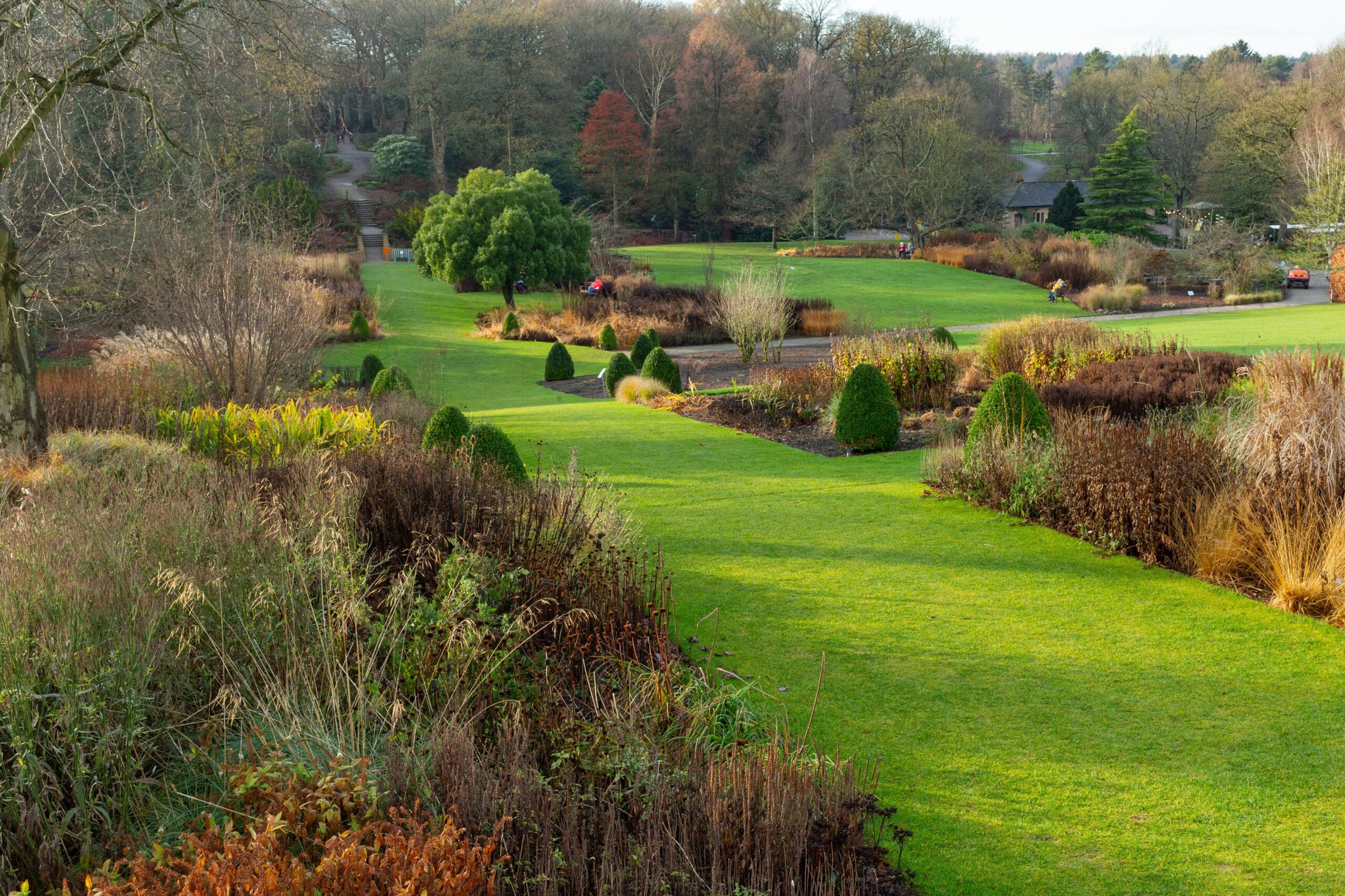
The main borders at RHS garden Harlow Carr.

The Stray Gardener is written by Rudding Park’s Kitchen Gardener, Fiona Slight. Fiona has worked in horticulture for more than 30 years in the UK and abroad, and specialises in growing fruit and vegetables for fine dining. This month, Fiona explains the different ways to sow seed.
March is the time of year when a lot of different types of seed can be sown successfully. There is nothing so rewarding as being able to grow a plant from seed and either enjoy its beautiful blooms throughout the summer or reap the rewards of tasty vegetables home grown by yourself. If you follow a few easy steps and quite often just follow the instructions on the packet, you can have success!
So where do you start? It makes sense to choose seed that you really want to grow. Read the packet instructions closely to ensure you can provide the right conditions that germinating seed will need. Most seed will need good light conditions, the correct temperature (usually given on the seed packet) and moisture. It is more than possible to grow and raise seeds on a windowsill. I do it myself every year.

Sweet pea seedlings planted in cardboard tubes.
Seed can be sown in a variety of different containers, for example, sweet pea seeds are best grown in cardboard tubes or root trainers which are tall thin containers to allow the plants a good root run and also minimal root disturbance when planted. Calendula (Pot Marigold) on the other hand, is best grown in a small seed tray or pot to allow them to grow to a size large enough to handle to be pricked out into larger pots. Whichever one you use, ensure it is clean and dry to avoid passing on any pests and diseases to your seedlings.
The next thing to think about is what material you grow your seeds in, the compost you choose is important, depending on the size and type of seed. Generally, shop bought seed compost works very well and is ready sterilised. It is important to ensure the compost is reasonably fine and well-drained. This is especially important for small seed to ensure good contact with the soil for germination.

Firmed down compost
For sowing smaller seed, fill your container with compost, and tap down to remove excess air holes. Smooth the compost off to get a level, flat surface, and then firm down either with another pot or tray with a flat bottom or a specially made wooden tamper. You now have a good surface to scatter your seed onto. Be careful not to sow too thickly as this can cause problems later on. Firm down the seeds to get good contact with the compost, and then, if the seeds requires it, cover with a thin layer of vermiculite, perlite or compost (generally until you can’t see the seed anymore). After that, I prefer to soak the seed from underneath in a tray of water as there is less chance of displacing the seeds and it ensures the compost is fully moist.
For larger seed, such as peas or beans, you can sow them individually or in pairs. Lay the seed on top of each cardboard tube or section of the root trainer and once all the seeds are placed, you can then push them down into the compost, usually a finger nail deep but it does depend on the size of seed. Then cover over the hole with more compost and water in thoroughly.

A variety of seedlings
Keeping the seed packets for future reference is very useful and helps with going on to the next stage of growing. Don’t forget to label your seeds, and if you have too many, share them with your friends.
Happy sowing!
Fiona’s Five Top Tips for March
- Now is the time to cut back any Cornus or Willow grown for their colourful stems
- March is a great time to divide congested clumps of grasses
- Plant onion and shallot sets
- Divide and re-plant bulbs in the green such as snow drops and winter aconites
- Pot on Dahlia tubers and place in the greenhouse to start to grow before planting out in May