Harrogate Business Improvement District has announced it will provide grants to support businesses in making improvements to shop fronts and accessibility.
Each year, the BID provides the match funding to levy paying businesses for support with improvement work.
The organisation will provide match funding up to £750 towards these improvement works. All members within the Harrogate BID area are eligible to apply for the grant which is available on a first come first served basis.
The aim is to offer investment into repairs and redecorations of business entrances and streets as well as the refurbishment or replacement of graphics and signage to improve the appearance of the town.
The funding will also go towards making Harrogate businesses more accessible. The grants will provide improvements including the installation of ramps, handrails, and automatic doors.
The BID said the funding “helps to create a great first impression for any visitors to the town and allows residents and business owners in Harrogate to take pride in their town”.
Matthew Chapman, Harrogate BID manager, said:
“Harrogate is always championed as the jewel in Yorkshire’s crown, and we know that first impressions really do count. This is why we are proud to once again launch the Shop Front Match Funding Grant to support our members and this worthy representation.”
Businesses wishing to submit a request for a grant should email info@harrogatebid.co.uk with a short description of the proposed work, any equipment needed, the expected completion date and any quotations or proposals.
Further details on the terms and conditions of the grants can be found on the Harrogate BID website.
Read more:
- Town-centre residents launch petition to demand Station Gateway details
- City council supports rejuvenation plans for Ripon’s Spa Baths
Town centre living: a welcome trend for Harrogate?
Barely a month passes without a new planning application to create flats in Harrogate town centre.
This week we reported on plans to turn the offices on the first, second and third floors of 5 Cambridge Road into three flats.
Planning permission has been previously granted to create flats in buildings that used to host the Kings Club strip club and the main post office, among others. And, in a few weeks, the former River Island unit on Cambridge Street, will open as Trinity House, a 14-flat development incorporating retail units. It’s hard to think of a more central location.
Town centres are changing from places to shop to places to live — and Harrogate appears to be at the forefront of the trend. Is this good or bad, and what challenges does it present?
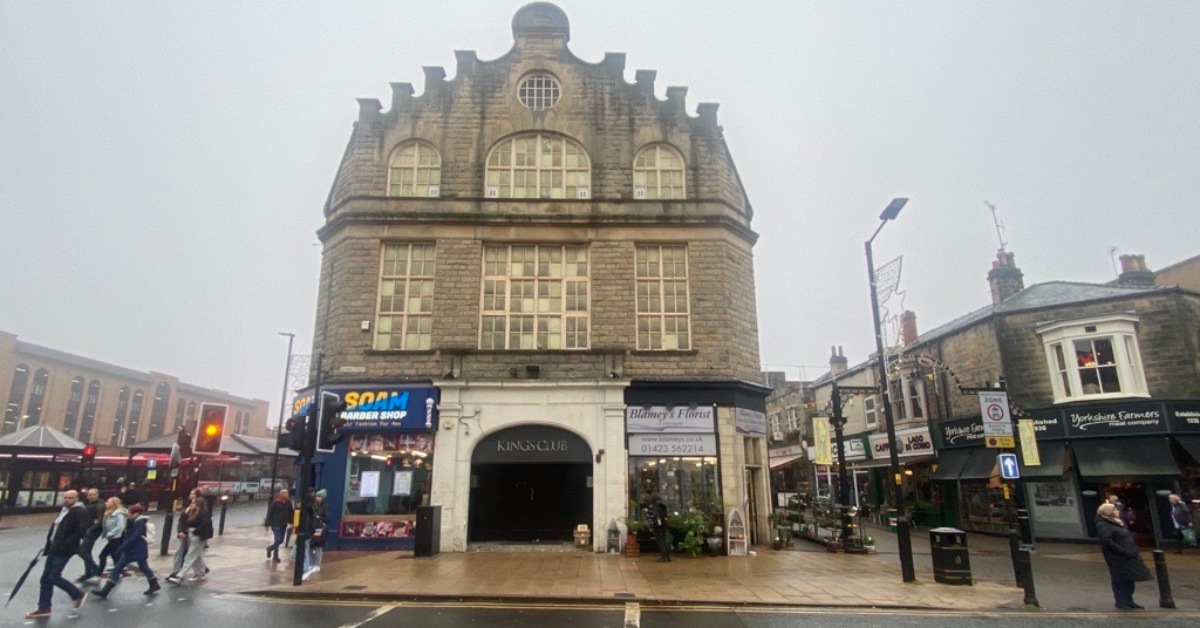
The former Kings Club
The Stray Ferret sat down this week with Tariq Shah, chief executive of Vigo Group, the property developer behind Trinity House, and Matthew Chapman, chief executive of Harrogate Business Improvement District, to discuss the trend and whether it posed a threat to retail.
Mr Shah, whose company is based in Doncaster, said Harrogate was particularly attractive to developers because it was seen as a desirable place to live and has good transport connections, which lessened the need for cars in town centres.
He said Harrogate had reasonable short-term accommodation for tourists and conference centre delegates but a shortage of town centre flats for living, adding:
“Harrogate is a town centre in transition. We are seeing more people from outside Harrogate wanting to come here.
“Trinity House has attracted more interest than any other scheme we have done. We would like to do more here.”

Cambridge Street
Trinity House flats will be marketed from £300,000 and although a nice town centre pad might suit some people, what impact will it have on retailers and on people who live here who regard the town centre predominantly as somewhere to shop?
The BID is funded by town centre businesses but Mr Chapman is not opposed to the change.
He said:
“A collaborative approach with landlords and developers is key. If people are willing to put something back into the community then we welcome it. Where I struggle is if buildings are owned by offshore investors, like Debenhams.
“Every town has probably had too much retail space for a long time. It’s an emerging trend but there needs to be a long-term vision for the town centre.”
Besides the 14 upper floor flats, Trinity House includes the existing Body Care shop and has additional room for a storage facility or small dance or yoga studio, as well as a kiosk space for a start-up business wanting a town centre presence.
Mr Shah said his company had agreed to improve lighting at the rear of the building, put up security cameras and create an internal bin storage area to improve safety and appearance and reduce the risk of vermin and fire. He said these were examples of the firm’s commitment to town centre improvement as well as profit.
He added having more people milling around at night added to the vibrancy and created “natural surveillance” at night in empty town centre streets where some people feel unsafe.
Mr Chapman said many of the units being converted to flats were first and second floor offices that had been unused for years, adding:
“If you have spaces that people live in and take pride in, it has to be better than having them crumble away.”
Despite his overall positivity, Mr Chapman said there was probably a ceiling on the trend and there were dangers. For example, he said converting ground floor retail units on the fully occupied James Street to flats “would be seen as a threat”.
Mr Chapman said the system of determining business rates needed reviewing to adapt to the trend, which he said would see an increasing shift towards “experiential activities” in town centres. He added:
“Whether it’s a cool independent retailer or axe throwing, people will want to experience something in town centres.
“Harrogate needs to be forward thinking and unique.”

Health services are being made available in Barnsley town centre.
So what will Harrogate town centre look like in 10 or 20 years?
Mr Shah said besides a more diverse mixture of retail and living, there would be more short-term leases, more leisure opportunities due to the higher population, more food halls and even community healthcare facilities. He cited Barnsley Council’s decision to work with partners to create a health and wellbeing hub in the Alhambra Shopping Centre as an example of how health managers will increasingly take services into towns.
He said:
“When it comes to long-term planning and thinking about these issues on a local level it’s important that a variety of partners are involved in these discussions and that is also a real strength of Harrogate, as a number of organisations are already open to having these conversations about how we can reimagine town centre usage.
“It’s not about drastically changing what is here but everyone working together with what we already have to bring clear economic and social benefits and secure our town centre for the next 30 years and beyond.”
Read more:
- Local business raises concern about new Harrogate Tourist Information Centre
- Divino opens at ex-Lucia site in Harrogate
Police and council launch project to tackle crime in Harrogate
A new drive to target anti-social behaviour, street crime and shoplifting in Harrogate has been launched by North Yorkshire Police and North Yorkshire Council.
Project Spotlight was announced yesterday, just days before the Stray Ferret publishes Trading Hell, a week-long series of features investigating these very issues.
Over the course of our investigation we spoke to a chief inspector from North Yorkshire Police, as well as North Yorkshire Council, Harrogate BID, Harrogate Homeless Project and dozens of town centre traders. You can read the first of our special reports on Monday.
Project Spotlight sees teams working with residents, shoppers, town-centre workers and businesses to:
- gather information about crime and anti-social behaviour and use it to target police and council resources at key times and locations;
- reduce thefts, anti-social behaviour and other crimes by working with retailers and licensed premises;
- prevent begging and rough sleeping by ensuring vulnerable people have access to the services they need and are encouraged to use them;
- deploy targeted, high-visibility patrols to make sure residents, town-centre visitors, workers and businesses feel safe;
- reduce drink- and drug-related crime by working with specialist teams, licensed premises and support services;
- ‘design out crime’ by making changes to the town-centre environment;
- keep the public informed about the project and its progress, encouraging them to keep sharing information about any town-centre issues affecting them.
Project Spotlight builds on work between North Yorkshire Police, North Yorkshire Council and other organisations to address street crime, retail theft, begging, rough sleeping, substance abuse and anti-social behaviour.

Project Spotlight will work with retailers to tackle shoplifting and other town-centre problems.
In a sample of 140 patrols of the town centre since October 2023, North Yorkshire Police made 10 arrests and moved people on or gave words of advice 54 times. The force also issued one dispersal order, which effectively bans someone from an area for a certain amount of time.
Harrogate neighbourhood policing inspector Nicola Colbourne said:
“Project Spotlight sees us stepping up that positive work we’ve already done with partner organisations, the public and town-centre businesses.
“We’re using a good old-fashioned mix of community engagement, information-gathering, targeted policing and robust law enforcement during this project, which we’re delivering alongside policing Harrogate’s wider residential areas.
“Harrogate is already an incredibly safe town, in what is officially England’s safest county. With the help of the public, businesses and key organisations, we’re working hard to make it even safer.”
North Yorkshire Council’s assistant chief executive for local engagement, Rachel Joyce, said:
“Alongside North Yorkshire Police and others, we have been working hard to maintain Harrogate town centre’s reputation as a safe and welcoming place in which to visit and work.
“Operation Spotlight presents an opportunity for all concerned to come together and build on this work. To do this we need the co-operation of the public and the business community and I would encourage everyone to support us in this aim.”
Project Spotlight comes in response to problems highlighted by the Stray Ferret’s Trading Hell survey, which revealed very high levels of dissatisfaction among town-centre traders at North Yorkshire Police’s response to anti-social behaviour and retail theft.
The results of the survey, some of which have been shared with North Yorkshire Police, will be revealed in our first Trading Hell report, published on Monday.
Read more:
- Police issue CCTV appeal following Ripon supermarket theft
- Government inspectors hail improvements at North Yorkshire Police
- North Yorkshire Police apologises to LGBTQ+ community