Thank you for your interest in this story
To continue reading this article, subscribe to the Stray Ferret for as little as £1 a week
Already a subscriber? Log in here.
12
Jul
Why Harrogate does not need a bypass or park and ride
Vicky Carr is a journalist turned writer who grew up in Harrogate and returned in her late 20s to raise her family here. Find her on Instagram @vickycarrwrites.
It is a truth universally acknowledged that a town in possession of a traffic problem must be in want of a bypass.
Talk to anyone about congestion in Harrogate, and it won’t be long before someone brings it up as a solution.
If you’re lucky, they’ll also suggest a park-and-ride system. Then everyone will nod along wisely, agreeing that these two things would, indeed, remove all other cars from the roads, leaving us to continue driving about town without encountering any delays.
Sounds idyllic, doesn’t it? And perhaps in many ways it is. Remember the heady days of the first covid lockdown when the roads were empty enough to walk down, and if you had to drive anywhere (which you rarely did), you barely passed another car? They were happier times. In traffic terms, at least.
Imagine if the roads could be even half as quiet now. Just think of how easy our journeys could be, how much time we could save, if the roads were clearer.
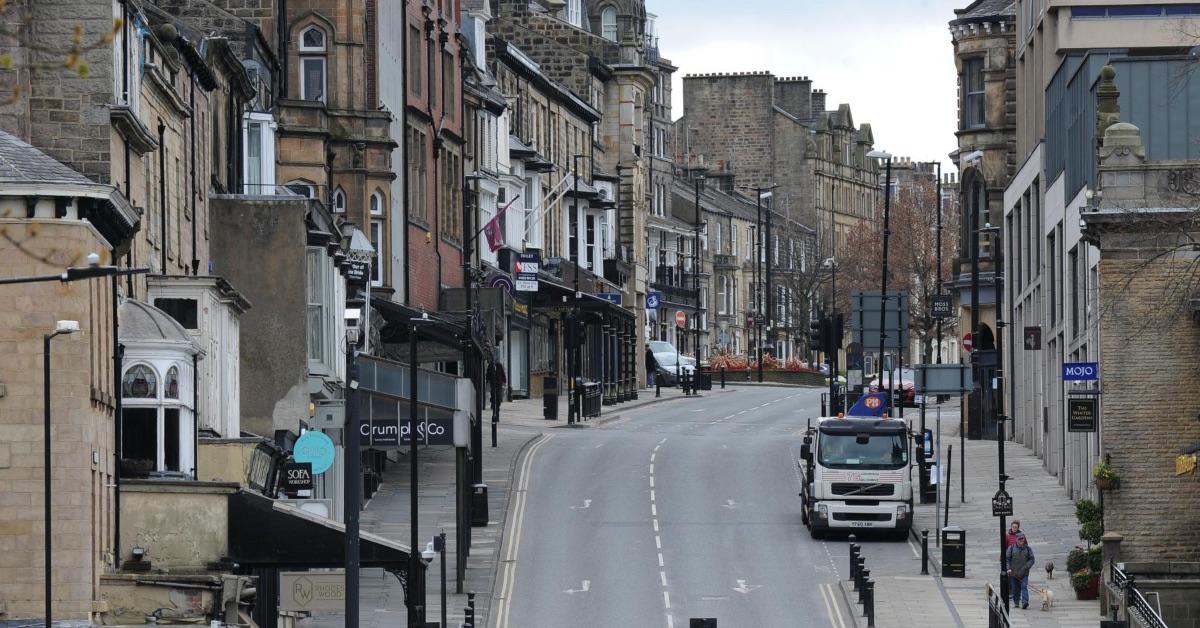
.Parliament Street pictured during the first covid lockdown in March 2020.
But have you spotted the flaw in the plan?
It’s obvious once you think it through, yet hardly anyone who advocates these ideas seems to notice.
Here it is:
When we picture the impact of the new bypass or park-and-ride scheme, we are still imagining ourselves in our cars, carrying on with our lives exactly as we did before, but unencumbered by traffic.
Does anyone who advocates for either a bypass or a park-and-ride system actually envisage themselves using it? Or is that for everyone else to do?
The last survey by (what was at the time) North Yorkshire County Council, in 2019, showed that almost half of journeys in Harrogate were local – less than two miles. These were people driving from Starbeck to Sainsbury’s, from Harlow Hill to the hospital, or from Oatlands to the Odeon.
Not one of those journeys is going to be removed by the addition of a northern or western bypass.
People point to the busy-ness of Skipton Road as evidence that vehicles are trying to pass Harrogate from west to east, or vice versa, and clogging up the road for locals. A bypass would, surely, remove that issue.
But how many of those vehicles are, in fact, using a section of that trunk road to get from one area of town to another?
The dramatic drop in traffic levels at peak commuting times during school holidays backs this up: a lot of Harrogate’s congestion is local people travelling around town.
The same NYCC survey found that 75% of people supported the creation of a park-and-ride scheme – but only 25% said they would ever use it.
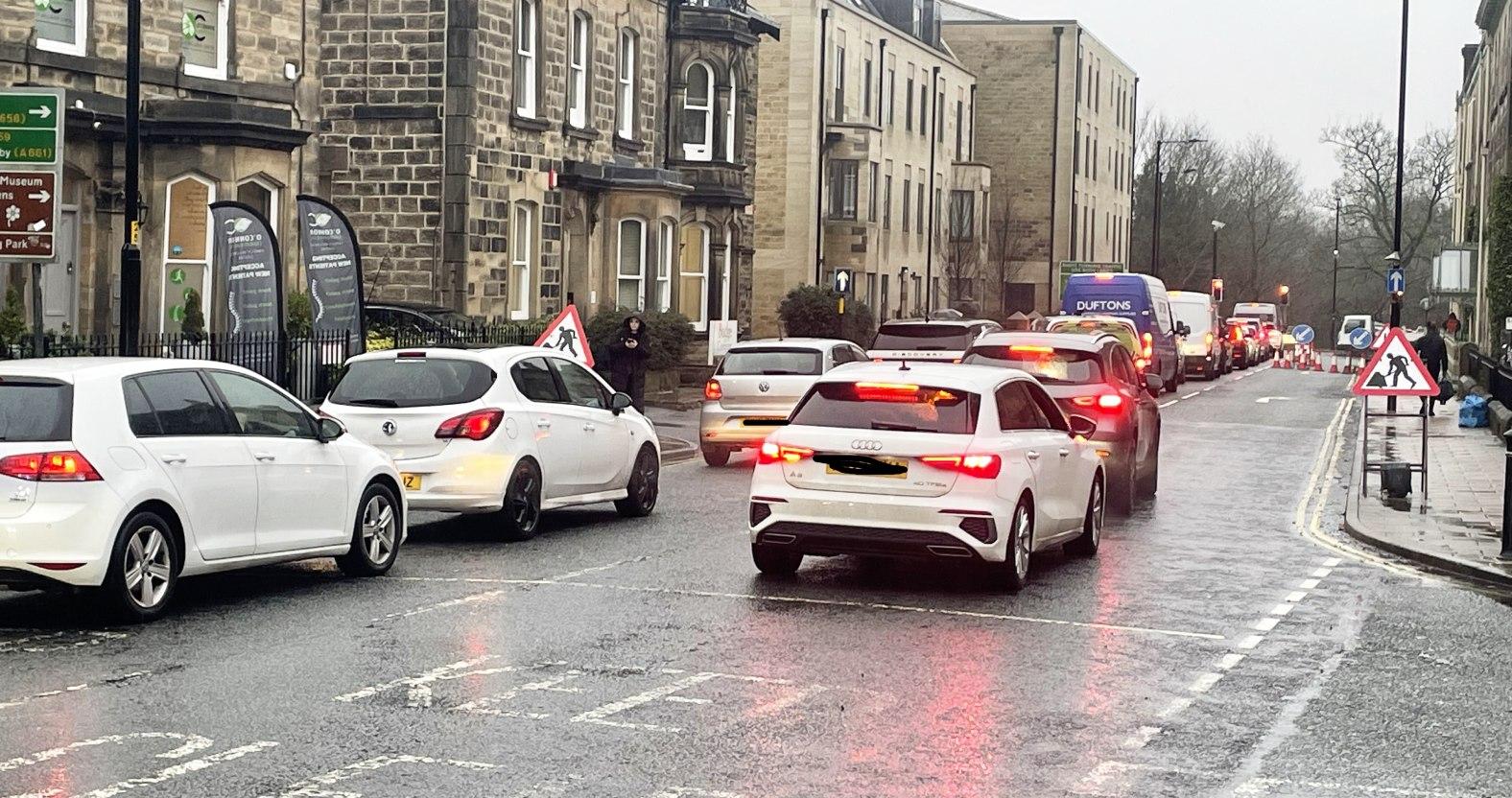
Traffic queueing on Station Parade.
Perhaps a park-and-ride system would slightly reduce the number of journeys into town by commuters and shoppers coming from elsewhere.
But if you’ve queued coming out of Leeds or York, then hit more congestion at Knaresborough or Pannal, are you going to crawl towards the showground (another favourite option of park-and-ride proponents – without any reference to its suitability or availability), get out of your car and wait for a bus to take you the final mile-and-a-half to work or the shops?
Would it ever be possible to set up a park-and-ride scheme that would suit parents taking their children from Bilton to Harrogate Grammar School, Hookstone residents going to Cardale Park for work, and people on the far side of Jennyfields heading to the town centre?
It seems unlikely, at best.
People often cite York as an example of how well a park-and-ride system can work. Why can’t that apply in Harrogate?
Well, size of population, for one. Number of regular visitors for another.
And don’t forget, as well as encouraging people to use park-and-ride, the council has to discourage people from driving into and parking in the city centre. So the city’s parking charges are astronomical – £5.50 for an hour at peak times.
Would Harrogate tolerate such a dramatic increase in parking fees? Something tells me there would be an outcry of equal proportions.
What is the solution?
So what’s the solution to Harrogate’s traffic woes? What can the council do to solve the constant queuing and help everyone get around more easily?
I actually don’t believe it can – or should – do anything.
When we sit in our cars complaining about the traffic, we are the traffic. We are the problem.
If we want to find a solution, we have to look at ourselves. We must be willing to change our own behaviour, otherwise there will be no change.
We can build the bypass, we can create the park-and-ride scheme, but we won’t solve the problem. We’ll still be sitting there in our cars, each of us wondering why nobody else has used the new set-up and got out of their cars, so we can carry on exactly as we were.
Every time we take the easy option and drive from our house directly to our destination, we are making a choice not to improve things.
What if we made a different choice? What if we chose to walk, to cycle, or to use public transport? What if we only drove part of the way and walked the rest? Even once a week?
It might feel like an act so small that it would make no difference. But what if 10 people did it? Or 100? Or even 1,000?
In a town the size of Harrogate, those kinds of numbers could make a noticeable impact on everyone’s experiences.
Imagine the difference we could make.

15