(Lead image: Harrogate Civic Society and Alex Goldstein)
London, Milan, New York – and Harrogate?
It might not be mentioned amongst the so-called style capitals of the world, but Harrogate certainly has sartorial credentials of its own. Just a brief wander around the central shopping district offers independent boutiques and designer brands, as well as the usual high street favourites.
However, it’s when looking back into the past that Harrogate’s reputation as a fashion-forward town really comes to the fore. In fact, it was once the home of a famous female fashion emporium, that considered members of the royal family as part of its clientele.
The shop belonged to Louis Copé (pronounced co-pay), a Jewish refugee whose family fled to the UK from Poland to pursue a better life. He was a major player in the fast-paced fashion world of the time, and while his shop closed in the 1970s, his influence in town remains to this day.
Early life
Copé’s distinctive moniker wasn’t actually his family name or birth name – he was officially christened Ulik Bidenkopf. His birth date is believed to be October 7, 1877.

Parliament Street in the 1900s (Image: Walker-Neesam Archive)
Copé was a later adaption of his surname, transitioning from Bidenkopf to Bidencope and then to Copé – a surname most commonly found in Europe – to sound more ‘sophisticated’.
His family first arrived in the UK in the early 20th century, having fled their home in Poland. In that time period, Poland was split between Prussia, the Habsburg monarchy, and Russia, with its Jewish citizens heavily persecuted.
Copé suffered from asthma, and the oppressive industrial smog of London wasn’t helping his health. In 1914, he made the move to Harrogate in search of the purer air that many believed the spa town, and the Yorkshire countryside, could offer.
Clothing Harrogate’s high society
While he may have first worked as a barber when he arrived in the UK – although this is unconfirmed – he made his first career change when arriving in Yorkshire, to become a jeweller. He was always a purveyor of the finer things in life, and in 1918 he opened the store which occupied numbers 52-58 on the corner of Parliament Street, facing the Royal Baths.
Copé’s shop rivalled that iconic building as an architectural talking point; the single pane of glass that wrapped around the main façade must have been an expensive installation, and indicated that customers could expect class when they stepped over the threshold.
The store sold a vast array of luxury couture such as dresses, fur coats, hats, and bags, as well as offering repairs to jewellery and clothing. The clientele was just as prestigious as the attire; the wealthy residents of Harrogate and beyond soon became loyal customers.

A fashion show organised by Louis Copé (Image: Alex Goldstein)
Copé’s reputation quickly grew, and ladies’ maids from across the country were soon contacting his shop to ask his advice on what latest accessory or style their mistress should be wearing.
The mid-1920s was a busy and prosperous time; not only did Copé get married and become a ‘naturalised British citizen’ in 1926, but he even had a brush with royalty. He received a request to dress Queen Mary, whose daughter Princess Mary was Countess of Harewood, the sprawling country estate near Leeds.
Later, the introduction of Freda – his only daughter out of three children – to a William Goldstein, a member of famed fashion house of its day Ellis & Goldstein of London, resulted in a marriage and the union of the two powerful families in society.
Fortune and philanthropy
A good indication of the dizzying heights of success and fortune Copé reached would be the time he came into possession of the ‘Tenant Diamond’, a gemstone valued at around £10,000 – a vast amount for the era.
Despite his lavish lifestyle, he still remained an active member of the Harrogate community and was just as well-known for his philanthropic endeavours. This included supporting several local charities, and throwing fundraising evenings for Harrogate Infirmary.
His legacy
Copé passed away on June 30 1957 at the age of 79. He is buried in Leeds, in the New Farnley Jewish cemetery. His store was taken over by his son Harry and enjoyed many more successful years trading, before eventually being sold in the late 1970s.
Copé’s great-great grandson Alex Goldstein is a property consultant and still calls Harrogate home. In 2022, alongside the late historian Malcom Neesam, he successfully petitioned for a brown plaque to be installed outside of the former premise – now home to Rhodes Menswear.

Alex Goldstein with the brown plaque
Speaking to the Stray Ferret in 2022 about the unveiling of the plaque, Mr Goldstein said:
“I am so pleased to have been able to mark the history and story of my great grandfather, whose fashion house spanned decades and formed important memories for so many people in and around Harrogate.”
Sources for this article include a biographical timeline on the Harrogate Civic Society website, Regional Couture: The Inter-war British Couture Fashion House Isobel (London & Harrogate) Ltd in the academic journal Costume, by Hannah Wroe, Edinburgh University Press, an article on Harrogate Spa Stories website and a profile on Geni.com.
Read more:
- Local history spotlight: Blind Jack of Knaresborough
- Local history spotlight: Dr Laura Veale
- Local history spotlight: Naomi Jacob
- Exploring North Yorkshire’s plaques and the history behind them
Knaresborough Heritage Centre opens
Knaresborough Heritage Centre officially opened over the weekend.
The centre, which celebrates and showcases Knaresborough’s rich history, is located in the former Printzone premises at 12 High Street.
Knaresborough Museum Association, which runs the centre, marked the occasion by holding an opening event attended by Harrogate and Knaresborough Conservative MP Andrew Jones, Knaresborough mayor Cllr Hannah Gostlow, and Liberal Democrat parliamentary candidate Tom Gordon, along with almost 100 visitors.
The heritage centre consists of a small heritage shop, a visitor information desk and a museum gallery with a programme of exhibitions.
The first exhibition is called ‘the archaeology beneath our feet’ and covers geology and social history. There is also a kids zone, audio visual presentations and hundreds of artefacts and models.
Visitors are asked to make a minimum donation of £2. Accompanied under-16s receive free entry.
The centre is open four days a week, on Wednesday, Friday, Saturday and Sundays from 10am to 4pm.
Kathy Allday, chair of Knaresborough Museum Association, said:
“The heritage centre is the first of its kind – by the community for the community. Knaresborough has a wealth of archaeology that even local people aren’t always aware of. We’ll display artefacts which show that people have been living in Knaresborough for an astonishing 4,000 years.
“We want the heritage centre to be a hub where schools, groups and individuals can all get involved with lifelong learning opportunities, helping to make Knaresborough an even more wonderful town.”

Knaresborough Heritage Centre display. Image: KMA Facebook
The opening marked the culmination of a long-running campaign to find larger and more suitable premises to the small gallery and office space that previously operated from a converted house at 8 York Place.
The association has spent almost £30,000 on refurbishing the premises.
Knaresborough Town Museum Group was set up in 2019 to campaign for a new museum and plans were first put to Harrogate Borough Council in 2020 to create the space. The museum group was renamed Knaresborough Museum Association and registered as a charity in 2021.
You can see images of the opening event below:

The town crier and trustees were in attendance

A window poster at the new centre. Image: KMA Facebook

MP Andrew Jones with vice-chair Malcolm Hay at the VIP preview.
Read more:
- Forestry England to create 35-hectare woodland near Harrogate
- Still no re-opening date for new Knaresborough playground
Harrogate’s ‘best kept secret’ club has just appointed its first female president
It’s perhaps one of Harrogate’s best kept secrets, a private members’ club first established in the 19th century, tucked away in one of the beautiful properties on Victoria Avenue.
But inside the walls that house The Harrogate Club, significant events are taking place; they’ve appointed their next club president and honorary secretary – and they’re both women.
Fiona Movley, the chair of Harrogate International Festivals, was elected as president by unopposed members’ vote on Tuesday, April 23, 2024, alongside Catherine Wormald who took up the mantle of honorary secretary.
This is the first time in the club’s history that a woman has held either position which is no small feat considering it has been in existence since 1857.

(L) Fiona Movley (R) Catherine Wormald
This appointment is timely, not in the least because another notable historical club, the Garrick in London, has recently announced that it is revising its men-only policy, which has been in place since 1831.
Following public backlash after a leaked list published by The Guardian revealed that many of the members were involved in promoting inclusivity and diversity – while being part of an organisation that has denied women acceptance for nearly 200 years – the notoriously secretive club had to break its silence on the matter.
In this respect, The Harrogate Club is ahead of the curve; women have been able to join since 2012 and to date, they have a diverse membership of nearly 200 people, with an age range from mid-twenties to mid-nineties.
However, Fiona’s recent presidential appointment marks a new chapter in the history of the club, and one that is another step forward for progression.
Speaking to the Stray Ferret, she explained:
“As the first female president of the Harrogate Club, along with Catherine Wormald, the first female honorary secretary, we’re thrilled to celebrate a significant milestone in the Club’s rich history.
“Times have certainly changed. We have recently introduced a variety of new events and offerings to enhance the Club experience. The response has been wonderful, resulting in a surge of interest in membership, reaffirming The Club’s relevance and appeal.”
‘A public reading and news room’
Not only would a woman never have dared to darken the door of The Harrogate Club in the 19th century, but membership was strictly limited to wealthy, white men.

36 Victoria Avenue (Image: The Harrogate Club)
The club was first established in the lounge of Gascoigne’s Hotel on February 13, 1857, as a way for esteemed members of the Yorkshire business elite to meet up, read and discuss newspapers and journals.
It proved to be a popular concept, attracting the attention of businessmen across the region and beyond; so much so that the hotel built a billiard room for the club to enhance their entertainment options.
In 1885 the club moved to 36 Victoria Avenue, where its headquarters can still be found today. While it has still retained much of its historical charm and period features, there have been some modern updates throughout the years, such as the introduction of Wi-Fi.
That might not sound revolutionary, but many private clubs still don’t allow their members to use phones, and laptops have to be left at the door.

The club has still maintained its period features (Image: The Harrogate Club)
The Harrogate Club, however, puts the emphasis on being a social place where members have the option to chat, relax or quietly work – therefore internet access is a welcome inclusion.
Notable club members
One of the first members of The Harrogate Club was Sir Titus Salt, mayor of Bradford and the industrialist behind the creation of Salt Mill and Saltaire model village. He joined with his brother Henry in 1857.
Cuthbert Brodrick, the architect who designed many iconic Yorkshire buildings, including Leeds Town Hall, the Corn Exchange, and Scarborough’s Grand Hotel, also was known to attend, as was engineer and inventor Samson Fox.
It wasn’t just industrial giants; Arthur Conan Doyle’s name crops up in the visitor’s ledger, and it’s rumoured, although not confirmed, that J.R. Tolkien may have even crossed the threshold.

(L) Samson Fox (M) Titus Salt (R) Cuthbert Broderick (Image: The Harrogate Club)
Today, members come from a diverse range of businesses, backgrounds, and locations. Individuals don’t have to be a Harrogate resident to join – but there is a waiting list, and hopefuls have to be approved before they can count themselves amongst the ranks.
Present day and the future
It’s clear that The Harrogate Club has been through many changes over the years, transforming from an exclusive group for prominent gentlemen to a club that strives towards diversity, according to their newly appointed president.
While the opening of the club to female members in 2012 might still be classed as relatively recent history, many equivalent organisations up and down the country are still yet to take this step.
Now, with the appointment of the first female president and honour secretary, The Harrogate Club has reaffirmed their statement of intent to respect the club’s history, while adapting for the times.

Inside the dining room of The Harrogate Club (Image: The Harrogate Club)
Fiona added:
“Since 1857 the Club has provided a welcoming space for members to connect and exchange ideas. Preserving this tradition as a private members club is a priority for us, while also embracing diversity and celebrating the different cultures that make our club special.
“Today the club blends tradition with modern lifestyles, catering to all. It’s truly remarkable to think that the visionaries of Harrogate established the building as a club, and now, generations later, it continues to serve its original purpose.”
Read more:
- Local history spotlight: Blind Jack of Knaresborough
- Local history spotlight: Dr Laura Veale
- The Yorkshire cafes putting sustainability at the heart of their business
Local history spotlight: Naomi JacobLocal history spotlight: Naomi Jacob
(Lead image: Pixabay and Ripon Civic Society)
North Yorkshire boasts numerous connections to the literary world across the centuries; the Brontë family immortalised Haworth and the dramatic scenery of the moors, Whitby Abbey famously inspired Bram Stoker’s Dracula, and both the television show and book series All Creatures Great and Small captured life in the Dales.
Someone who has not retained the same level of recognition – yet undoubtedly played a significant role in arts and culture at the time – is Naomi Jacob.
A prolific writer, actor, broadcaster, and political figure, she published around 50 books in her lifetime, and was known as a larger-than-life character in the circles she moved in.
Labelled ‘eccentric’ at the time, Jacob rarely used her given name, instead opting for her surname, Jake, or Mickie to introduce herself. She also preferred to wear what would have been deemed masculine attire, commenting: ‘I just find that men’s clothes are more practical and more economical’.
It was also a well-known secret that she had female partners throughout her lifetime, although this was never addressed either by her personally, or through her literary work.
Viewed through a modern lens, Jacob would have been considered part of the LGBTQIA+ community. However, because she didn’t speak about her experience, or have access to the updated language and knowledge surrounding gender identity and use of pronouns we have today, we cannot presume to know how she would have chosen to define herself.
For this reason, in the article she’ll be referred to by her surname, with she/her pronouns.
Early life
Jacob was born on July 1, 1884, in Ripon, the first daughter to Samuel Jacob and Selina Sara Ellington Collinson.
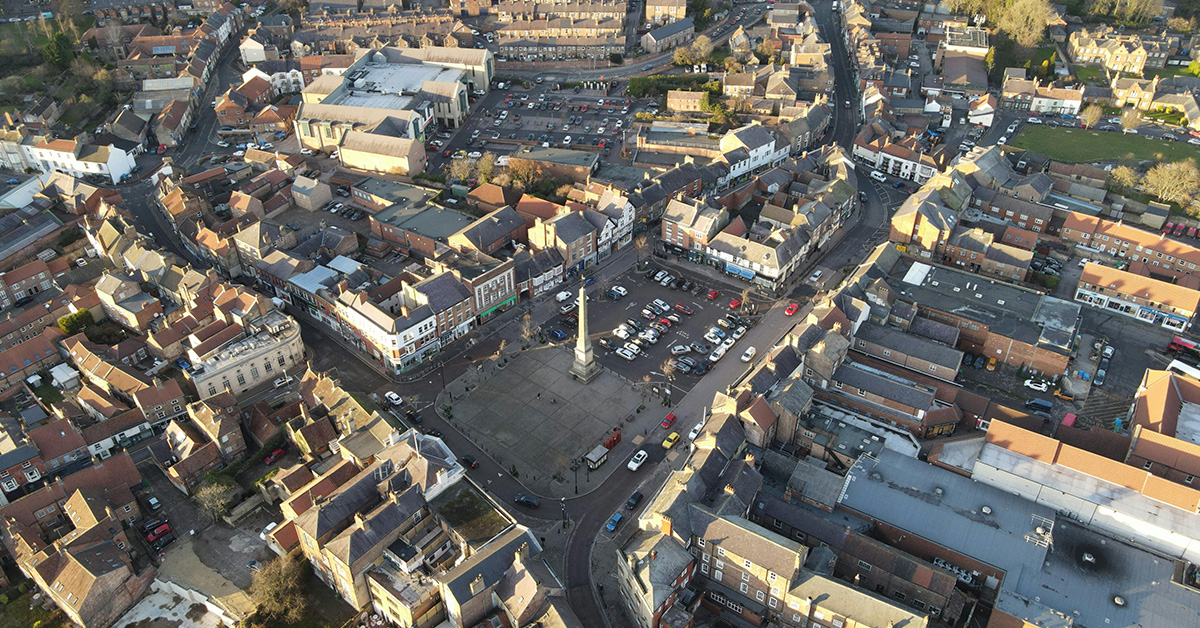
Ripon (Image: Pixabay)
Her family were fairly prominent in the town; her father was the headmaster of Ripon Grammar School, where her mother also taught, and her grandfather and great-grandfather were the mayor and chief police officer of Ripon respectively.
While her mother’s lineage had roots firmly in Yorkshire, Jacob’s father was the son of a Jewish refugee from the area formerly known as Prussia. Jacob’s paternal grandfather, whom she was very fond of, still spoke Yiddish and was a great influence in Jacob exploring her dual heritage.
Her upbringing was comfortable but her parents’ marriage was an unhappy one; when they eventually separated, Jacob moved to Middlesborough at the age of 14 to complete her education, following in her family’s footsteps to become a teacher.
While in the North East, Jacob contracted tuberculosis, and would suffer with it to varying degrees throughout the rest of her life.
A diverse and lengthy career
It also appeared that teaching wasn’t the right fit for Jacob either; the lure of the glittering lights and creative freedom that the theatre offered was tempting, and by 18 she was frequenting music halls in Leeds.
Jacob soon successfully introduced herself to some of the time period’s notable theatre alumni, including Henry Irving, Sarah Bernhardt, and Marie Lloyd. She also made a name for herself as a character actor, performing at the West End and in several touring productions.

The childhood home of the Jacob family (Image: Ripon Civic Society)
It wasn’t until the mid-1920s that her lengthy career as a writer really began in earnest. Her first novel Jacob Usher was first published in 1925 and was a prolific author during the rest of her life, able to complete two books a year at the height of her productivity.
Jacob had a deep love for Yorkshire, and this passion, and her astute observations on the region’s idiosyncrasies, were often a key feature of her novels. While she produced a vast quantity of work, sometimes under the pen name Ellington Gray, the ones she was best known for – and garnered critical acclaim – were her series about the Gollantz family, and her 1935 novel Honour Come Back.
The latter was recognised with an Eichelberger International Humane Award but Jacob refused to accept it when she discovered Adolf Hitler had also been recognised with the prize for Mein Kampf.
She penned an impassioned letter to The Sydney Morning Herald in 1936, which explained her reasons why. In an address to the editor, she explained:
“With a sense of great disappointment, I was obliged again to write to the committee, and respectfully refuse to accept the award… because of the terrible persecution, the monstrous injustices and the abominable cruelties which are even now being laid upon the Jewish race in Germany.
“To have accepted it would have been to almost betray those people to whose race I partly belong, and who have been my good and loyal friends all my life.
“I have talked with refugees, listened to stories of oppression and wickedness, which have roused me to indignation and fury, and as a result of what I know it was impossible for me to accept this award under the circumstances under which it was given.”
While Jacob relocated to Lake Garda, Italy, in 1930 in order to alleviate some of the symptoms of her tuberculosis, she moved back to the UK during the Second World War to help with the war effort.

(L) the plaque in Sirmione (R) Sirmione (Image: Ripon Civic Society and Pixabay)
This included tapping into her acting credentials as part of the Entertainments National Service Association, to entertain the troops and keep morale high. She became well-known for wearing a Women’s Legion uniform, monocle, and sporting a cropped hairstyle.
Later in life she was a contributor to the Radio 4 programme Woman’s Hour, as well as a writing articles and opinion pieces for local and national newspapers.
Political activism
Politics was a major part of Jacob’s life, and alongside her impressive output of work she managed to be an active participant on the political stage.
A fierce proponent for women receiving the vote, she was part of the suffragette movement before World War One and joined the Women’s Social and Political Union (WSPU) in 1912.
According to an article published in The New York Times in 1964, she once recalled that she was frequently ‘flung down steps and into horse ponds’ when out campaigning. She once stood, unsuccessfully, as a Labour PPC (Prospective Parliamentary Candidate) in East Ham, London, and was a devoted Labour party member for over 35 years.
However, she actually switched sides and joined the Conservative party after 1947, citing her disappointment in what she perceived to be Labour’s more radical brand of socialism.
Later life and legacy
Jacob moved back to Italy, and to the town of Sirmione where her villa was, after the Second World War. Also known as Casa Mickie, after one of her chosen names, she enjoyed hosting friends and family there – but she regularly returned to visit England, and Yorkshire in particular.
Although she had been married to a man for a brief time – so brief in fact, that they divorced within two weeks – she had several long-term partners that she lived with in open but unspoken relationships, including the actor and singer Marguerite Broadfoote.
After she passed away in 1964 age 80, a plaque was installed in Sirmione in her honour. Jacob’s vast amount of work fell out of the general public consciousness after her death, but in recent years there has been renewed efforts to preserve her legacy.

Later generations of the Jacob family at the plaque’s unveiling (Image: Ripon Civic Society)
In 2019, the Ripon Civic Society recognised Jacob’s impact on not only the town but wider society, with a green plaque outside her childhood home at 20 High St Agnesgate.
Inaugurating the plaque, Christopher Hughes, Chairman of Ripon Civic Society, welcomed Jacob’s two generations of her family, Tony Atcheson and Thomas Atcheson, to the event.
He commented:
“We are delighted to be able to mark the life and work of one of Ripon’s brightest literary stars with this plaque. We hope it may stimulate interest in Naomi Jacob’s life and work, and inspire others to follow her example.”
Tony Atcheson, who lived in Sirmione with Naomi Jacob and his mother as a young child, added:
“Mickie had a great affection for Ripon throughout her life and this shaped her achievements. Very much ahead of her time, she was a strong character who forged her own success with little support in an era when women were not afforded the same opportunities.”
Sources for this article include an article in The New York Times, an article by Jocelynne Scutt for the Women’s History Network website, the Ripon Civic Society website, a biography on LibraryThing.com, Naomi Jacob’s original 1936 letter to The Sydney Morning Herald from the National Library of Australia archive and Orlando – a University of Cambridge online anthology.
Read more:
- Local history spotlight: Blind Jack of Knaresborough
- Local history spotlight: Dr Laura Veale
- Exploring North Yorkshire’s plaques and the history behind them
Crime writer Malcolm Hollingdrake has returned to Ripon to visit a mosaic mural he created 50 years ago.
In February, Holy Trinity Infant School enlisted the help of the Stray Ferret to track down the creators of a mosaic wall mural dating back to the 1970s.
Mr Hollingdrake solved the mystery when he noticed a photo in the article included him.
The mosaic, which was completed by Ripon College students on April 5, 1974, had been hidden beneath a cloth for years.
Mr Hollingdrake contacted the school and was invited back to see the mural. The author visited the Ripon primary school on Friday, April 12 — almost exactly 50 years to the day from its completion.
Mr Hollingdrake lives in Wigan and specialises in crime writing. He even created a series of thrillers titled the Harrogate Crime Series featuring DCI Cyril Bennett after acquiring a fondness for the area.
Originally from Bradford, he studied art and history at Ripon College between 1971-1974. He revealed the mural is based on the theme of ‘feeding the birds’ — at the time it was created the school children had been studying birds and life sciences.

Author Malcolm Hollingdrake and the newspaper clipping of him creating the mosaic in 1974.
The artwork was created using clay and powdered glass, which was fired and glazed. The mosaic was made inside Ripon College and Holy Trinity students were sent over in small groups to help with the creative process.
Mr Hollingdrake said:
“It was delightful going back to see it and I am grateful it has been brought to light. I was anxious at first as I didn’t know what to expect. It is an old artwork, and I was thinking ‘is it as I remember?’, it is easy to think of it through rose tinted glasses. But the mural was even better than I remembered and it is still in good condition.
“The school was so welcoming, the children were beautifully behaved and really enthusiastic. It was a special day and I have left with good memories.”
Deputy headteacher Amanda Bell-Walker said:
“We were so excited to welcome Malcolm into school, it was the culmination of a few months of hard work on the part of the pupil governors. Speaking to Malcolm really brought the mural to life for the pupils. It gave them a context for it and a much greater understanding of the figures portrayed in the mosaic. His visit created such a positive and joyful buzz around school.”
At the reunion Mr Hollingdrake spoke to students about how the artwork was made and answered their questions about the piece. Pupils were also involved in an art workshop creating rubbings, paintings, and collages reminiscent of the mosaic.

Holy Trinity pupils talking with Malcolm Hollingdrake and creating art to be displayed around the mural.
Ms Bell-Walker added:
“The pupils created some marvellous work. They were thoroughly engrossed in the activities and the results will be displayed around the original mural to show the inspiration behind the work.
“Malcolm was so generous with his time on Friday; he spoke to the staff, pupils and the parents/visitors who joined us with such enthusiasm that we feel even more passionate in school about caring for the future of our now famous mural.”
Malcom Hollingdrake’s latest book, Edge of the Land, the third in the Merseyside crime series, was published by Hobeck Books yesterday (April 16) and he is currently writing the 14th book in the Harrogate Crime Series.
Read more:
- Crime author solves mystery of Ripon mural
- Can you help solve the mystery of the Ripon mural?
- Ripon Races begins 125th anniversary season this week
Local history spotlight: Dr Laura VealeLocal history spotlight: Dr Laura Veale
If you’re walking down Victoria Avenue in Harrogate and keep your eyes peeled, you’ll notice a brown sign affixed to a stone wall outside one of the impressive town houses.
If you stop to take a closer look, the person commemorated by this plaque might not be known to you – but Dr Laura Veale has left a worthy legacy in the field of medicine, both in Harrogate and beyond.
As the first female doctor in North Yorkshire, she’s been described as a pioneer and a trailblazer, but it can be argued that both words fall short of encapsulating her extraordinary life.
The early years
Dr Veale was born on August 30, 1867, in Hampsthwaite, a village near Harrogate. It appears as though medicine was something of a family affair; her father Dr Richard Sobey Veale was a prominent doctor in the area, and both her brothers Henry and Rawson Augustus also pursued medical careers.
It was sadly unsurprising, and reflective of the general sentiment of the time, that Dr Veale encountered hostility and derision when she expressed her intention to follow the same path as her family.
Despite the fact her father was associated with the Leeds School of Medicine, it would not accept her as a student, which led her to apply to the University of London instead.
She felt as though she had received an ‘unsatisfactory schooling’ compared to her male peers which made the university’s matriculation especially daunting.

Hampsthwaite
In a move that must have been considered quite unusual at the time, the headmaster of Harrogate College allowed her to work with the sixth form boys in order to improve in the areas she felt she lacked knowledge.
Dr Veale then went on to the Royal Free Hospital to complete her medical studies in 1904, and once qualified she returned to Yorkshire and took up a position at the Hospital for Women and Children in Leeds.
After six months, she moved back to Harrogate and set up a general practice at 3 Victoria Avenue, cementing her status as the first female doctor not only in the town, but in the North Yorkshire region too.
An advocate for women and children’s health
While in Harrogate, Dr Veale made a big impact not only in the medical profession, but in the local community too.
At a time when not only were women and children still considered inferior to adult men, she was at the forefront of advocating for improvements in the care offered to those groups, especially in deprived communities.
Notable achievements include setting up a dispensary in New Park, acting as medical officer at the Municipal Babies Hospital and helping set up numerous child welfare and antenatal clinics in Harrogate.
The clinic at 2 Dragon’s Parade still stands today, and is a base for child and adolescent mental health services.
Dr Veale worked as an obstetrician and a gynaecologist at Harrogate Infirmary for many years. By 1937, the first maternity ward was finally opened at the hospital – something that she had campaigned hard to establish for nearly three decades at that point.
Outside of her profession, she continued to improve life for residents of the area, and was heavily involved in several charitable organisations, including the Yorkshire Council for the Empire Cancer Campaign, and organising the Yorkshire Children’s Jewel Fund.
She retired from medicine in 1936 but continued to play a huge part in the local community, taking on an integral role in establishing the Women’s Voluntary Service for Harrogate during the Second World War.
A continued legacy

The plaque outside 3 Victoria Avenue
Dr Laura Veale died on August 14,1963, at Scotton Banks Hospital in Knaresborough at the age of 95.
Her obituary in the British Medical Journal described her as a ‘remarkable woman’, and The Harrogate Advertiser accredited her with having a ‘noble mind’ that kept pace with the ‘vast changes in her profession’ over the years.
In 2017, the Harrogate Civic Society installed a brown plaque on Victoria Avenue, where her general practice had been located.
Speaking to the Stray Ferret in 2020, Dr Paul Jennings from Harrogate Civic Society History said:
“She deserves recognition as an important figure in the history of both medicine and feminism and a key figure in medical provision, especially for women and infants, in her native county and more particularly Harrogate.
“It is as a pioneering woman in the medical profession and through her wider work for the community that she is so important to Harrogate.”
Sources for the article include an article on nycroblog.com, the Harrogate Civic Society website, the Harrogate plaques website and Dr Veale’s obituary on bmj.com.
Read more:
- Local history spotlight: Blind Jack of Knaresborough
- Exploring North Yorkshire’s plaques and the history behind them