A further 40 people have tested positive for covid-19 in the Harrogate district since yesterday.
It brings the total number of cases with positive tests in the district to 1,598 since the start of the outbreak.
There have been no deaths of patients with coronavirus at Harrogate District Hospital since September 29, with the total during the pandemic standing at 83.
One further person was this week reported to have died in a care home in the district after being diagnosed with the virus.
Read more:
- Permanent covid testing site to open in Harrogate next week
- Police consider ‘covid cars’ as part of enforcement
The latest statistics show Harrogate has the highest rate of infections in the seven districts in North Yorkshire.
Latest weekly figures showed 154 cases per 100,000 people in the district. This compares with 151 in Selby, 147 in Craven and 138 in Hambleton. Richmondshire recorded 104, Scarborough had 94 and Ryedale 89.
Health Secretary Matt Hancock told the House of Commons this week the government would consider a district-by-district approach to its new tier system.
Today, the government announced Lancashire would be placed in the highest tier of restrictions – but remains in dispute with the leaders of Greater Manchester over introducing further limitations there.
Dr Lincoln Sargeant, director of public health for North Yorkshire, said the main cause of spread of coronavirus in the county was between households.
He said he supported the new tier system as it would help to tackle the spread in the county, but said there were “very few instances” of infection in hospitality.
‘Very few’ covid infections in North Yorkshire pubsPubs and restaurants have been responsible for hardly any covid outbreaks in North Yorkshire, according to the county’s public health director.
Dr Lincoln Sargeant said there had been “very few instances” of coronavirus spreading between customers in the hospitality sector.
He also said schools and workplaces had been responsible for few transmissions. The main source of spread, he said, was households.
Speaking today at a press briefing of North Yorkshire Local Resilience Forum, which is a partnership of agencies that tackle emergencies, Dr Sargeant said:
“We have had very, very few instances of pubs where there has been outbreaks and spread to customers. It has largely been staff members that we have picked up.
“The predominant spread in North Yorkshire is between households.
“Our school heads and the teams supporting them have done a brilliant job of keeping schools safe from spread of covid. We are in contact with our care homes on a daily basis.”
Read more:
- Permanent covid testing site to open in Harrogate next week
- Harrogate Nightingale hospital put on standby
Harrogate has the highest weekly rate of infection of the seven districts in North Yorkshire, with 116 cases per 100,000 people. It also has the highest cumulative number of cases, which stands at 1,473, mainly because of its size.
Dr Sargeant said this could partly be due to the district’s high number of care homes.
North Yorkshire is currently classed in the lowest of the three tiers that were introduced this week, which means it continues to follow only national measures, such as the rule of six and 10pm curfew.
But neighbouring West Yorkshire is in the second tier, which bans different households mixing and socialising indoors.
This has led to fears some people may decide to cross the border into North Yorkshire if pub closures are imposed in West Yorkshire.
Superintendent Mike Walker, gold command for North Yorkshire Police’s response to covid, said the force would be prepared to police those coming into the county.
He said:
“We will just have to see what the impact is of other areas being in the higher tiers and what impact it will have on us.
“It is the minority who decide to throw caution to the wind and breach those restrictions. Absolutely, we will be ready to deal with those individuals.”
Some northern mayors, such as Andy Burnham in Greater Manchester, have criticised the government for a lack of consultation.
But Richard Webb, director of adult care at the county council, said it had been well consulted by the UK government:
Harrogate district in lowest tier of new local restrictions“We are in constant conversation with different arms of government and there is no one single point of government.
“I can only speak from our own experience. We have been involved in discussions all along the way and that feels quite productive and helpful. We are in a national emergency so things will move at quite a quick pace and in that situation you can’t necessarily consult with everyone.”
Harrogate has been spared further restrictions with the news that it has been placed in the lowest category in the government’s new three-tier local lockdown system.
It means the district will continue to follow national measures, such as the rule of six, but will face no additional local restrictions.
Kevin Hollinrake, Conservative MP for Malton and Thirsk, confirmed this afternoon that North Yorkshire would be in the medium alert level of the new tier system.
Good news that we’re still in Medium Alert level (lowest) so current rules still apply in North Yorkshire, so, for example, can still go to a pub/restaurant in a group of 6 from up to 6 different households
— Kevin Hollinrake MP (@kevinhollinrake) October 12, 2020
Prime Minister Boris Johnson announced the new tier system earlier today, which will see millions of people in the north of England affected from 5pm on Wednesday.
Mr Johnson said:
“It is the narrow path we have to tread between the social and economic costs of a full lockdown and the massive human and indeed economic cost of an uncontained epidemic.
“I must warn the House the weeks and months ahead will continue to be difficult and will test the mettle of this country. I have no doubt at all that together we will succeed.”
According to figures released by North Yorkshire County Council today the Harrogate district has the highest rate of coronavirus cases of the seven district councils in North Yorkshire.
Currently, the Harrogate district has a seven-day coronavirus rate of 117 per 100,000 people and a total of 1,437 cases since the start of the pandemic.
Read more:
- Harrogate bars warn further measures could ‘finish us off’
- Harrogate to get permanent Covid testing site
Will the Harrogate district face tougher restrictions today?
The government is set to announce tougher lockdown restrictions today for millions of people in northern England — but to what extent the Harrogate district will be affected remains unclear.
Pub closures and a ban on travel outside of restriction zones are on the cards for swathes of the north, as part of a new three-tier lockdown system.
While metro mayors Steve Rotheram in Liverpool and Andy Burnham in Manchester are threatening to rebel against the initiative, leaders in North Yorkshire have so far kept quiet.
The Stray Ferret today asked Harrogate Borough Council and North Yorkshire County Council whether the government had consulted them on the tier system, if they knew which tier the district was likely to be allocated and whether they agreed with it.
The borough council referred us to the county council, which had not replied by the time of publication.
Rising infection rates
Harrogate has a covid rate of 127.5 per 100,000 people. The figure for North Yorkshire as a whole is 101.9, according to NHS Digital.
Harrogate’s infection level is rated as high but nevertheless is well below the 689.1 figure for Nottingham or 578.7 in Liverpool.
Craven has the highest case rate in the county at 166 per 100,000. Ryedale stands at 102, Richmondshire at 109 and both Scarborough and Selby at 91.
The number of cases in the Harrogate district has increased sharply since the start of September. A further 42 cases were confirmed yesterday, taking the overall number to 1,412.
Professor Stephen Powis, national medical director at NHS England, said this morning the Harrogate Nightingale hospital will be asked to “mobilise to be ready to accept patients if necessary”.
Read more:
- Harrogate bars warn further measures could ‘finish us off’
- Harrogate to get permanent Covid testing site

Harrogate’s Nightingale Hospital at Harrogate Convention Centre, Kings Road, has been asked to be ready to accept patients.
The Harrogate district relies heavily on hospitality trade and local businesses have been vocal about the impact of any further restrictions, and warned that Harrogate falling into the highest tier would “finish them off”.
Martin Greenhow, managing director of Mojo bars, told the Stray Ferret:
“We are currently sat on a precipice and we are going to fall. Things are so bad now, more measures would be inconsequential – we may even be better off closed. It is that dire. But we don’t want to close because we want to keep our staff in employment.”
Closure would be ‘disaster’
Peter Banks, managing director of Rudding Park Hotel and Spa and chair of the Harrogate Hospitality and Tourism Association, said if areas such as Leeds and Newcastle were locked down then it would have an impact on the district.
He said:
“If new restrictions are imposed, stopping anyone in a lockdown area from travelling, it will be damaging.
“We won’t be told to close so the new furlough rules won’t apply – that is when we will be hung out to dry. Fewer guests and no furlough pay will be damaging.
“If neighbouring cities such as Leeds and Newcastle are locked down Harrogate businesses will struggle in a big way. “
“If the government are going to insist they’re following the science, then it’s hypocritical to choose gyms as one of the primary business types responsible for transmission of covid. Since the sector reopened, UK Active have reported just 78 cases from 22 million gym visits.
“It would be a disaster if we were made to close again. My bigger concern is for our team the new job support scheme isn’t particularly appetising from a financial perspective.
“If we’re going to be placed in tiers, then the precise data and reasoning for doing so, should be shared explicitly to the entire nation”
Today’s announcement
Prime Minister Boris Johnson is set to outline the three-tier system in the House of Commons this afternoon before presenting the measures at a press conference at 6pm.
The tier system is expected to be split into risk categories and operate as follows:
- Tier one: low risk areas, which have a low rate of coronavirus infections will continue to follow national restrictions, such as the rule of six and 10pm curfew.
- Tier two: high risk areas will see a ban on indoor socialising with other households and restrictions on home visits.
- Tier three: very high risk areas will see pubs, gyms and casinos closed. The strictest measures will be in place for four weeks before being reviewed, according to The Times.
The Stray Pets Rescue Club is our monthly pet profile of animals in desperate need of a loving home. This month’s selected pooches are Gracie and Boki with the addition of a six-foot Boa constrictor, Sssirius, and adorable kitten, Rosie…
English Bulldog, Gracie
 Age: 5
Gracie’s story: Gracie was rescued by Saving Yorkshire Dogs. She was used for breeding to make money and was abandoned after reaching the maximum age for reproducing. Gracie has given birth to around 30 puppies in her lifetime. As a result, she has been left with a large caesarean scar.
Temperament: Despite her rough life, Gracie gets along very well with humans and other dogs and she loves to give slobbery kisses.
Ideal home: She loves her food a little too much, so be sure not to leave any sitting on tables or counters. She is also very strong to walk with on a collar and lead, so she is currently being trained to walk on a harness. She will not be rehomed with families who have cats or children under 10 years old.
To find out more about Gracie and the adoption process, you can visit Saving Yorkshire Dogs‘ website by clicking here or contact them on 07562 986101.
Boa constrictor, Sirius – ADOPTED
 Age: 8
Sirius’ story: Sirius was named after the Harry Potter character and is a staggering 183cm in length (6ft). He was rescued by K’rescue Knaresborough and was covered in sores after coming into direct contact with an unprotected heated bulb which has been treated.
Temperament: Sirius arrived at the rescue as a cautious and very cage-defensive (protective of the enclosed area) individual. He has since become passive and extremely inquisitive through hours of taming sessions. With his good-hearted nature and beautiful colours and patterns, Sirius would make a fine pet for any reptile-loving family.
Ideal home: Sirius will require a large enclosure. As these snakes are typically nocturnal, a hiding area should be provided. His new home must include a water bowl and a protected heat bulb or heat mat. Reptiles are ectotherms; they acquire thermal energy from the environment. A thermometer must be used to check that the temperature is at 25 degrees and he must be fed a large thawed rat every two weeks.
To find out more about Sirius and the adoption process, you can visit K’rescue Knaresborough‘s Facebook page by clicking here or give them a call on 07837 445352.
Golden Retriever/Collie, Boki

Age: 5
Boki’s story: Boki was saved by Miss Mollies Rescue from Romania when he was a puppy. He was run over by a car and left on the side of the road when the rescue found him. He has since made a full recovery and is now looking for a permanent home.
Temperament: When he first arrived at the rescue, he was quite a nervous pooch and didn’t like to interact with people. But after years of TLC, he has blossomed into a sociable pet and is ready to find his forever family. He is clean, non-destructive and a gentle soul – perfect for a family with children.
Ideal home: Boki needs a home that already accommodates a canine to be his companion and somewhere with a regular routine in a quiet area.
To find out more about Boki and the adoption process, you can visit Miss Mollies Rescue‘s website by clicking here or call them on 07585 324172.
Kitten, Rosie – FOSTERED

Age: 10 months
Rosie’s story: Celia, who owns Harrogate Cat Rescue, found Rosie abandoned on the street with her kittens after their carer died. So, she took them into foster care, but noticed that Rosie’s breathing was louder than usual. After taking three doses of prescribed antibiotics with no improvement, she returned her to the vet. She was diagnosed with Laryngeal Hemiplegia, a disease which causes paralysis of the voice box (larynx). This is rare in cats and usually affects horses. Her illness has now lead to lung inflammation. She is currently taking steroids to reduce the inflammation. She now needs a long-term foster home and Harrogate Cat Rescue will cover her veterinary treatments.
Temperament: Rosie is the most sweet-tempered, affectionate girl who loves human company. She is very family-friendly and would make a wonderful companion. She still has a full life ahead of her and is looking for some tender, love and care.
Ideal home: She is after a long-term foster family (rather than adoptive) and all she needs is dust-free cat litter, as dust exacerbates her noisy breathing.
To find out more about Rosie and the foster process, you can visit Harrogate Cat Rescue‘s website by clicking here or call Celia on 07305 332961.
The Stray Pets Rescue Club currently works with four different rescues on its monthly profiles; K’rescue Knaresborough, Miss Mollies Rescue, Saving Yorkshire Dogs and Harrogate Cat Rescue.
35 more coronavirus cases in Harrogate districtA further 35 cases of coronavirus have been confirmed in the Harrogate district, according to latest Public Health England figures.
It takes the total number of cases in the district since the start of the pandemic to 1,337. The weekly case rate for the district stands at 120.6 per 100,000 population.
Meanwhile, county-wide a further 92 cases were confirmed, taking the total infections in North Yorkshire to 4,753.
It comes as North Yorkshire Local Resilience Forum, which is a partnership of agencies that tackle emergencies, warned the county is at a “tipping point” amid increased cases earlier this week.
Read more:
- Harrogate to get permanent Covid testing site
- Harrogate Borough Council gets £58,000 for covid enforcement
Officials from the resilience forum expect Craven to be added to the government’s watchlist today after the district’s weekly case rate stands at 152.3.
Scarborough and Selby were added to the watchlist last month as “areas of concern”, but officials said the case rates in both districts have since decreased.
Dr Lincoln Sargeant, director of public health at North Yorkshire County Council, urged people to stick to the rules in order to keep cases down this weekend.
He said:
Harrogate care worker says visiting restrictions essential to protect residents“I know that many people are making a concerted effort and I am grateful for their sacrifices but unfortunately not everyone is sticking to the guidance that we know makes the difference.
“This is not about blaming or finger wagging. This is about fighting the virus, supporting our businesses, keeping our schools open and saving lives. I want to be very clear that while many people experience minor symptoms, for some residents who become infected they will sadly not recover. We will see more lives lost and I appeal again for everyone to show real restraint to help avoid that.
“This weekend people may be tempted to get together or meet at pubs and other places in larger groups to socialise. covid-19 thrives on a crowd and is easily transmitted when your guard is down. Please play your part and protect your friends and family.”
A care worker has said she backs measures to restrict visitors to care homes in the Harrogate district as they put the health of residents first.
Cheryl Allan, a care supervisor at a care home in Harrogate, said while she understands the concerns of relatives, limiting the spread of covid 19 among vulnerable people was vital.
North Yorkshire County Council introduced a seven-day restriction on visitors in September, before announcing it would be extended for the whole of October.
Mrs Allan said:
“It’s sad for the residents and their families. We were allowing residents to see their families – socially distanced – but there is new legislation and we have to follow that.
“The residents do understand, and their health and well-being is our main priority.”
Mrs Allan said the residents were good at supporting each other, along with the staff ensuring they stayed positive and did not feel lonely.
“They enjoy chatting and socialising with each other and with staff. We have a group who sit out every evening and chat and have a drink together.
“The doctors have been in touch and we’ve got plans in place for people who do suffer with mental health. We’re trying to keep their routines as similar to before lockdown as possible.”
Like many care homes, Mrs Allan said the residential home where she works – which she asked us not to name – has been using technology to enable residents to video call their families while they could not meet in person.
Read more:
- Care home visits in district may be allowed after October
- Allow care home visits, says Andrew Jones MP
Andrew Jones, MP for Harrogate and Knaresborough, has said care homes should be allowed visitors who can see relatives through a pane of glass. While one daughter of a patient with dementia told the Stray Ferret this can cause extra distress, Mrs Allen said it was a positive experience for some of the people she worked with.
One resident was able to speak to her daughter on the phone while waving through the windows, which she said benefitted both. For residents who are less confident with technology, Mrs Allan said this offered a good alternative.
However, she said suggestions of nominating one relative for each resident, offering them a weekly test and enabling them to visit would be impractical.
Plea for people in North Yorkshire to return home after curfew“I don’t think it would work. Staff are testing weekly and residents monthly. In between visitors being tested, you could pick it up and we wouldn’t know. It would work in some ways, but there’s a chance you could bring it in without realising.
“The residents’ health is the most important thing and we have to protect that.”
People across North Yorkshire have been called upon to return home safely after pubs and restaurants close this weekend in an effort to avoid crowds.
North Yorkshire’s Resilience Forum, a partnership between public agencies including police and NHS, have made the plea following crowds on the streets in York last weekend.
Officials said they want to avoid further incidents of people gathering on the streets after the 10pm curfew.
Read more:
- Harrogate hospital prepares for winter with 100 coronavirus beds
- No plans to add Harrogate to Covid watchlist
Superintendent Mike Walker, gold commander for North Yorkshire Police’s response to covid 19, and the chair of the North Yorkshire strategic coordination group, said:
“I am sure that people enjoying the freedom to go out and about in North Yorkshire this weekend do not want to see the enforced interventions being seen in many other northern areas being imposed on the county.
“We must all do what we can to stem the tide of infection and this means that people wanting to enjoy a night out in the pub or restaurant take all the necessary steps to make sure they can get home safely and quickly.”
Supt Walker said police were working with other organisations, including councils, to do all they could to help slow the spread of the virus.
He added:
“However, it’s not just down to police, partners, business owners and licensees to stop the spread of this deadly virus, it’s also down to the public to make the right decisions and abide by the regulations.
“We have been living with covid-19 for some time now and we all know the devastating impact it could have on our loved-ones, families, businesses and our NHS. We also know what we have to do to halt the spread – think hands, face, space, wear a face covering and try to limit contact as much as possible.
“North Yorkshire Police will continue to do everything within our power to keep the people of North Yorkshire safe. We know the majority of the public will join us and follow the rules. Those who do not, and who put the vulnerable among us at risk, should fully expect police to take action against them.
“So my advice to anyone who is thinking of enjoying a night out this weekend is to follow the regulations, otherwise your night could suddenly become a very expensive one.”
Meanwhile, Richard Flinton, chair of the resilience forum, said the county was at “tipping point” and urged people to follow social distancing guidelines.
Mr Flinton added that most infections are linked to households and social interaction.
He said:
‘No worse time’ for devolution, say council leaders“Rather than wait for government intervention and the imposition of more serious lockdown measures being faced by people in many parts of the north of England, we are appealing to people to take the necessary precautions now.”
North Yorkshire’s seven district and borough council leaders, including Harrogate’s Richard Cooper, have written to the Prime Minister saying there “could not be a worse time” for local government reorganisation due to the worsening Covid situation.
But speculation is mounting that the government might put its devolution plans on hold.
Hambleton council leader Cllr Mark Robson, writing on behalf of all of North Yorkshire’s district and borough council leaders, urged the government to press ahead with devolving powers to the county even if it does not reorganise local government,
Cllr Robson said:
“There is no doubt the Covid situation has worsened nationwide and this will inevitably put extra pressure and new demands on district and borough councils to further support our communities and businesses as we work through this crisis together.
“Let me be clear, this critical responsibility must come first, and we must not be distracted by an unnecessary, resource-intensive and ill-timed local government reorganisation.
“The letter we have sent makes this point in the strongest possible terms and we look forward to the government response with what we hope is a sensible and realistic way forward for North Yorkshire in these difficult times.”
Read more:
Last week, Cllr Carl Les, leader of North Yorkshire County Council, told the Stray Ferret he was still “hopeful” that a devolution deal could be put on the table.
A spokesperson for the Ministry of Housing, Communities and Local Government said:
“We have set out a clear commitment to level up all areas of the country by empowering our regions through devolving money, resources and control away from Westminster.
“We are considering a range of options and will set out our detailed plans in the White Paper that will be published in due course.”

 Stray Foodie is a bi-monthly food review written by Michelin-starred chef, Frances Atkins.
In 1997, Frances opened the Yorke Arms near Pateley Bridge, where she was the owner for 20 years. During her ownership, she held her Michelin-star status for 16 of those years.
Vista View Bistro, How Stean Gorge, Nidderdale
It was a dreak night and I was in one of the most beautiful parts of deepest Nidderdale; How Stean Gorge is a place of such outstanding natural beauty, especially on clear sunny days of which we rarely have. This was not the case on this occasion, as we bumped along a windy road to our destination. Ahead of us rose an amazing, stilted building that towered over dramatic turbulent water with lustrous jungle land and deep vegetation.
A vision of creative owners, Mr & Mrs Stanley Beer who have developed their Gorge with great dedication over many years to its current acclaim. What a beautiful place to live and continue to develop a business. Full of exciting opportunity in this new world of hospitality that we find ourselves in. Exciting outdoor pursuits with fresh, tasty, good food seems to be the order of the day.

The glass viewing area at How Stean Gorge.
My old man and I were there for an early dinner and we felt lucky, as How Stean – as it is known locally – is not often open in the evenings. Like a lot of people, it was the first time out for us for some time. As we entered, the feeling of cleanliness was exemplary and made us feel very safe.
Would you like Frances to review your restaurant or cafe?
From pop-up to fine dining, Frances would like to hear from you. If you’d like her to write a review on your food, send her an email to: foodie@thestrayferret.co.uk.
My old man’s face was a picture of sheer contentment as he devoured a very beautiful Prawn Cocktail. I examined a starter of vegetables and thought, here we have some style. Jowayne, a young and ambitious Chef has given his food a lot of love shown by a neat, clean hand and a good balance of flavour. Although I would have been happy to see or feel more colour and excitement with the menu. Having said that, to find such honest food in the depths of this fine country is a plus. Maybe I was being over-influenced and relaxed by the Spa-themed music during dinner which was ethereal and stark.
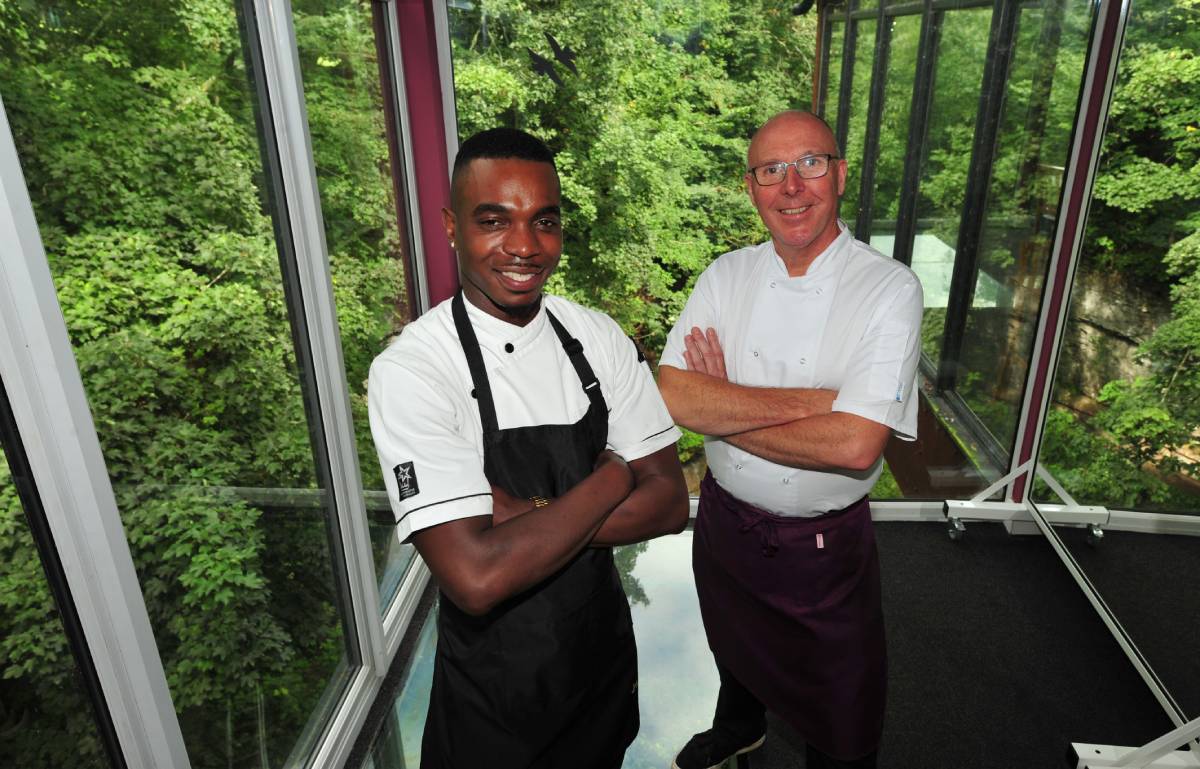
Two Vista View Bistro chefs pictured, including its head chef, Jowayne Marshall (left).
The time to visit is obviously during the day with all the lovely Autumnal hues. You will sit and gasp at the extraordinary views over a glass or savour the very good and satisfying local beef or feel spoilt by what’s on offer on the menu; something for all tastes, I am told. Let’s hope Chef puts his Fruit Mousse Spoon on the dessert menu – something I have come across before – and of course it was well worth the drive up the Dale.
Whenever you decide to visit, which is a must during these times, you will be rewarded by friendly Yorkshire hospitality that stimulates you and gives you the good feeling of being British. My little journey for dinner x2, three courses and a glass of wine each cost £85.20 excluding service. Don’t be afraid, there are more economic ways of enjoying this treasure.
To find out more about Vista View Bistro click here.
To read more about Frances’ fantastic career click here.